If your wire-free robot mower maps cleanly one day and seems confused the next, the mower may not be the main problem. Good RTK antenna placement gives the mower a stable reference point, which is what helps virtual boundaries, no-go areas, and mowing zones stay where you put them.
Rooftop mounting, drilling into siding, and routing antenna cables near electrical equipment should be handled by a qualified installer or contractor so the work complies with local codes, manufacturer instructions, and safety requirements.
At a glance
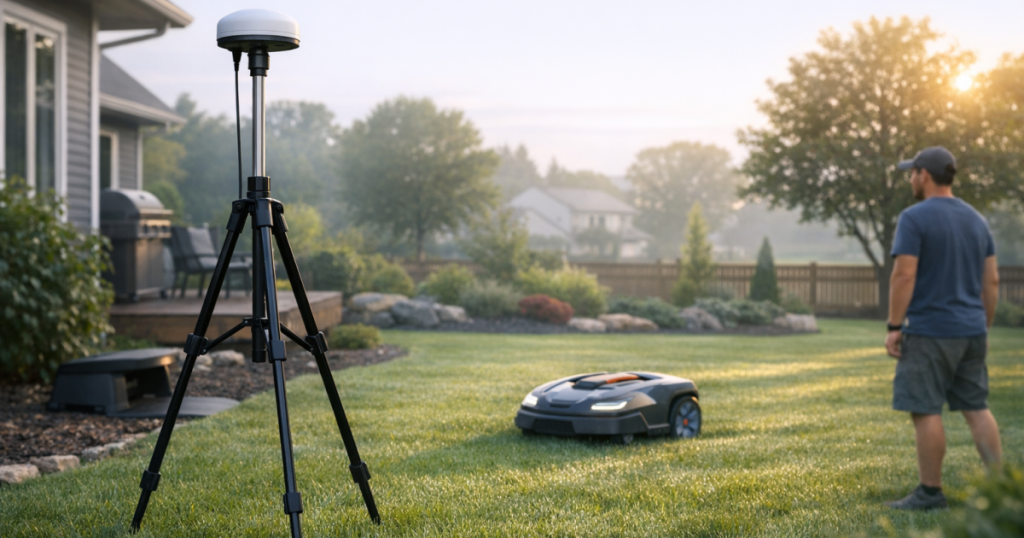
The best place for an RTK reference station or GPS antenna is a fixed, rigid spot with the widest practical view of the sky, away from eaves, walls, dense tree cover, chimneys, metal roofs, and anything that can move. A roof edge, deck post, open fence post, pole, or shed corner can work if it stays solid and has clear sky exposure; the charging dock can often be somewhere else when the mower’s instructions allow the dock and antenna to be separated.
- Pick open sky before you pick convenience.
- Mount the antenna where it will not wobble, twist, or be bumped.
- Avoid placing it directly under roof overhangs, next to tall walls, or beneath heavy tree canopy.
- Do not move the antenna after mapping unless you are prepared to recalibrate or remap.
- Test reception around the whole mowing area before trusting the first map.
Why the antenna location matters
An RTK robot mower uses satellite positioning plus a nearby reference station to improve location accuracy. The important detail is that the reference station is not simply “talking to the mower” like a garden light remote. Both the mower and the station need usable satellite visibility, and the station must remain fixed so the mower’s mapped boundaries have a reliable point of reference.
That is why a tidy-looking install under an eave can fail while a plain post in the open side yard works beautifully. The antenna does not care that the first option looks neater. It cares about sky, stability, and a clean signal path.
Start by walking the yard, not by drilling holes
Before you mount anything, walk the property with the robot mower’s map in mind. Look at the places where the mower will need the most confidence: narrow side strips, front-yard corners near the street, the back edge along a fence, and any transition between mowing zones.
Stand at each possible antenna location and look up. If you see mostly open sky, you are on the right track. If the view is boxed in by a two-story house, mature oaks, a chimney, and a porch roof, keep looking. US suburban yards often have one decent “sky window” near a driveway corner, deck rail, or open fence line, even when the backyard feels heavily shaded.
Good candidate spots
- Roof edge or gable end: Often strong for sky visibility, but use a qualified installer for rooftop work and exterior penetrations.
- Deck corner or railing post: Useful when the deck is open to the sky and the mount is rigid, not a loose cap rail that flexes.
- Fence post in an open run: Can work well if the post is solid, not leaning, and not directly under branches.
- Shed wall or corner: Better when the shed is not under trees and the antenna sits clear of the roofline.
- Dedicated pole: A clean option when the best sky view is away from buildings, provided it is firmly installed.
Spots to avoid
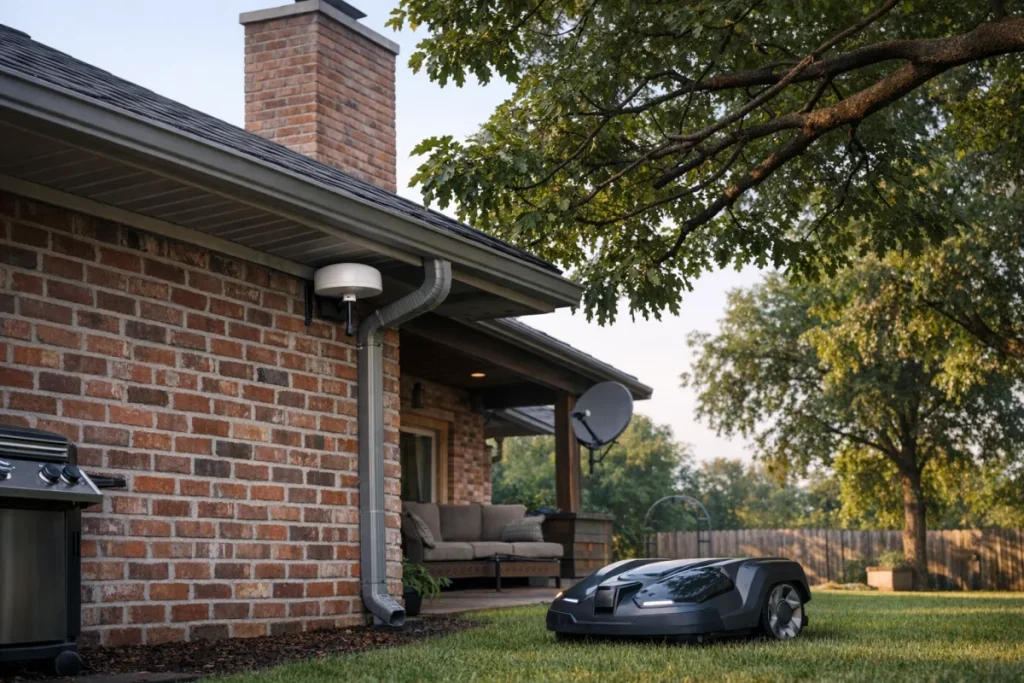
- Under a roof overhang, porch ceiling, or covered patio.
- Right against tall brick, stucco, or metal-sided walls.
- Below dense trees, especially where summer leaf cover changes the signal from “fine” to “why is it lost again?”
- Beside chimneys, satellite dishes, gutters, or large metal surfaces.
- On a gate, flimsy fence panel, movable planter, or anything that shifts in wind.
Roof, fence, shed, or deck: which is best?
There is no universal winner. A roof edge may offer the cleanest sky view, but it can be harder to install safely and neatly. A fence post is easier to reach, but it must be steady and free from tree cover. A deck corner can be a smart middle ground if it gives the antenna open sky without putting it in the way of people, pets, or patio furniture.
For small, uneven lawns, compact wire-free mowers such as the model covered in our Segway Navimow i206 AWD review show why installation details matter even when the mowing area is not huge. A short strip beside the house or a shaded corner can be enough to expose a weak antenna location.
On larger properties, the antenna decision can matter even more because the mower may work across wider zones, deeper backyards, and more interrupted sightlines. If your lawn looks more like the kind of complex terrain discussed in our Mammotion LUBA 3 AWD 5000H review, plan the antenna location as part of the whole-yard layout, not as an afterthought next to the dock.
Can the RTK antenna and charging dock be in different places?
Often, yes, but follow the mower manufacturer’s instructions for your specific model. Some robot mower systems allow the RTK reference station to be mounted away from the charging station, which is useful because the best docking location is not always the best sky location.
The dock wants level ground, convenient mower access, and a clean approach path. The antenna wants sky. Those needs overlap sometimes, but not always. If you are still choosing the dock area, our guide to the best robot mower charging station spot explains the docking side of that decision.
Step-by-step setup checks before mapping
- Read the mounting rules first. Check the manufacturer’s guidance for height, orientation, cable routing, separation from the dock, and any app prompts before choosing a final spot.
- Choose the clearest sky view available. Prioritize open exposure over hiding the antenna. A slightly visible antenna that works is better than a discreet one that ruins mapping.
- Mount it rigidly. Tighten brackets, avoid flexible surfaces, and make sure the antenna cannot rotate after you save the map.
- Keep it clear of metal and overhangs. Metal roofs, gutters, siding, and eaves can block or reflect signals. More clearance is usually better than tucking it close for neatness.
- Power up and wait for the system to stabilize. Do not rush straight into mapping the moment a light turns on. Let the mower and reference station complete their normal startup process.
- Map slowly the first time. Walk boundaries carefully, pause if the app reports poor positioning, and fix signal issues before creating every zone.
- Save the location mentally and physically. Once the map is built, treat the antenna like a property marker. Moving it can shift the mower’s understanding of the yard.
RTK antenna placement mistakes that cause mapping trouble
The most common mistake is mounting the antenna where it is convenient for the outlet rather than where it can see the sky. The second is assuming “higher” automatically means “better.” Height helps only when it clears obstructions; a high spot tucked beside a chimney or under tree limbs can still be poor.
Another easy miss is seasonal change. A location that works in early spring may struggle once maples, oaks, or magnolias leaf out. If you live on a wooded lot, choose the antenna position for the worst signal season, not the prettiest installation photo.
How to test before you trust the map
After mounting, run the mower through the areas most likely to cause trouble before you commit to a normal schedule. Watch for pauses near the house, boundary drift along fences, trouble entering narrow passages, or app warnings about poor positioning. One awkward corner on day one is a gift; it is much easier to move the antenna before you have built several zones and no-go areas.
If the mower repeatedly loses positioning in the same place, do not immediately blame the boundary you drew. Check whether the antenna has a blocked sky view, whether the mower itself is passing under dense cover, and whether nearby structures are creating a signal shadow. Sometimes the right fix is moving the reference station; sometimes it is adjusting the mowing route or accepting that a heavily covered strip may need a different setup approach.
Fast answers
Can I mount an RTK antenna on a wooden fence post?
Yes, if the post is solid, upright, and in an open-sky location. Avoid loose fence panels, gates, and posts shaded by heavy branches.
Is a roof always the best place?
No. A roof can be excellent for sky visibility, but it is not automatically better than a clear deck post or pole. Safety, cable routing, metal roofing, and nearby obstructions all matter.
Can the antenna go inside a window?
That is usually a poor choice for RTK robot mower mapping because the antenna needs reliable satellite visibility. Use the outdoor mounting guidance from your mower’s manual.
What happens if I move the antenna after mapping?
The mower’s saved map may no longer line up correctly. Expect to recalibrate or remap if the reference station is moved, rotated, or remounted.
What to do next
Choose the clearest rigid mounting point first, then fit the dock around practical mower access rather than forcing both pieces into one tidy corner. A reliable antenna location makes the first map easier, and it saves you from chasing strange boundary problems later.