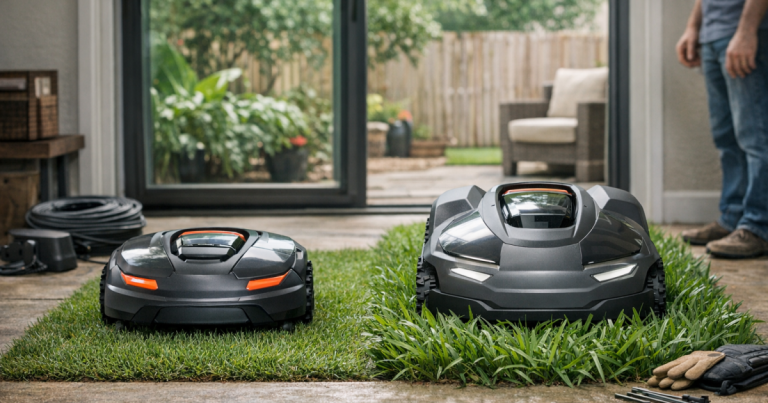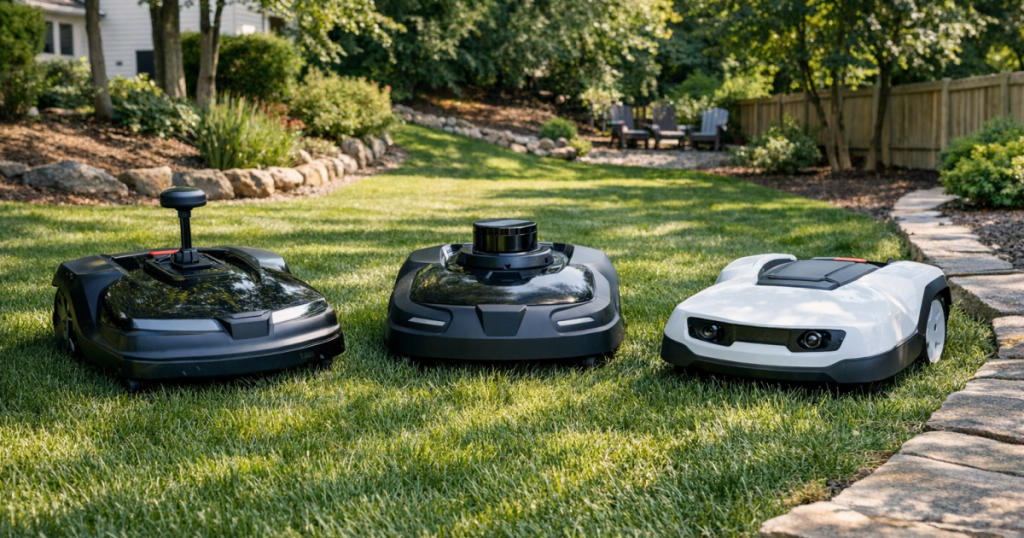
A robot mower can have the right lawn-size rating and still be the wrong fit if its navigation system hates your yard. The RTK vs LiDAR vs vision robot mower choice is really about what the mower depends on to stay oriented: open sky, visible surroundings, camera-readable edges, a physical wire, or some combination of those.
The useful question is not which technology sounds newest. It is which one will keep working on a Tuesday afternoon when the mower is beside a fence, under a maple, next to a driveway, or passing through the narrow strip between your house and the neighbor’s hedge.
The big picture
Buy RTK if your lawn has generous open-sky exposure and you want wire-free positioning with a carefully placed reference point. Buy LiDAR if trees, rooflines, or shaded side yards make satellite reception less reliable and the mower can use visible surroundings to navigate. Buy vision if your lawn has clear visual boundaries and you are comfortable with camera-based navigation that depends on readable edges and conditions. Choose a hybrid or boundary-wire system when repeatable limits matter more than avoiding installation work.
That short answer is the core decision matrix: match the mower’s navigation dependency to the hardest part of your yard, not the easiest open rectangle in the middle.
Step 1: Walk the yard before comparing models
Start with a slow lap around the mowing area. Do not think like a homeowner looking at the whole lawn; think like a small machine trying to know exactly where it is.
- Look up. Note heavy tree canopy, roof overhangs, tall fences, covered patios, and narrow side yards. These are the places where satellite-heavy systems can have a harder time.
- Look sideways. Mark areas where the mower would see walls, trunks, beds, fences, and hardscape edges. These features can help LiDAR-style navigation, but clutter and seasonal changes still matter.
- Look down. Identify lawn-to-mulch transitions, gravel edges, shallow roots, bare patches, toys, hoses, and fallen branches. Vision systems especially need boundaries and obstacles to be visually distinct.
- Find the awkward passages. Gates, strips beside the garage, and dog-run-style corridors often decide whether a mower feels easy or fussy in real use.
- Check hills separately. Navigation does not replace traction. A steep or damp slope may call for all-wheel drive or a higher slope rating regardless of whether the mower uses RTK, LiDAR, vision, or wire.
Step 2: Match the technology to the yard condition
RTK: strongest fit for open lawns with clear sky
RTK robot mowers use satellite positioning plus correction data to help the mower locate itself more accurately than basic GPS. In plain English, RTK works best when the mower and its reference hardware have a clean enough view of the sky. Open front lawns, newer subdivisions with fewer mature trees, and broad backyards are the friendliest setups.
The trade-off is dependency. If the hardest parts of your lawn sit tight against the house, beneath dense trees, or beside tall structures, an RTK mower may need extra planning, careful antenna placement, or another navigation aid. RTK can be excellent, but it is not magic sky tape.
LiDAR: useful when the yard has objects the mower can read
LiDAR navigation uses laser-based distance sensing to understand the mower’s surroundings. It can be attractive for shaded yards because it is not relying only on satellite view. A LiDAR mower still needs a yard that gives it useful features to recognize, such as edges, obstacles, structures, or defined zones.
For shoppers comparing an antenna-free LiDAR class, the Segway Navimow i215 LiDAR is the kind of model page worth studying because it lets you focus on navigation type, boundary method, and practical yard fit instead of only acreage claims.
Vision: best for clear edges and visually readable lawns
Vision mowers use cameras to interpret the lawn and its boundaries. They can be appealing because the setup can feel cleaner than burying or staking wire, and the mower is making decisions from what it sees. The limitation is also obvious: the mower has to see something useful.
Lawns with crisp edges, sidewalks, fences, and consistent turf transitions are friendlier to vision systems than lawns that fade gradually into mulch, pine straw, leaves, or gravel. Low-contrast edges, seasonal debris, dark corners, and objects left in the grass can all make the job harder. If you are looking at a camera-led option, compare how a model such as the Worx Landroid Vision Cloud WR320.1 defines its boundary method and intended yard size before assuming it will suit every edge.
Hybrid and boundary-wire systems: still the steady choice for tricky borders
Boundary wire is less glamorous, but it gives the mower a defined perimeter that does not depend on sky visibility or visual contrast in the same way. Hybrid systems can be even more flexible when they allow virtual boundaries for some areas and physical wire where the yard needs firmer control.
If your lawn has flower beds with soft borders, a drop-off near the driveway, narrow strips, or places where “close enough” is not close enough, a wired or hybrid system deserves serious consideration. The Husqvarna Automower® 410 iQ is a useful example to compare because it represents a hybrid virtual/physical-boundary approach for small-to-medium lawns.
Step 3: Choose by failure mode, not marketing label
Every navigation method can fail in a different way. A good purchase is the one whose weak points are least likely to show up in your yard.
- RTK weak point: interrupted satellite view or poor reference placement. Watch for trees, houses, covered areas, and tall fences.
- LiDAR weak point: surroundings that are too open, too repetitive, or too changeable for reliable recognition. Think plain open lawns, moved furniture, or seasonal clutter.
- Vision weak point: unclear edges and changing visual conditions. Leaves, bare patches, mulch transitions, and toys can matter more than they would with a wire.
- Boundary-wire weak point: installation effort and wire damage. The upside is a highly defined work area once installed well.
- Hybrid weak point: more setup decisions. The upside is having more than one way to solve awkward zones.
This is the most practical way to handle the RTK vs LiDAR vs vision robot mower decision: list the places where navigation is most likely to struggle, then choose the system whose normal weakness is least exposed in those places.
Common buying mistakes
- Buying for total lot size instead of mowable grass. Exclude the house, driveway, patio, beds, pool area, and woods. Robot mower capacity should be judged against the grass it actually has to maintain.
- Treating slope as a navigation feature. A mower can know where it is and still lack the traction or slope rating your hill requires.
- Ignoring the side yard. The side passage often has the worst sky view, tightest clearance, and most awkward boundary lines.
- Assuming “wire-free” means “no setup.” Wire-free mowers still need mapping, boundary definition, charging-station placement, and periodic checks.
- Forgetting pets, kids, and weekend clutter. No robot mower should be treated as fully aware of every object in every condition. A quick yard pickup remains part of good ownership.
What I would choose for common US yard layouts
- Open suburban lawn with few large trees: RTK should be high on the list, assuming the reference hardware can be placed well and the mower’s yard-size rating fits.
- Older neighborhood with mature trees and shaded strips: LiDAR or hybrid navigation is usually more reassuring than a satellite-only setup.
- Simple fenced backyard with hardscape edges: Vision can make sense, provided the mower’s boundary approach matches your actual lawn edges.
- Complex beds, tight borders, and risk-sensitive edges: Boundary wire or hybrid control is worth the extra setup because repeatability matters.
- Steep, uneven, or damp areas: First filter for drive type, traction, and slope capability, then choose the navigation system that fits the site.
Straight answers
Is LiDAR better than RTK?
Not automatically. LiDAR is often more appealing where sky view is compromised, while RTK can be a strong fit for open lawns. The better choice is the one that has the clearest navigation reference in your yard.
Is vision navigation enough without a boundary wire?
It can be enough in the right lawn layout, but the edges need to be visually understandable. Before buying, check how the mower defines grass, non-grass, obstacles, and work zones.
Should I still consider a boundary-wire mower in 2026?
Yes. Boundary wire remains a sensible option for yards where exact borders, tight passages, or awkward edges are more important than avoiding installation work.
Your next step
Take photos of the most difficult five parts of your lawn: the shadiest edge, the narrowest passage, the steepest slope, the messiest border, and the charging-station area you are considering. Then compare mowers against those photos. The winner is not the model with the flashiest navigation label; it is the one whose setup style makes those five spots boringly repeatable.