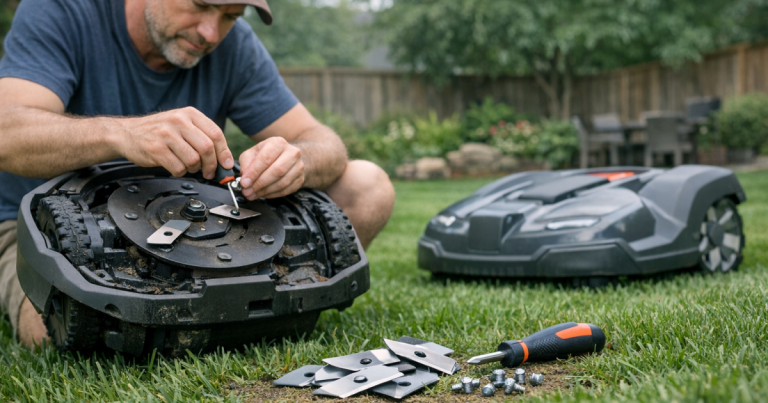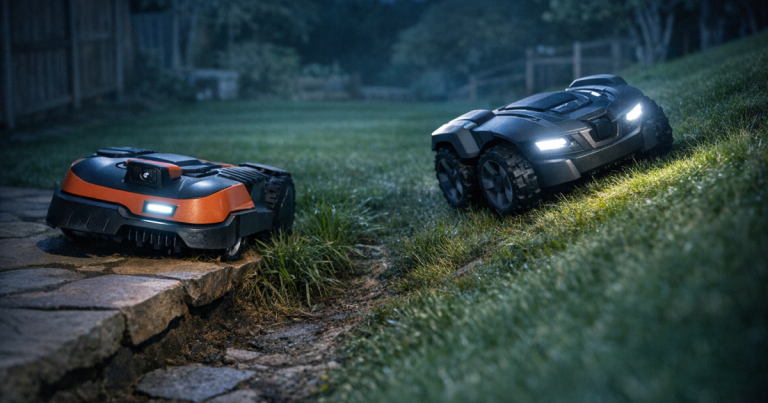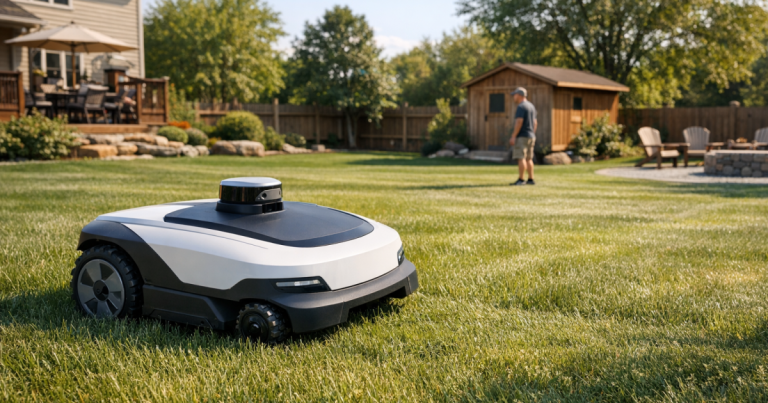
A steep, broken-up yard can make ordinary robot mowers feel a little out of their depth. For this Husqvarna Automower® 435 iQ AWD review, the key question is whether its AWD drive system, EPOS satellite positioning, and hybrid boundary setup solve the problems that actually frustrate homeowners: slopes, zones, awkward edges, and setup friction.
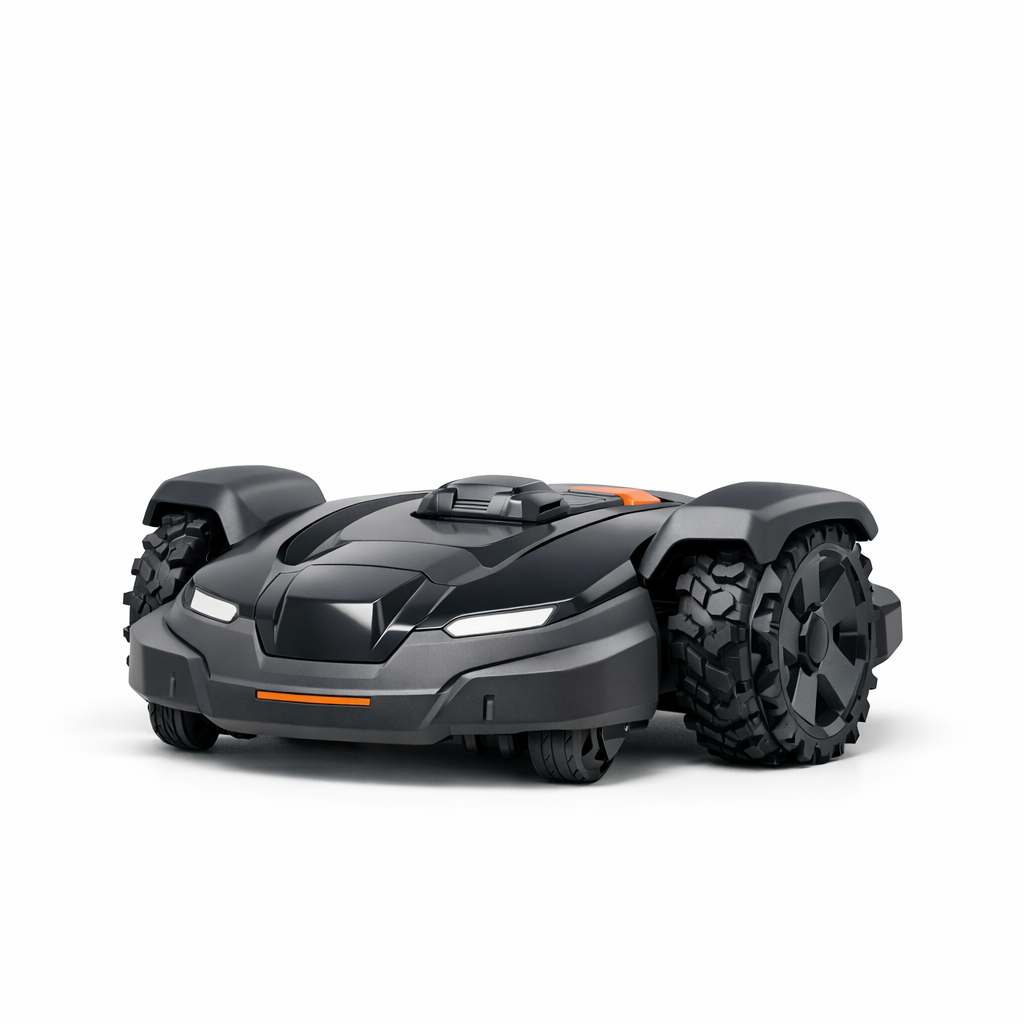
Husqvarna Automower® 435 iQ AWD
A strong fit for steep, multi-zone lawns where AWD traction and hybrid boundary setup are the deciding factors
The reviewed model is Husqvarna Automower® 435 iQ AWD – 970 74 52-05, a current US-market residential robotic lawn mower sold with a charging station, power supply, low-voltage cable, and EPOS® Reference Station for virtual-boundary operation. It uses the Automower® Connect app for setup and control. My read: this is a strong fit for complex lawns where traction and flexible boundaries matter more than keeping the system as simple as possible.
Product Details
- Recommended yard size: 1.3 acres
- Navigation: EPOS satellite positioning with cellular correction
- Boundary method: Virtual wire or physical perimeter wire
- Drive type: All-wheel drive
- Maximum slope: 70%
- Multi-zone support: Yes
- Cutting width: 8.7 in
- Cutting height range: 1.2–2.8 in
- Weather handling: Operates rain or shine
- Theft deterrence: GPS theft tracking, GeoFence, PIN code, alarm, lift sensor, and tilt sensor
AWD is the reason this model earns attention
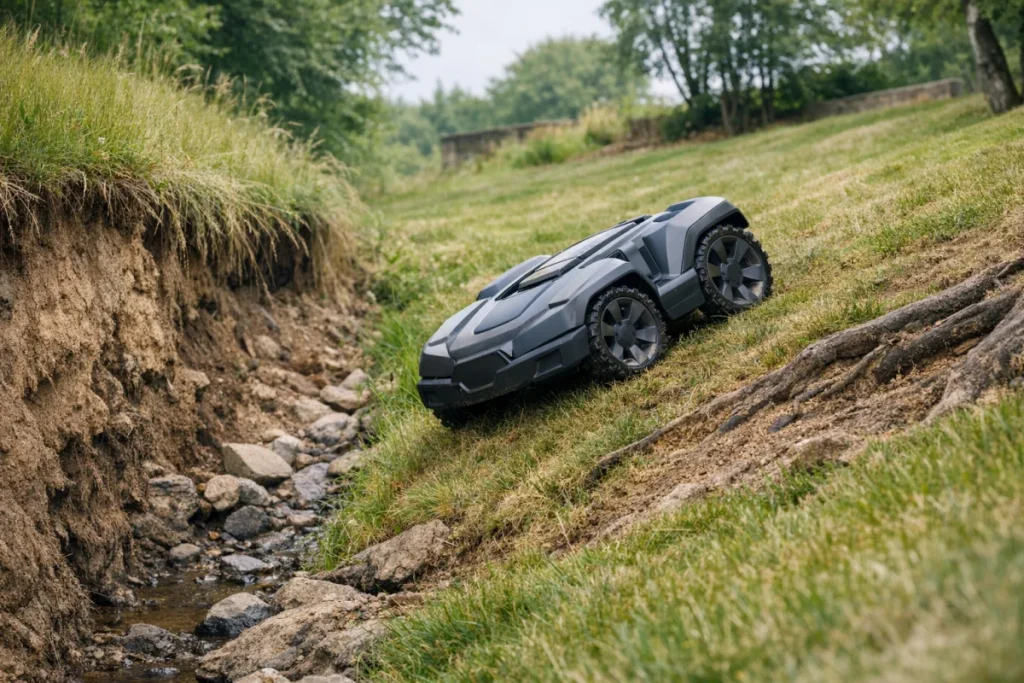
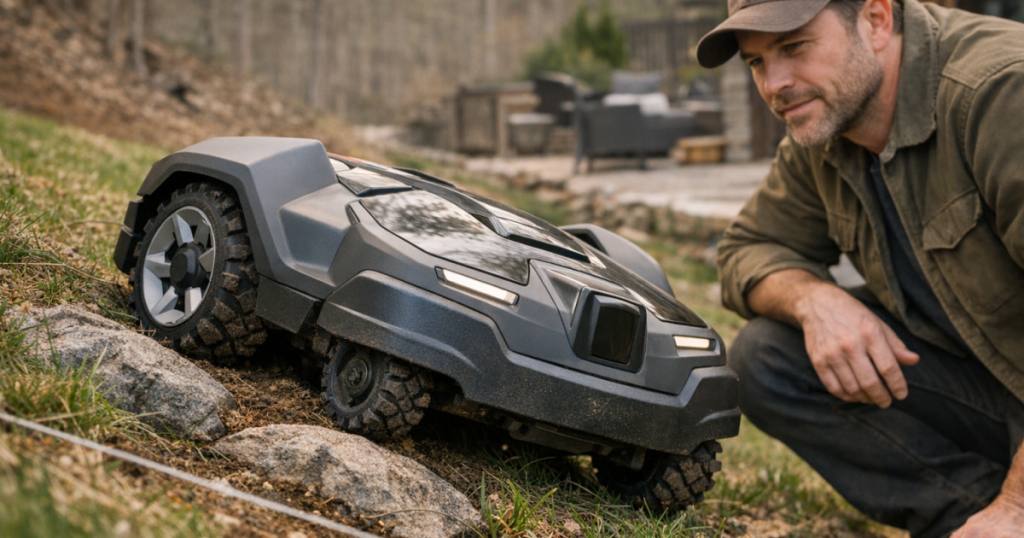
The standout spec is not subtle: all-wheel drive paired with a 70% maximum slope rating. For US homeowners with rolling yards, ditch banks, raised back sections, or a lawn that falls away from the patio, that matters more than a long list of app niceties. A robot mower that cannot confidently move through the hard parts of the yard will spend too much of its life being rescued.
The 435 iQ AWD is best understood as a mower for difficult terrain first and a convenience gadget second. The AWD system is the feature that changes the buying decision. It does not magically turn a rutted, root-filled lawn into a golf fairway, and it does not remove the need to clear sticks, toys, hoses, or debris. But for a lawn where the grade is the main reason you have been hesitant about automation, this is exactly the kind of specification that deserves a closer look.
The practical trade-off is that a slope-capable mower only helps if the rest of the yard supports a workable robotic mowing pattern. Tight pinch points, disconnected lawn islands, rough transitions, and poorly placed obstacles can still create friction. The mower has the traction credentials; the homeowner still needs a yard layout that can be mapped and maintained sensibly.
Hybrid boundaries give you more setup flexibility
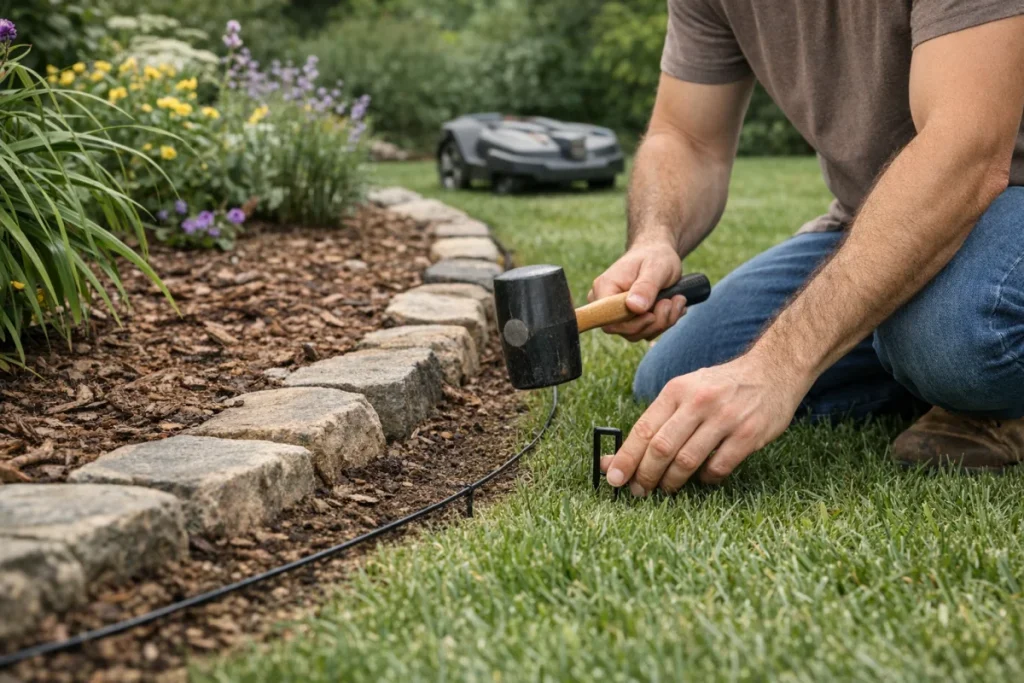
The 435 iQ AWD supports virtual wire or a physical perimeter wire, which is one of its most useful ownership advantages. A fully physical boundary can be reliable, but installing wire around a complicated property can be tedious. A virtual boundary setup can be cleaner and easier to adjust as the yard changes. Having both options means the mower is not locked into one installation philosophy.
That flexibility is especially valuable around yards with changing flower beds, separate mowing areas, or areas where a homeowner wants to experiment before committing to a more permanent layout. The EPOS satellite positioning with cellular correction is the navigation foundation for virtual-boundary operation, and the included EPOS® Reference Station is part of that system. In plain English: the wire-free side of this mower is not just the mower wandering around and hoping for the best. It relies on positioning hardware and app-based setup.
The charging station still deserves careful planning. A mower with advanced positioning can still be annoying if the dock sits in a cramped, uneven, or inconvenient corner. Before committing to a location, use a practical placement checklist like this guide to choosing the best robot mower charging station spot. Good docking geometry is not glamorous, but neither is walking outside in slippers to nudge a mower home.
The 1.3-acre rating makes sense for demanding residential yards
A 1.3-acre recommended yard size puts this mower in a serious residential category. It is not aimed at the tiny postage-stamp lawn where almost any compact robot mower would do. The stronger case is a larger home lawn with meaningful terrain changes, more than one mowing area, or landscaping that makes a basic boundary-wire mower feel restrictive.
Multi-zone support also matters here. Many US yards are not one clean rectangle. You might have a front lawn divided by a driveway, a fenced backyard, a side strip, or a slope behind the house that behaves like a separate mowing problem. Multi-zone capability is what turns a robot mower from a single-area machine into a more practical whole-property tool.
That said, the 1.3-acre figure should not be treated as permission to ignore layout. A simple 1.3-acre open lawn and a 1.3-acre property broken into narrow corridors, tree clusters, gates, and slope transitions are different jobs. The more interrupted the lawn, the more the boundary method, docking location, and zone plan matter.
Cutting specs favor frequent maintenance mowing
The 8.7-inch cutting width tells you how to think about this machine: it is built for repeated autonomous mowing, not for replacing a wide-deck riding mower in a single weekly session. Robot mowers work best when they trim little and often. That style can keep a lawn looking consistently managed, but it also means the system needs a reliable schedule and a lawn kept within its workable range.
The cutting height range of 1.2–2.8 inches is an important fit check. Homeowners who prefer a lower or moderate cut may find that range suitable. Those who intentionally keep turf much taller for heat stress, shade, or personal preference should pay close attention to that upper limit. Cutting height is not a flashy feature, but it is one of the quickest ways to rule a mower in or out for your lawn-care style.
Because the mower operates rain or shine, it is positioned for routine outdoor work rather than fair-weather use only. That does not mean every lawn condition is ideal at every moment; saturated soil, standing water, and storm debris are still real-world issues. The useful takeaway is that weather handling is part of the design, while common-sense yard care still remains part of ownership.
Security features are stronger than the average checklist
The theft-deterrence package is another reason this model feels aimed at higher-stakes residential use. GPS theft tracking, GeoFence, PIN code, alarm, lift sensor, and tilt sensor are all listed for this mower. No feature list makes an outdoor machine impossible to steal, but these deterrents matter when the mower spends its working life outside and unattended.
For suburban front lawns, corner lots, and properties where the mower will be visible from the street, those features are more than nice-to-have extras. They are part of the ownership calculation. A robot mower should reduce your workload, not give you a new hobby called staring nervously out the window.
Where it fits — and where another mower may be smarter
The 435 iQ AWD makes the most sense for homeowners with a lawn that combines size, slope, and layout complexity. If your yard is mostly flat, small, and open, this mower is likely more machine than the job demands. The features that make it appealing — AWD, EPOS positioning, hybrid boundaries, multi-zone support — are most valuable when the lawn gives them something meaningful to do.
If your priority is covering an even larger property rather than solving steep-slope traction, compare the Husqvarna Automower® 440 iQ. It sits in the same modern Automower® iQ family but is better framed around larger-property coverage. The 435 iQ AWD is the one that stands out when the lawn is less forgiving under the wheels.
For the right yard, though, the combination is persuasive. The boundary flexibility reduces commitment anxiety, the AWD system addresses terrain, and the multi-zone support makes it more realistic for real residential layouts. It is not the simplest robot mower to think through before purchase, but complicated lawns rarely reward oversimplified tools.
Verdict
Score: 9.3/10. The 435 iQ AWD earns its recommendation through three connected strengths: AWD traction for steep residential terrain, hybrid virtual-or-physical boundaries, and a 1.3-acre yard fit with multi-zone support. The main caution is fit, not capability. If your lawn is small, flat, and simple, this is more mower than you need. If your yard has slopes, zones, and layout headaches that make lesser robot mowers feel risky, it is one of the most compelling Husqvarna options to consider.
Husqvarna Automower® 435 iQ AWD
A strong fit for steep, multi-zone lawns where AWD traction and hybrid boundary setup are the deciding factors
You might also like: How to Troubleshoot a Robot Mower That Won’t Charge.