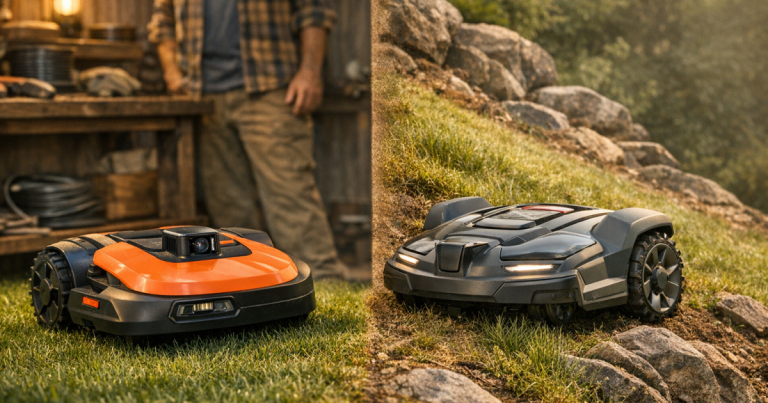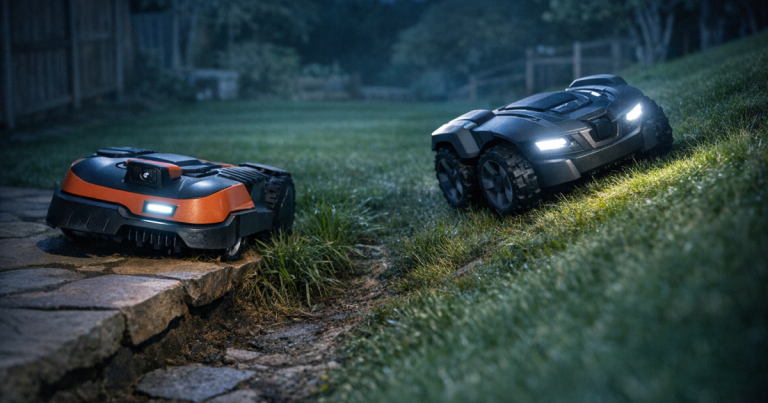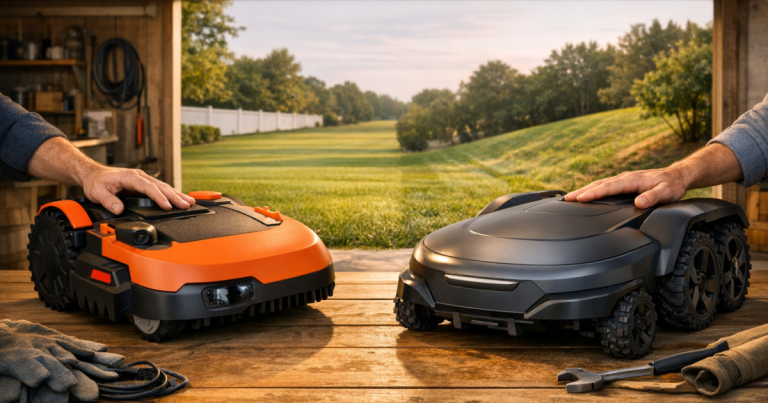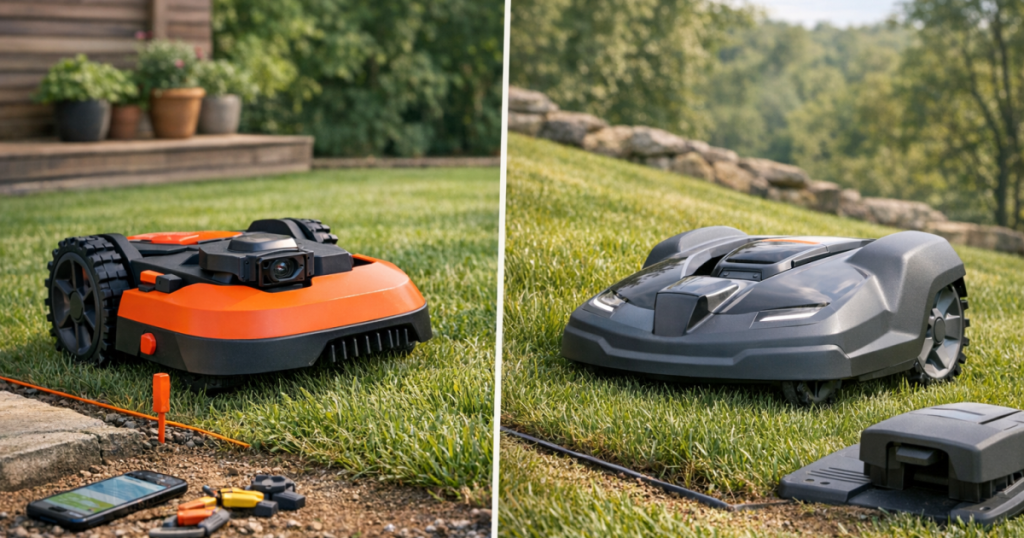
Two 1-acre robotic mowers can look similar on a spec sheet, but the yard fit can be very different once you factor in slopes, boundaries, trees, driveway edges, and signal conditions. For homeowners comparing Landroid Vision Cloud WR340 vs Automower 420 iQ, the split is not about acreage; both are manufacturer-rated for 1 acre. The real choice is boundary approach, slope rating, cutting range, and how much installation flexibility your lawn needs.
Quick Buying Links
Worx Landroid Vision Cloud 1 Acre (WR340)
1-acre yards where RTK Cloud mapping and no on-site antenna are the main setup priorities
Husqvarna Automower® 420 iQ
Better for steeper 1-acre lawns, broader cutting-height adjustment, and owners who want physical or virtual boundary options
The Landroid Vision Cloud 1 Acre WR340 is the more cloud-and-camera-centered option in this matchup, while the Automower® 420 iQ leans into Husqvarna’s physical-or-virtual boundary flexibility. Neither is automatically the better mower for every 1-acre property. The better pick is the one that matches how your yard is actually laid out.
At a glance
Here is the quick read based on the verified manufacturer-stated specifications for the exact Worx WR340 and Husqvarna Automower® 420 iQ 970 72 75-01 sold for the US market.
- Rated lawn size: Both are listed for 1 acre by their manufacturers.
- Boundary and navigation: The Worx WR340 uses RTK Cloud positioning with Vision AI-assisted automatic mapping and no on-site antenna. The Husqvarna 420 iQ supports physical wire or virtual wire, includes an EPOS Reference Station, and uses Husqvarna Cloud only in select locations.
- Slope rating: Worx lists 30%; Husqvarna lists 45% maximum slope performance inside the installation.
- Cutting width: Worx lists 8.7 inches; Husqvarna lists 9.4 inches.
- Cutting height range: Worx lists 1.57 to 3.54 inches; Husqvarna lists 1 to 4 inches.
- Connectivity: Worx lists Bluetooth, Wi-Fi, and 4G. Husqvarna lists Cellular, Wi-Fi, and Bluetooth.
- Weight: Worx lists 30.9 pounds with battery; Husqvarna lists 38 pounds.
The short version: choose the Worx WR340 if its cloud-based, no-on-site-antenna setup fits your property and you do not need the higher published slope rating. Choose the Husqvarna 420 iQ if your lawn benefits from physical-or-virtual boundary choice, the included EPOS Reference Station, a broader cutting-height range, or the higher listed slope capability.
The setup difference is the heart of this comparison
The most important difference is not the 1-acre rating. It is how each mower defines and navigates the working area.
Worx positions the WR340 around RTK Cloud positioning and Vision AI-assisted automatic mapping, with no on-site antenna. That is a clear appeal for homeowners who want to avoid placing a separate reference station in the yard. The product’s yard-fit details are also listed in the site’s Landroid Vision Cloud 1 Acre WR340 profile, which is useful when comparing it against other 1-acre-capable models.
Husqvarna takes a different route with the 420 iQ. Its verified boundary type is physical wire or virtual wire, and the evidence pack notes that an EPOS Reference Station is included, with Husqvarna Cloud available only in select locations. That matters for a homeowner who wants a fallback between a traditional wire-defined installation and a virtual-wire approach. The site’s Automower® 420 iQ yard-fit entry is the natural next stop if you are comparing the model against other Automower options.
Editorially, this is the cleanest dividing line: Worx is the simpler-looking pitch if the property is a good match for its RTK Cloud and Vision AI-assisted mapping approach, while Husqvarna gives you more boundary-method flexibility in the verified specs.
Both are rated for 1 acre, but not every acre behaves the same
A manufacturer-rated 1-acre capacity is helpful, but it is not the same thing as saying every 1-acre yard will be equally easy. A flat, open rectangle is a very different mowing problem than a property with a fenced backyard, a narrow side passage, mature tree cover, a sloped front bank, and islands around landscaping.
For this comparison, the rated coverage is a tie: Worx lists the WR340 for 1 acre, and Husqvarna lists the 420 iQ for 1 acre. That means the decision should move quickly to the physical yard constraints that tend to make or break a robot mower installation.
- Open lawns: The setup approach and preferred boundary method will probably matter more than stated acreage.
- Sloped lawns: The Husqvarna’s higher listed slope rating is a meaningful advantage on the verified specifications.
- Mixed layouts: A model that supports your preferred boundary method may be easier to fit around separate mowing areas, edges, and obstacles.
- Signal-sensitive yards: The Worx uses RTK Cloud and 4G connectivity; the Husqvarna lists Cellular, Wi-Fi, and Bluetooth and has location-specific Husqvarna Cloud coverage with an included EPOS Reference Station path.
If you are still working out whether your yard is a realistic candidate for automation at all, start with the site’s checklist on whether a robot lawn mower will work in your yard. It helps frame the same issues this comparison turns on: size, slope, zones, obstacles, and boundary practicality.
Slopes: Husqvarna has the verified advantage
Slope rating is one of the most practical differences here. Worx lists a 30% maximum slope for the WR340. Husqvarna lists 45% maximum slope performance inside the installation for the 420 iQ.
That does not mean the Husqvarna is the right answer for every uneven yard, but it does make the 420 iQ the stronger fit on paper for lawns where slope is a central concern. A 45% rating gives it a higher manufacturer-stated ceiling than the WR340’s 30% rating.
For a typical US homeowner, this matters most in places like a sloped front lawn, a drainage swale, a hill between the driveway and sidewalk, or a backyard that drops away from the house. If your mower will mostly operate on flat turf with only gentle transitions, the slope difference may not be the deciding factor. If the mower has to work across a noticeably steep section inside the mowing area, the verified specs favor the Husqvarna.
Cutting width and cutting height: Husqvarna gives you more range
The Husqvarna 420 iQ also has the edge in the two cutting dimensions supplied in the evidence pack. It lists a 9.4-inch cutting width, compared with 8.7 inches for the Worx WR340. It also lists a cutting height range of 1 to 4 inches, compared with the Worx range of 1.57 to 3.54 inches.
The cutting-width difference is modest, but it is still a verified difference. The Husqvarna is the wider-cutting mower in this head-to-head. More importantly for many homeowners, the Husqvarna’s stated height range is broader at both the low and high ends.
That broader range can matter if you want more adjustment room between a shorter maintained lawn and a higher cut. Many US lawns are maintained at different heights depending on grass type, season, shade, irrigation, and homeowner preference. This comparison does not need to pretend one height range is universally best; it is enough to say the 420 iQ gives more room to adjust within the verified specifications.
The cutting systems are similar in broad layout but not identical in manufacturer wording. Worx lists a 3-blade cutting system. Husqvarna lists 3 pivoting razor blades. Without additional verified testing data, that wording should not be stretched into a performance claim. For buying purposes, the more useful distinctions are the published width and height range.
Charging, battery, weight, and connectivity
The supplied specs also show several smaller differences that can still matter in day-to-day ownership.
- Battery capacity: Worx lists 20 V 5 Ah. Husqvarna lists 5 Ah.
- Charging information: Worx lists a 60-minute charge time. Husqvarna lists 54 minutes typical charging time and 84 minutes typical mow time.
- Weight: Worx lists 30.9 pounds with battery. Husqvarna lists 38 pounds.
- Connectivity: Worx lists Bluetooth, Wi-Fi, and 4G. Husqvarna lists Cellular, Wi-Fi, and Bluetooth.
The weight difference is straightforward: the Worx is the lighter mower in the verified specs. That can matter when carrying the mower for cleaning, storage, or repositioning. The Husqvarna is heavier, but the evidence supplied does not support turning that into a quality or durability claim, so the fair comparison is simply that the listed weights differ.
Charging specs are also not perfectly symmetrical. Worx provides charge time. Husqvarna provides typical mow time and typical charging time. The useful takeaway is that Husqvarna lists a shorter typical charging time at 54 minutes versus Worx’s 60-minute charge time, and Husqvarna also publishes an 84-minute typical mow time in the supplied evidence. There is not enough verified evidence here to declare a runtime winner for both products.
Which mower fits which yard?
The right answer depends less on brand loyalty and more on the problem your yard gives the mower every week.
Pick the Worx WR340 for a 1-acre lawn where its no-on-site-antenna approach is the appeal
The WR340’s standout verified setup claim is RTK Cloud positioning with Vision AI-assisted automatic mapping and no on-site antenna. If that is the installation style you want, and your lawn does not need more than the listed 30% slope rating or the broader cutting-height range of the Husqvarna, the Worx has a clear lane in this comparison.
It is also the lighter mower by the supplied specs, at 30.9 pounds with battery versus 38 pounds for the Husqvarna. That is not the first thing most homeowners shop for, but it is a real ownership detail.
Pick the Husqvarna 420 iQ for slope, cutting range, and boundary flexibility
The 420 iQ earns its advantage where the verified differences are clearest. It has the higher listed slope rating, the wider cutting width, and the broader cutting-height range. It also supports physical wire or virtual wire, includes an EPOS Reference Station, and has a location-dependent Husqvarna Cloud path in the manufacturer-stated setup.
That makes the Husqvarna the stronger specification fit for a 1-acre property with steeper sections inside the mowing area or for homeowners who value the option of using a physical wire or virtual-wire setup rather than a cloud-first, no-on-site-antenna approach.
Quick answers
Are both models really for 1-acre lawns?
Yes. The Worx Landroid Vision Cloud 1 Acre WR340 and the Husqvarna Automower® 420 iQ are both manufacturer-rated for 1 acre. Treat that as rated capacity, not a promise that every 1-acre layout will be equally simple.
Which one is better for steep lawns?
The Husqvarna 420 iQ has the stronger verified slope specification. Husqvarna lists 45% maximum slope performance inside the installation, while Worx lists 30% for the WR340.
Which one avoids an on-site antenna?
The Worx WR340 is the model in this comparison listed with RTK Cloud positioning and Vision AI-assisted automatic mapping with no on-site antenna. The Husqvarna 420 iQ includes an EPOS Reference Station and supports physical wire or virtual wire.
Which one has more cutting-height flexibility?
The Husqvarna 420 iQ lists the broader cutting-height range at 1 to 4 inches. The Worx WR340 lists 1.57 to 3.54 inches.
The practical recommendation
For most homeowners, the decision should start with the installation style and terrain, not the shared 1-acre rating. If you want the model built around RTK Cloud positioning, Vision AI-assisted automatic mapping, and no on-site antenna, the Worx WR340 is the clearer match. It also has the lower listed weight.
If your yard has steeper sections, you want more cutting-height adjustment, or you prefer a mower with physical-wire or virtual-wire boundary support, the Husqvarna 420 iQ is the stronger fit based on the verified comparison points. Its 45% slope rating, 9.4-inch cutting width, and 1-to-4-inch cutting height range give it the edge where yard conditions are more demanding.
The cleanest verdict is this: choose Worx for its no-on-site-antenna cloud-and-vision setup when the yard fits that approach; choose Husqvarna for tougher slopes, broader cut-height adjustment, and boundary-method flexibility.
Quick Buying Links
Worx Landroid Vision Cloud 1 Acre (WR340)
1-acre yards where RTK Cloud mapping and no on-site antenna are the main setup priorities
Husqvarna Automower® 420 iQ
Better for steeper 1-acre lawns, broader cutting-height adjustment, and owners who want physical or virtual boundary options