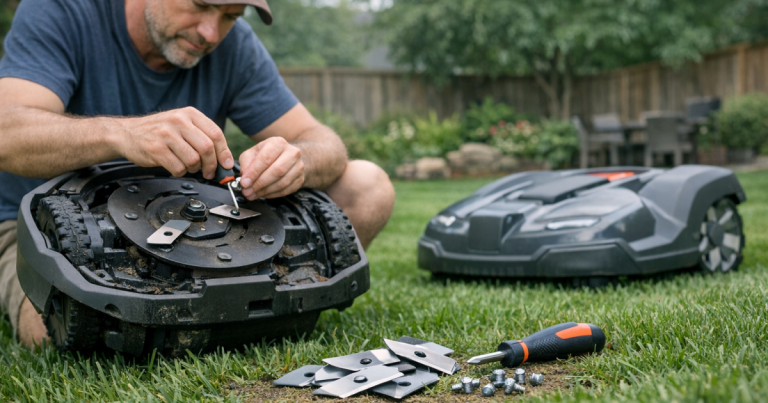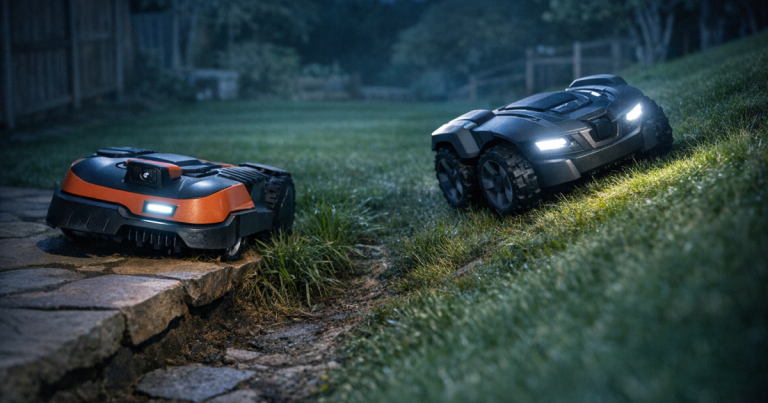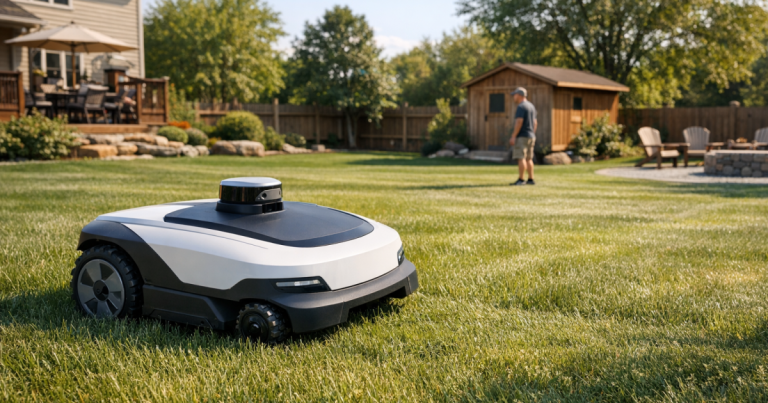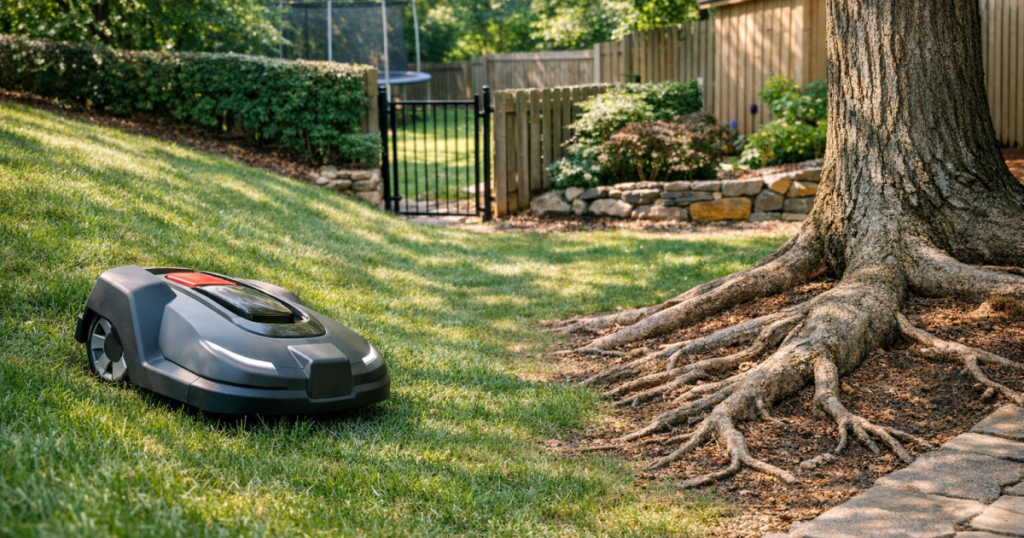
A robot mower can be a great fit for a suburban lawn, a fenced backyard, or even a complicated property with slopes and separate mowing areas. The first step is a plain robot mower yard fit check, not a brand comparison. Your yard’s shape, signal conditions, terrain, and daily clutter usually matter more than any single headline feature.
The short answer: a robot lawn mower is most likely to work reliably if the mowable grass area is within the mower’s rated coverage, the steepest slopes are comfortably below its limit, passages are wide enough for consistent travel, the lawn surface is reasonably smooth, and the boundary or navigation system matches your yard’s layout. If one of those areas is marginal, the mower may still work, but setup becomes more important.
In brief: the yard checks that matter most
Before falling in love with a model, walk your yard and make these checks. They are the difference between a mower that quietly becomes part of the routine and one that needs constant rescuing.
- Measure mowable grass, not your full lot size. Exclude the house, driveway, patio, pool, mulched beds, and wooded areas.
- Find the steepest slope and compare it with the mower’s published maximum slope. Leave a margin for wet grass, bumps, and turns.
- Measure narrow passages, gates, and side-yard corridors. Anything around 3 feet wide or tighter deserves extra attention.
- Look up, not just down. Dense trees, tall houses, and narrow spaces between buildings can affect some wire-free navigation systems.
- Check the ground surface. Exposed roots, holes, ruts, sharp transitions, and loose edging can stop or damage a mower.
- Decide whether you want a physical boundary wire, a wire-free setup, or a hybrid approach before choosing a model.
- Be honest about yard habits. Toys, hoses, fallen branches, dog waste, and temporary obstacles still need human attention.
If you want to compare models against those yard conditions, the Robot Lawn Mower Yard Fit Comparison is a useful next step because it lets you filter by practical fit factors such as yard size, navigation type, boundary method, slope capability, drive type, and mowing features.
Start with lawn area, not property size
Robot mower coverage ratings are usually based on mowable lawn area, not the size of the parcel on your county record. A quarter-acre lot with a large house, wide driveway, shed, deck, and landscaping may have much less grass than you think. A smaller corner lot with open turf on three sides may have more mowing work than expected.
Use a satellite view, property map, or tape-wheel estimate to separate turf from non-turf. Then add a little breathing room. A mower rated exactly at your estimated lawn size may be technically possible, but it has less flexibility when grass grows quickly, when weather interrupts mowing, or when the yard is split into several zones.
Multi-zone lawns also complicate the picture. A mower may handle the total area on paper, but it still needs a reliable way to move between the front yard, backyard, side strip, and any fenced sections. If it must cross a driveway, pass through a gate, or travel through a narrow corridor, that transition becomes part of the fit test.
Slopes: measure the real steep spots
Slope ratings are one of the most important robot mower specs, but they can be misunderstood. The number to check is not whether your yard “feels hilly.” It is the steepest section the mower must cut, turn on, or travel across. A short bank near a drainage ditch can matter more than a long, gentle rise across the backyard.
To estimate slope in homeowner-friendly terms, measure the rise over a 10-foot horizontal run. If the ground rises 2 feet over 10 feet, that is a 20% grade. Compare that with the mower’s published slope rating and pay attention to where the slope occurs. Slopes at the edge of the lawn, near a boundary, or beside a retaining wall are more demanding because the mower has less room to correct itself.
All-wheel-drive mowers can help on uneven or steep properties, but they are not magic. Traction still depends on grass condition, soil firmness, tire contact, and whether the mower is turning or driving straight. For a deeper look at a slope-capable premium example, our Husqvarna Automower® 435 iQ AWD review explains why complicated lawns need more than just a high slope number.
Passages, gates, and awkward connectors
Many yards fail the robot mower test in the skinny places, not the open lawn. The mower may have plenty of room in the backyard but struggle to consistently travel through a narrow gate, between the house and fence, or around an air conditioner pad.
Measure the actual clear grass path, not fence-to-wall distance. If a 4-foot side yard includes edging stones, a downspout extension, and a mulch bed, the usable mowing lane may be far less. Tight passages can also be harder for wire-free systems because the mower needs to maintain its position confidently while moving through a constrained area.
A good rule of thumb is to treat anything around 3 feet wide or less as a design problem. That does not automatically rule out a robot mower, but it means you should check the manufacturer’s minimum passage guidance and decide whether the passage needs trimming by hand, a physical guide solution, or a different mowing zone strategy.
Trees, houses, and wire-free navigation
Wire-free robot mowers are appealing because they reduce or eliminate the need to bury or stake a boundary wire. Many use satellite-based positioning, camera systems, LiDAR, beacons, or a combination of technologies depending on the model. The important point for homeowners is simple: wire-free does not mean condition-free.
Satellite-based systems can be challenged by dense tree canopy, tall houses, garages, narrow side yards, and covered areas. A wide-open front lawn with a clear sky view is usually an easier environment than a backyard tucked between mature oaks and a two-story house. Camera- or LiDAR-assisted systems may reduce reliance on satellite visibility in some designs, but each model has its own limits and setup requirements.
Walk the yard at mowing height and ask where a mower would lose a clear view of the sky or its reference points. The hardest areas are often beside the house, under low branches, near detached garages, and along fence lines with overhanging trees. If those areas are small, occasional manual trimming may be acceptable. If they form the main route between zones, choose very carefully.
Boundary wire, wire-free, or hybrid setup?
The right boundary type depends on your tolerance for installation, your lawn shape, and how often the yard changes.
- Boundary-wire systems suit defined lawns where you want a stable, physical perimeter. They take more installation work, but they can be predictable once dialed in.
- Wire-free systems suit open layouts, flexible mowing zones, and homeowners who dislike the idea of installing wire. They depend more heavily on navigation conditions.
- Hybrid systems can be useful when most of the yard works wire-free, but a tricky section benefits from a physical boundary or guide.
For smaller and mid-size lawns where flexibility matters, a hybrid-capable option such as the Automower® 410 iQ is worth comparing because the setup approach can matter as much as the mower’s cutting capacity. The best choice is not always the most advanced navigation system; it is the system that fits your specific lawn’s weak points.
Terrain roughness and everyday obstacles
Robot mowers are built to work regularly, cutting small amounts of grass at a time. They are not brush cutters, stump grinders, or cleanup machines. A lawn with shallow roots, dips, soft edges, pine cones, walnuts, small branches, sprinkler heads, and uneven transitions may need some prep before automation feels effortless.
Focus on the mower’s path. Fill holes that could trap a wheel. Smooth ruts where water collects. Trim low branches that might snag the mower body. Move landscape edging that creates a sharp drop. Mark or protect sprinkler heads and drainage hardware that sit high in the turf.
Daily clutter matters too. Most modern robot mowers include safety systems, but homeowners should not rely on them as a substitute for yard cleanup. Pick up dog toys, garden hoses, soccer goals, extension cords, and fallen branches before scheduled mowing. If children or pets use the lawn, set mowing times that reduce overlap and follow the manufacturer’s safety guidance.
Signs your yard is an easy match
Your yard is likely a straightforward candidate if it has one mostly open lawn area, moderate slopes, clear boundaries, limited tree cover, and few tight passages. A typical fenced backyard with a simple rectangle or L-shape can be one of the easiest setups, especially if the charging station has a clean approach and the mower does not need to cross hardscape.
Open front lawns can also work well, but you should think about theft deterrence, sidewalks, street edges, and where the mower parks. If the front and back yards are separated by a fence, gate access becomes a bigger question than grass area.
Signs your yard needs a more careful plan
A robot mower may still work in a complicated yard, but you should slow down if you have several of these conditions:
- Steep banks near fences, ditches, retaining walls, or water.
- Multiple isolated grass zones with no easy mower route between them.
- Dense shade or tree canopy over major mowing areas.
- Very narrow side yards or gates the mower must use regularly.
- Rough ground with exposed roots, holes, or frequent debris.
- Complex landscaping with many islands, beds, curves, and temporary obstacles.
- Dogs, kids, or yard equipment that regularly leave objects on the grass.
None of these issues is an automatic no. They simply move the project from “pick a mower and set it up” to “design the mowing system.” That may mean choosing all-wheel drive, splitting the yard into zones, using a boundary wire in one section, trimming a side corridor manually, or accepting that a robot mower will handle 85% of the lawn while you finish the edges.
Common questions
Can a robot mower handle roots?
It depends on the size and shape of the roots. Smooth, shallow roots may be manageable if the mower can pass over them without scalping or getting hung up. Raised, sharp, or clustered roots should be treated as obstacles or corrected before regular mowing.
Will it mow right to the fence or wall?
Usually not perfectly. Most robot mowers leave some edge trimming because the blade disc is set inside the body for safety and durability. The amount of leftover trimming depends on the mower design, boundary setup, and lawn edge.
Is wire-free always better than boundary wire?
No. Wire-free setup is convenient, but it can be sensitive to navigation conditions. Boundary wire requires more installation work, but it can be a strong fit for yards with tree cover, tight shapes, or fixed borders.
Practical takeaway
A robot lawn mower will work best in your yard when the mower’s limits are comfortably above your yard’s hardest conditions. Measure the grass, check the steepest slope, walk the narrowest routes, look for signal trouble spots, and clean up terrain problems before choosing a model. The right mower is the one that fits the lawn you actually have, not the ideal lawn in the brochure.
If your yard is simple, automated mowing can feel surprisingly hands-off after setup. If your yard is complex, the goal is still realistic: match the mower to the problem areas, plan the boundaries carefully, and keep expectations grounded. That is how homeowners get the quiet, steady benefit of robot mowing without turning ownership into another weekend chore.