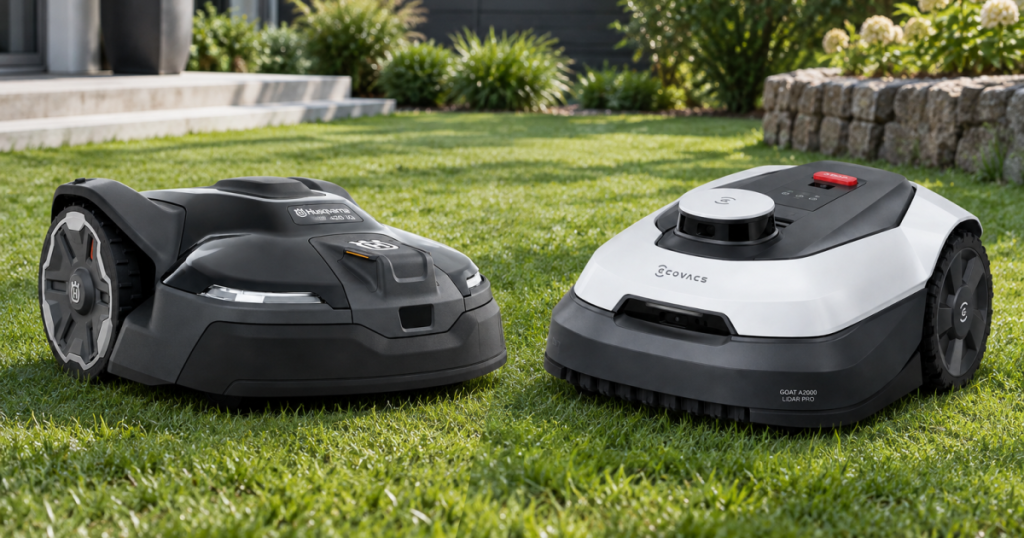
Two mowers can both promise hands-off mowing and still fit very different yards. The Husqvarna 420 iQ vs ECOVACS GOAT A2000 comparison comes down to capacity, mapping style, cutting height, and how much installation flexibility you want around slopes, borders, and everyday mowing routines.
Quick Buying Links
Husqvarna Automower® 420 iQ
Best if your priority is stated coverage up to 1 acre, a taller 4 in maximum cutting height, longer listed typical mow time per charge
ECOVACS GOAT A2000 LiDAR PRO Robot Lawn Mower
Better fit for lower listed price, LiDAR navigation, wider cutting width, and smaller mowable areas
The short version: Husqvarna Automower® 420 iQ is the stronger fit on stated lawn size and taller maximum cutting height. ECOVACS GOAT A2000 LiDAR PRO Robot Lawn Mower is the lower-priced option with a wider stated cutting width, higher listed working-area slope, and LiDAR-based navigation.
Standout differences at a glance
- Listed price: Husqvarna lists the Automower® 420 iQ at $3,299.99 MSRP. ECOVACS lists the GOAT A2000 LiDAR PRO at $1,999.99.
- Stated area: Husqvarna states a 1 acre lawn size. ECOVACS states a working capacity equivalent to about 0.49 acre.
- Navigation approach: Husqvarna lists physical wire and virtual wire boundary types, with EPOS satellite positioning and an included reference station. ECOVACS uses Multiline LiDAR and its HoloScope 360 Dual-LiDAR Navigation System.
- Slope rating: Husqvarna lists 45% maximum slope performance inside the installation. ECOVACS lists 50% maximum slope for the work area.
- Cutting height: Husqvarna covers 1 to 4 in. ECOVACS covers 1.18 to 3.54 in.
- Cutting width: Husqvarna lists 9.4 in. ECOVACS lists 12.96 in.
For readers already leaning toward Husqvarna, the dedicated Husqvarna Automower® 420 iQ overview is a useful next stop after this head-to-head comparison.
Side-by-side spec comparison
- Product type: Husqvarna Automower® 420 iQ 970 72 75-01 is a residential robotic lawn mower. ECOVACS GOAT A2000 LiDAR PRO Robot Lawn Mower MR2507C is a robot lawn mower.
- Current official listed price: $3,299.99 MSRP for Husqvarna; $1,999.99 for ECOVACS.
- Stated lawn or working capacity: 1 acre for Husqvarna; about 0.49 acre equivalent for ECOVACS.
- Boundary or navigation: Husqvarna lists physical wire and virtual wire, plus EPOS satellite positioning with an included reference station. ECOVACS lists Multiline LiDAR and HoloScope 360 Dual-LiDAR Navigation.
- Maximum working-area slope: 45% for Husqvarna; 50% for ECOVACS.
- Cutting height range: 1 to 4 in for Husqvarna; 1.18 to 3.54 in for ECOVACS.
- Cutting width: 9.4 in for Husqvarna; 12.96 in for ECOVACS.
- Mowing time per charge: Husqvarna lists 84 minutes typical mow time. ECOVACS lists 50 minutes mowing time per charge.
- Charging time: Husqvarna lists 54 minutes typical charging time. ECOVACS lists 50 minutes charging time.
- Water resistance rating: IPX5 for Husqvarna; IPX6 for ECOVACS.
- Weight: 38 lb for Husqvarna; 39.24 lb for ECOVACS.
Yard size: the cleanest split between these two
The simplest difference is stated mowing area. Husqvarna gives the Automower® 420 iQ a 1 acre lawn size, while ECOVACS gives the GOAT A2000 LiDAR PRO a working capacity equivalent to about 0.49 acre. That does not make one mower automatically better; it tells you which lawns each manufacturer is positioning the mower to handle.
For a larger open lawn, a broad corner lot, or a property where the actual mowable grass is closer to an acre after subtracting beds, driveways, and buildings, the Husqvarna has the clearer manufacturer-stated capacity advantage. For a smaller property where the mowable grass is closer to half an acre or less, the ECOVACS capacity figure can still be a natural match, while leaving more of the decision to mapping style, price, and cutting range.
One useful habit before buying either mower is to measure mowable grass, not lot size. A 0.75 acre parcel can have much less grass after the house, patio, driveway, pool, and landscape beds are removed. Robot mower capacity is about the grass the machine must actually maintain, not the size printed on a property listing.
Navigation and boundaries: EPOS flexibility versus LiDAR mapping
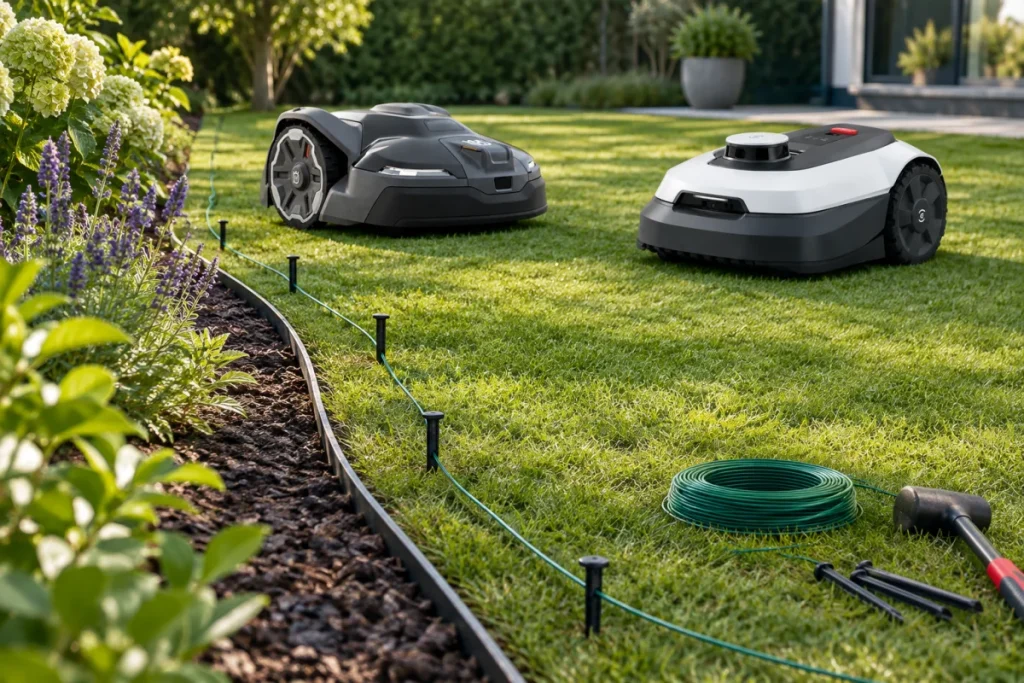
Husqvarna’s setup story is more flexible on paper because the Automower® 420 iQ lists both physical wire and virtual wire boundary types. The evidence also identifies EPOS satellite positioning with an included reference station. There is one important limit in the verified data: Husqvarna Cloud availability is location-dependent, with the included EPOS Reference Station listed as the fallback installation method. Loop wire is listed as not included.
ECOVACS takes a different route. The GOAT A2000 LiDAR PRO uses Multiline LiDAR and the HoloScope 360 Dual-LiDAR Navigation System. The ECOVACS product page describes automatic or remote mapping and does not use Husqvarna-style physical wire or satellite EPOS terminology.
That difference changes the kind of owner each mower will appeal to. Husqvarna is the more flexible choice if you like having both physical-wire and virtual-wire boundary approaches in the official specification. ECOVACS is more appealing if you want a mower built around LiDAR mapping rather than a satellite-reference-station setup. Neither approach should be treated as magic; fences, trees, house walls, narrow strips, and dock placement can still shape how smoothly a mower behaves in the real yard.
If LiDAR navigation is the feature pulling you toward ECOVACS, compare its profile against the dedicated ECOVACS GOAT A2000 LiDAR PRO yard-fit page before narrowing your shortlist.
Cutting height and grass type
Cutting height is one of the most underrated specs in robot mower shopping because it affects the lawn every week. Husqvarna lists a 1 to 4 in cutting height range. ECOVACS lists 1.18 to 3.54 in. The bottom of those ranges is close, but the Husqvarna reaches higher.
That gives the Automower® 420 iQ the clearer fit for homeowners who want a taller maintained cut, based strictly on the listed ranges. A taller maximum can be useful for lawns managed at the upper end of common cool-season mowing heights, while the ECOVACS range still covers a broad set of shorter-to-mid-height mowing plans.
If you are matching a mower to cool-season turf and want more context on height range, the guide to robot mowers for tall fescue and Kentucky bluegrass explains why maximum cut height can become a deciding spec rather than a footnote.
Cutting width, charge timing, and weekly rhythm
ECOVACS has the wider stated cutting width: 12.96 in versus Husqvarna’s 9.4 in. A wider cutting width is not the same thing as guaranteed better coverage in every yard, but it is a real hardware difference. In open spaces with fewer interruptions, width can be a meaningful part of the mowing plan. In complicated yards, navigation pattern, boundaries, passages, and schedule design still influence the result.
Husqvarna lists the longer mowing time per charge at 84 minutes typical mow time. ECOVACS lists 50 minutes mowing time per charge. Charging time is much closer: 54 minutes typical charging time for Husqvarna and 50 minutes for ECOVACS.
The editorial read is straightforward: Husqvarna combines a longer stated mow time with a narrower deck, while ECOVACS combines a shorter stated mowing time with a wider deck. Without controlled testing on the same lawn, it would be unfair to declare one faster overall. What the specs do show is that the two mowers get to their workload in different ways.
Slopes, water ratings, and weight
On slopes, ECOVACS has the higher listed work-area rating at 50%, compared with 45% maximum slope performance inside the installation for Husqvarna. That gives the ECOVACS the spec-sheet edge for working-area slope. The difference is not a license to ignore the actual ground. Roots, ruts, soft edges, and uneven transitions can make a yard harder than the slope number suggests.
Water resistance is another ECOVACS advantage on the listed rating: IPX6 versus IPX5 for Husqvarna. IP ratings are useful comparison points, but they are not the same as a promise that mowing through poor conditions is always wise. Wet grass, storms, and saturated soil can still affect lawn quality and ownership routine.
The weight difference is small. Husqvarna lists 38 lb, while ECOVACS lists 39.24 lb. In normal ownership, that gap is unlikely to be the deciding factor compared with area rating, boundary method, cutting range, and price.
Price and value: what the dollar gap buys
The official listed prices create a clear value question. Husqvarna is listed at $3,299.99 MSRP. ECOVACS is listed at $1,999.99. That is a $1,300 difference using the supplied official prices.
For the higher price, Husqvarna brings the larger stated lawn size, the taller maximum cutting height, longer listed typical mow time per charge, and the dual boundary-type listing of physical wire and virtual wire with EPOS satellite positioning and an included reference station. For the lower price, ECOVACS brings LiDAR navigation, wider cutting width, higher listed work-area slope, higher listed water rating, and a much lower official price.
That makes the price difference easier to think about. Do not treat the Husqvarna premium as automatically worthwhile unless your lawn benefits from its stated strengths. Do not treat the ECOVACS savings as automatically better unless its working capacity and cutting height range fit your grass and yard size.
Which one should you choose?
Choose the Husqvarna Automower® 420 iQ if your priority is stated coverage up to 1 acre, a taller 4 in maximum cutting height, longer listed typical mow time per charge, and the flexibility of manufacturer-listed physical and virtual boundary types. It is the cleaner pick for a larger mowable area or a lawn where cut height at the upper end is part of your care plan.
Choose the ECOVACS GOAT A2000 LiDAR PRO if your mowable grass fits within its stated working capacity equivalent to about 0.49 acre and you want the lower official price, LiDAR-based navigation, wider listed cutting width, higher listed work-area slope, and IPX6 rating. It is the stronger spec fit for shoppers who want LiDAR mapping and do not need the Husqvarna’s larger stated lawn capacity or 4 in maximum height.
The fair verdict is not “one mower wins.” It is this: Husqvarna is the better match when lawn size, taller cut height, and boundary flexibility lead the decision. ECOVACS is the better match when the yard is smaller, LiDAR navigation is preferred, and the lower listed price leaves more room in the budget.
Quick Buying Links
Husqvarna Automower® 420 iQ
Best if your priority is stated coverage up to 1 acre, a taller 4 in maximum cutting height, longer listed typical mow time per charge
ECOVACS GOAT A2000 LiDAR PRO Robot Lawn Mower
Better fit for lower listed price, LiDAR navigation, wider cutting width, and smaller mowable areas