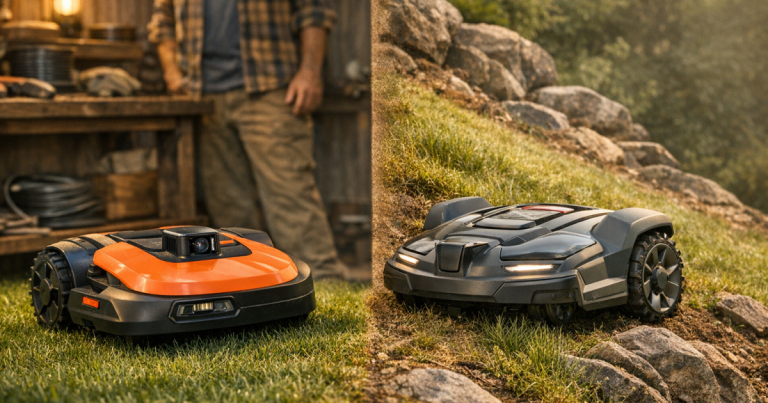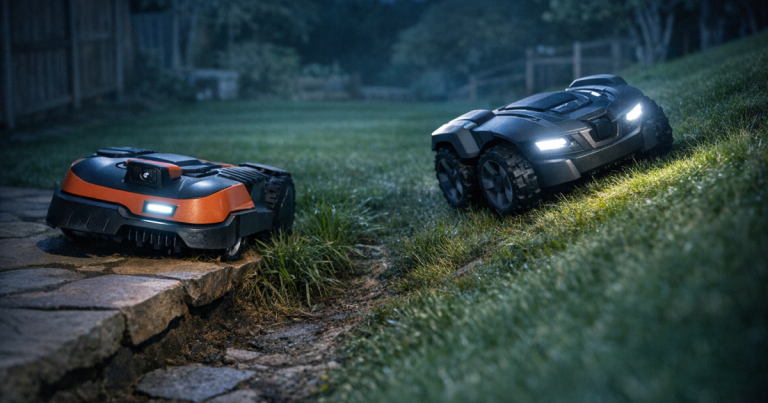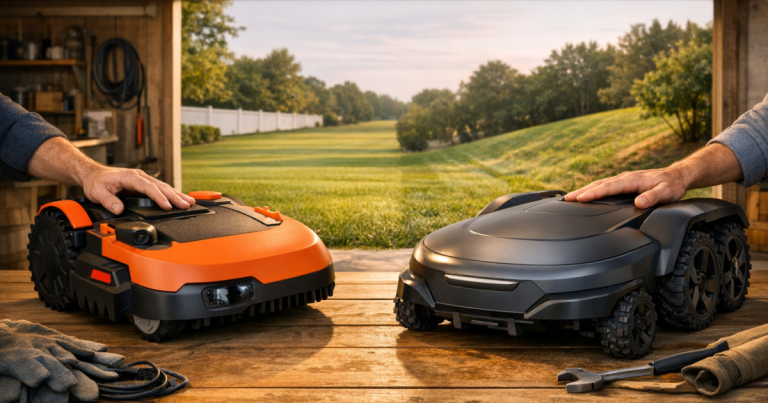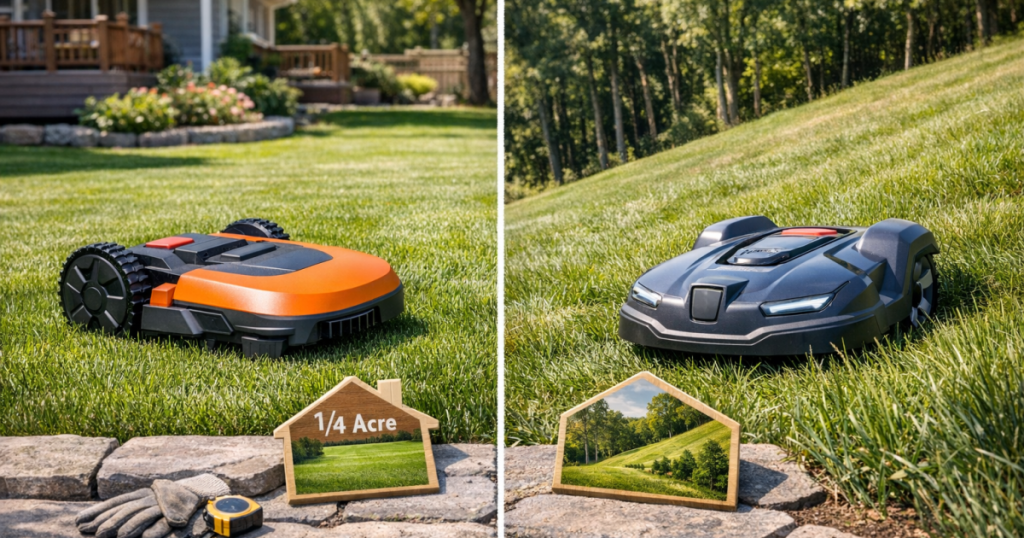
A camera-and-cloud quarter-acre mower and a one-acre EPOS-capable mower can look like they are solving the same homeowner problem: less weekend mowing and a cleaner routine. But Landroid Vision Cloud vs Automower 420 iQ is really a yard-fit decision. The Worx Landroid Vision Cloud 1/4 Acre WR310.1 is officially sized for 0.25 acre, while the Husqvarna Automower 420 iQ is officially sized for 1 acre, and that difference shapes almost every practical recommendation.
Quick Buying Links
Worx Landroid Vision Cloud 1⁄4 Acre (WR310.1)
A camera-and-cloud quarter-acre mower and a one-acre EPOS-capable mower can look like they are solving the same homeowner problem: less weekend mowing and a cleaner routine
Husqvarna Automower® 420 iQ
Stronger fit for up to one acre, steeper rated slopes, broader cutting height range, and EPOS boundary flexibility
The short version: choose the Worx WR310.1 for a smaller residential lawn that fits its 0.25-acre rating and where a lighter mower is attractive. Choose the Automower® 420 iQ when the lawn is closer to one acre, includes steeper rated slopes, or benefits from Husqvarna’s physical-wire or virtual-wire EPOS setup with the EPOS plug-in and reference station included.
Main points
- Yard size is the biggest split: Worx lists the WR310.1 for 0.25 acre; Husqvarna lists the Automower® 420 iQ for 1 acre.
- Slope rating favors Husqvarna: Worx lists 30% (17°); Husqvarna lists 45% maximum slope inside the installation.
- Boundary approach is different: Worx uses RTK Cloud with Vision AI-assisted automatic mapping and V-SLAM; Husqvarna supports physical wire or virtual wire with EPOS.
- Cutting range is wider on Husqvarna: 1 to 4 in versus 1.57 to 3.54 in for the Worx model.
- Worx is lighter: 30.9 lbs with battery versus 38 lbs for the Husqvarna.
For a spec-by-spec yard-fit snapshot of the smaller model, the Landroid Vision Cloud 1/4 Acre WR310.1 yard-fit page is the most direct next stop.
The two mowers in plain English
Worx Landroid Vision Cloud 1/4 Acre WR310.1
The Worx WR310.1 is the smaller-lawn choice in this comparison. Manufacturer-stated specs put it at 0.25 acre recommended lawn size, with RTK Cloud navigation, Vision AI-assisted automatic mapping, V-SLAM, and a stereo camera. Its cutting width is 8.7 in, cutting height range is 1.57 to 3.54 in, battery is listed as 20 V 4 Ah, charging time is 80 minutes, and weight with battery is 30.9 lbs.
That profile points toward tighter suburban yards, small front-and-back lawn layouts, and homeowners who are not trying to stretch one mower across a full acre. The lighter weight is a real practical distinction when lifting the mower for cleaning, seasonal storage, or moving it around the garage, but it does not override the official 0.25-acre yard-size rating.
Husqvarna Automower® 420 iQ
The Husqvarna Automower® 420 iQ is the larger-capacity model here. Husqvarna lists it for 1 acre, with physical wire or virtual wire using EPOS. The official product facts also state that the EPOS plug-in and EPOS reference station are included. Its cutting width is 9.4 in, cutting height range is 1 to 4 in, battery capacity is 5 Ah, typical charging time is 54 minutes, typical mow time on one charge is 84 minutes, and weight is 38 lbs.
For the complete model entry, see the Automower® 420 iQ yard-fit page. The key editorial takeaway is simple: the 420 iQ is not just a slightly larger alternative; it is officially rated for four times the recommended lawn size of the Worx WR310.1.
Side-by-side differences that actually affect the yard
Recommended lawn size
This is the first filter to apply. The Worx WR310.1 is listed for 0.25 acre, while the Husqvarna Automower® 420 iQ is listed for 1 acre. A quarter-acre-rated mower can be a clean fit for a modest lawn where the actual mowable grass area stays within that range. A one-acre-rated mower makes more sense for a larger property where the robot has more ground to keep trimmed over a regular mowing schedule.
For homeowners, this is not just a capacity number. Yard size affects how much time the mower needs to spend working, how much margin it has during fast spring growth, and whether the mower feels comfortably matched to the property rather than constantly catching up.
Navigation and boundary system
Worx lists RTK Cloud with Vision AI-assisted automatic mapping and V-SLAM for the WR310.1, plus a stereo camera. Husqvarna lists physical wire or virtual wire with EPOS for the Automower® 420 iQ, and the official package includes the EPOS plug-in and EPOS reference station.
The practical distinction is control style. The Worx approach is centered on RTK Cloud, vision assistance, automatic mapping, and V-SLAM. The Husqvarna approach gives the 420 iQ both physical-wire and virtual-wire EPOS options, with the reference station included for the EPOS setup. That matters for yards where the owner wants a defined installation path rather than a single navigation approach.
Cloud-based coverage is address-specific for both brands’ cloud components. That does not make either mower wrong; it means the strongest comparison is the one tied to your actual yard layout, house position, trees, and open sky exposure. If tree cover is a major concern, our guide to robot mowers for tree-covered yards with weak GPS explains why navigation method matters so much in shaded lawns.
Slope rating
Slope is another clear difference. Worx lists the WR310.1 at 30% (17°). Husqvarna lists the Automower® 420 iQ at 45% maximum slope inside the installation. On paper, that gives the Husqvarna more rated margin for hilly areas within the installed mowing zone.
Use the slope rating as a fit screen, not as a promise that every uneven bank will behave the same. Robot mowers work in real lawns, and real lawns include damp grass, roots, dips, exposed soil, and turns near boundaries. Based strictly on the verified ratings, the Husqvarna is the stronger candidate when slope is a central part of the yard decision.
Cutting width and cutting height
The Husqvarna also has a modest cutting-width edge: 9.4 in versus 8.7 in for the Worx WR310.1. Cutting width is not the only factor in mowing productivity, but a wider deck can be useful when comparing machines meant for different lawn sizes.
The cutting-height range difference is more noticeable for turf preference. Worx lists 1.57 to 3.54 in. Husqvarna lists 1 to 4 in. That gives the 420 iQ a broader manufacturer-stated range at both the low and high ends. For homeowners who cut higher in summer heat or want more adjustment flexibility across the growing season, that wider listed range favors the Husqvarna.
Battery, charging and weight
The published battery figures are not a simple apples-to-apples “bigger number wins” comparison because the Worx battery is stated as 20 V 4 Ah and the Husqvarna battery is stated as 5 Ah. Charging time is easier to compare: Worx lists 80 minutes, while Husqvarna lists 54 minutes typical charging time. Husqvarna also lists 84 minutes of typical mow time on one charge.
Weight tilts the other way. Worx lists 30.9 lbs with battery. Husqvarna lists 38 lbs. If you expect to carry the mower up steps, lift it onto a storage shelf, or move it by hand during seasonal cleanup, the lighter Worx body is the more convenient one. If the mower mostly stays in its mowing area and charging station, the weight difference may matter less than yard size, slope rating, and boundary setup.
Where the Worx WR310.1 makes more sense
The Worx Landroid Vision Cloud 1/4 Acre WR310.1 is the better fit when the yard is genuinely within its 0.25-acre recommended lawn size and the owner wants the smaller, lighter model in this matchup. Its official 30.9-lb weight with battery is meaningfully lower than the Husqvarna’s 38 lbs, and its published navigation package centers on RTK Cloud, Vision AI-assisted automatic mapping, V-SLAM, and a stereo camera.
It is not the right editorial pick for a lawn that needs a one-acre-rated mower. The verified size rating is the boundary here. Stretching beyond that 0.25-acre recommendation would turn a clean small-yard choice into a mismatch.
Where the Automower® 420 iQ pulls ahead
The Husqvarna Automower® 420 iQ is the stronger pick for larger residential lawns, steeper rated slopes, and homeowners who value boundary flexibility. The manufacturer-stated 1-acre recommendation is the largest difference in the comparison. The 45% maximum slope rating inside the installation, 9.4-in cutting width, 1 to 4-in cutting height range, and 54-minute typical charging time all reinforce that larger-yard role.
The physical-wire or virtual-wire EPOS setup is also a meaningful distinction. The official facts state that the EPOS plug-in and EPOS reference station are included, giving this model a defined EPOS installation path rather than relying on cloud coverage alone.
The practical pick
Choose the Worx Landroid Vision Cloud 1/4 Acre WR310.1 if your mowable lawn fits the 0.25-acre rating and you want the lighter mower in this head-to-head. Its strengths are most relevant in smaller yards where capacity is not the limiting factor.
Choose the Husqvarna Automower® 420 iQ if your yard is closer to 1 acre, includes steeper areas within the installation, or needs the broader cutting-height range and EPOS boundary flexibility Husqvarna lists. Based on the verified specs, it is the more capable fit for larger and more demanding residential lawns.
Quick Buying Links
Worx Landroid Vision Cloud 1⁄4 Acre (WR310.1)
A camera-and-cloud quarter-acre mower and a one-acre EPOS-capable mower can look like they are solving the same homeowner problem: less weekend mowing and a cleaner routine
Husqvarna Automower® 420 iQ
Stronger fit for up to one acre, steeper rated slopes, broader cutting height range, and EPOS boundary flexibility