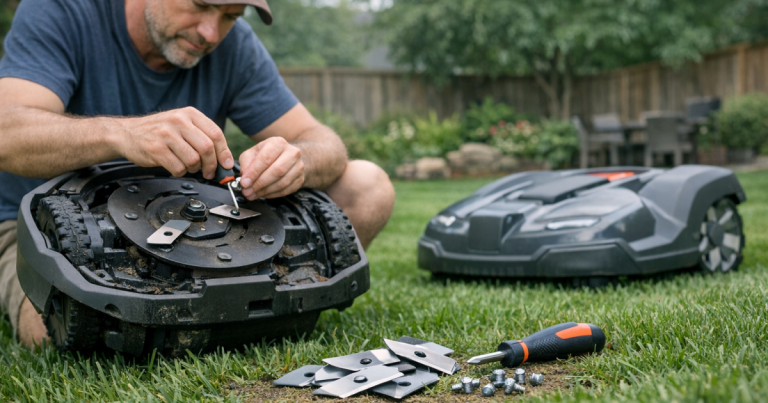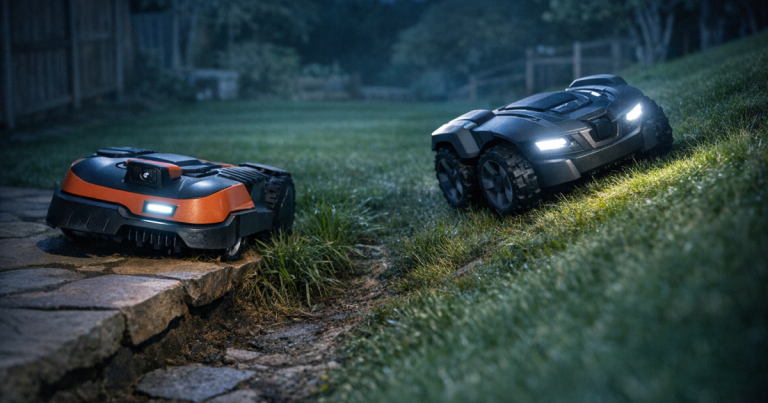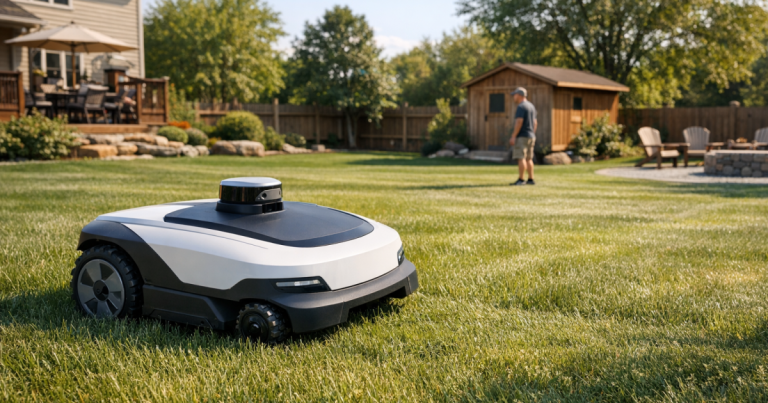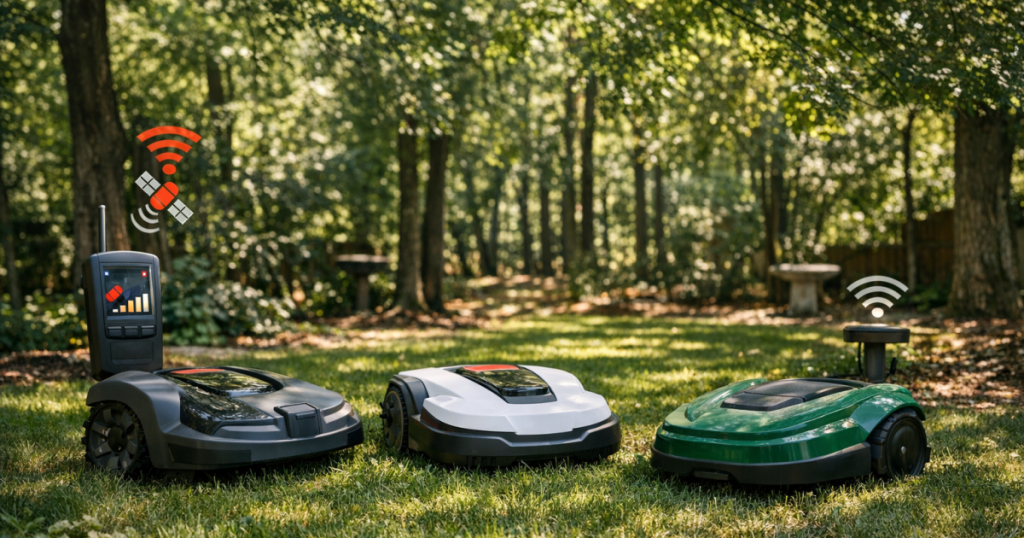
A tree-covered lawn can be a great place for a robot mower, but it is also where satellite navigation gets tested hardest. If you need a robot mower for weak GPS, start by matching the navigation system to the parts of your yard that block sky view: tree canopy, tall houses, sheds, fences, and narrow side yards.
The goal is not to find a mower that magically ignores trees. It is to choose a setup that still knows where it is when leaves, shade, trunks, and buildings make the yard harder to read.
The big picture
For dense tree canopy, a boundary-wire mower or a hybrid mower that can fall back to a physical boundary is usually the safest bet. For yards with moderate shade and visible lawn edges, LiDAR-led or vision-led wire-free mowers can be worth comparing because they do not depend only on satellite correction for every positioning decision. Pure RTK satellite mowers can work well in open lawns, but they are more vulnerable when the mower and its reference antenna have a poor sky view.
Before you shortlist models, walk the lawn the way the mower will. Look for the places where the sky disappears: under maples, behind the house, between privacy fences, along wooded back edges, and near detached garages. If several mowing zones are under full canopy, treat weak satellite reception as a design constraint, not a minor inconvenience. The broader yard-fit checklist for robot mowers is a good next step if you are still figuring out whether the whole property is a realistic match.
Why trees bother satellite-guided mowers
Satellite-based robot mowers need a reliable position signal. RTK systems improve accuracy by using correction data, but they still need enough satellite visibility for the mower and base/reference setup to calculate position consistently. A thick canopy can block, weaken, or scatter signals. The result may be poor localization, pauses, route errors, or areas the mower avoids because it cannot confidently place itself.
Tree problems are rarely uniform across a lawn. A sunny front yard may be easy, while the shaded strip behind the fence is the trouble spot. That is why the best choice often depends less on total acreage and more on where the weak-signal areas sit in the mowing pattern.
Step 1: Map the weak-sky zones
Start with a simple yard sketch. Mark the charging location, front and back lawn areas, narrow passages, trees, sheds, fences, slopes, mulch beds, patios, playsets, and gates. Then circle the places where you cannot see much open sky while standing at mower height.
- If weak-sky zones are small and surrounded by open lawn, a satellite-guided mower may still be workable depending on the model and setup.
- If the mower must pass through a shaded side yard to reach another zone, navigation reliability matters more than the size of that passage suggests.
- If the entire backyard is under mature canopy, prioritize wired, hybrid, LiDAR, or vision options before pure RTK.
- If tree roots, ruts, and uneven ground are part of the same area, drive type and traction become just as important as navigation.
Step 2: Choose the navigation approach that fits the canopy
Most dependable under heavy canopy: boundary wire
A boundary-wire mower does not need satellite positioning to know where the lawn edge is. The wire defines the work area, which makes this approach practical for wooded lots, fenced backyards, and yards with poor sky view. The trade-off is installation effort: the wire has to be placed correctly, protected from damage, and repaired if it is cut during edging, aeration, or landscape work.
Best compromise for mixed yards: hybrid virtual and physical boundaries
Hybrid systems are useful when part of the lawn is open enough for wire-free mapping but another section needs a physical boundary. For example, an open front lawn may be fine virtually, while a shaded back corner near woods may behave better with wire support. Models in Husqvarna’s Automower iQ family are worth comparing for this kind of flexible setup, but verify the exact boundary options and yard limits for the model you are considering.
Best wire-free direction for poor sky view: LiDAR or vision
LiDAR and camera-based mowers are attractive for tree-covered yards because they can use local perception rather than relying only on satellite positioning. Current examples to research include ECOVACS GOAT A2000 LiDAR PRO, Mammotion YUKA mini 2 1000H, Segway Navimow LiDAR models, and the WORX Landroid Vision Cloud line.
That does not mean LiDAR or vision is automatically better in every wooded yard. Cameras may depend on readable visual boundaries and lighting. LiDAR still needs a lawn layout the mower can interpret consistently. Leaves, toys, low branches, deep shadows, and seasonal changes can all affect how cleanly the mower reads the space. A vision-led option such as the Landroid Vision Cloud 1 Acre is most interesting when you want to reduce dependence on buried wire and satellite positioning, but you should still compare it against your edges, zones, and obstacle pattern.
Step 3: Do not ignore slope, roots, and traction
Tree-covered yards often come with more than shade. Roots can lift the surface. Drainage can create soft spots. Sloped backyards may hold leaves and damp grass. A mower that navigates well but lacks the traction for the terrain can still struggle.
Measure the steepest mowing area before you choose a model. Do not guess based on how the yard feels underfoot. Use a phone level, a long board and level, or another consistent method, then compare your result with the mower’s published slope rating. The site’s guide on measuring lawn slope before buying a robot mower walks through the process in plain terms.
For lawns that combine slopes, trees, narrow transitions, and uneven ground, all-wheel-drive models may deserve a closer look. The Automower 435 iQ AWD review is useful if your challenge is not just weak reception, but a complicated lawn shape with traction demands.
Step 4: Match the mower type to your yard scenario
- Dense woods behind the house: Start with boundary-wire or hybrid systems. Wire-free may still work in open areas, but do not make the shaded back zone the experiment.
- Open front yard, shaded side passage, open backyard: Look at hybrid systems or wire-free mowers with strong local navigation, then confirm how multi-zone movement is handled.
- Moderate canopy with clean lawn edges: LiDAR or vision-led mowers may be a good fit if the mower can consistently identify the mowing area.
- Large open lawn with scattered ornamental trees: RTK-based wire-free mowers may remain practical when the antenna and most mower paths have clear sky view.
- Steep, shaded, uneven lawn: Put traction, slope rating, and boundary reliability ahead of convenience features.
Common mistakes that cause disappointment
- Buying for acreage only. A mower rated for the lawn size may still be wrong for heavy canopy or awkward passages.
- Assuming wire-free always means easier. Wire-free setup can be simpler, but weak positioning can make a difficult yard more frustrating.
- Placing the charging station in the most shaded corner. The mower’s home area should be chosen for reliable access and setup requirements, not just invisibility.
- Forgetting seasonal change. A yard that works in early spring may become harder to navigate after trees leaf out.
- Expecting obstacle detection to replace yard cleanup. Fallen branches, toys, hoses, and pine cones still need regular attention.
Questions people ask
Can an RTK robot mower work under trees?
Sometimes, but heavy canopy is one of the main conditions that can make RTK less reliable. RTK needs adequate satellite visibility for positioning, so performance can vary between open lawn, light shade, and dense tree cover.
Is LiDAR better than GPS for wooded yards?
LiDAR can be better suited to poor-sky-view areas because it reads the mower’s surroundings rather than depending only on satellites. The yard still has to be readable for the mower, with manageable obstacles, routes, and edges.
Should I choose a wired mower if my whole backyard is shaded?
For a heavily shaded backyard, a boundary-wire or hybrid physical-boundary setup is usually the more conservative choice. It gives the mower a defined work area even when satellite reception is weak.
What to do next
Do one slow lap of the lawn and rank your problems in order: sky view, slopes, passages, obstacles, edges, and zone layout. If weak GPS is the biggest issue, do not start with the mower that has the slickest app or the largest acreage number. Start with the navigation method that fits the hardest part of the yard.
For many tree-covered US lawns, the best answer is either a wired or hybrid mower for reliability, or a carefully chosen LiDAR or vision mower where the lawn is visually readable. That is the practical path to automation that feels helpful instead of fussy.