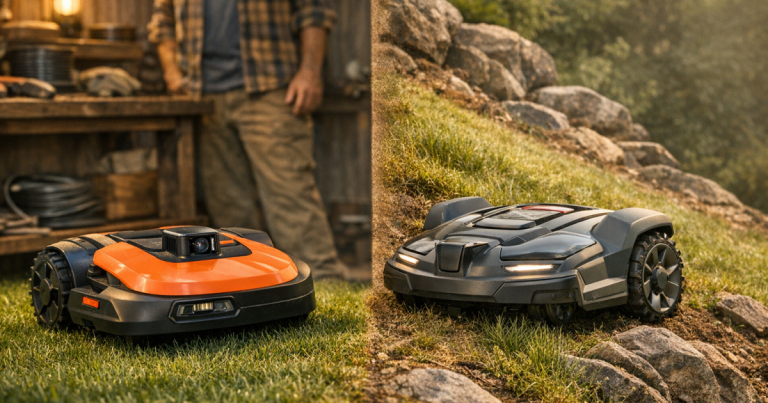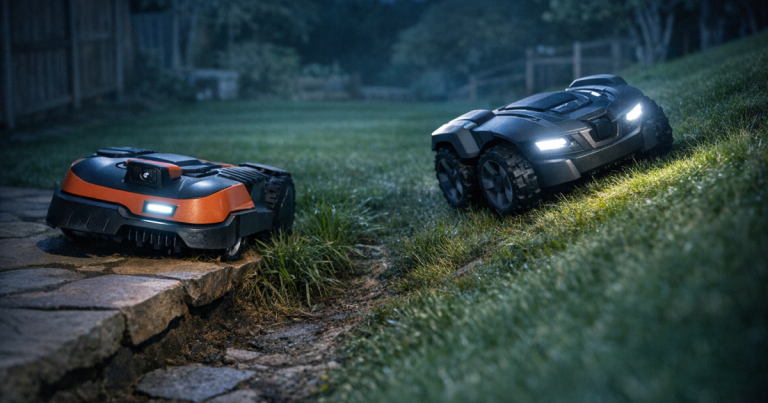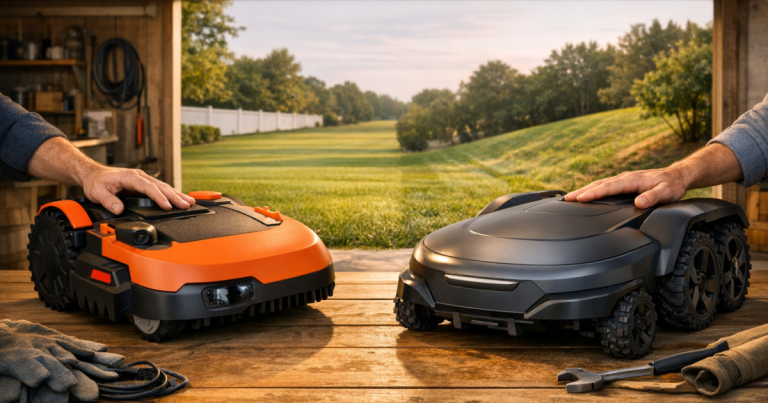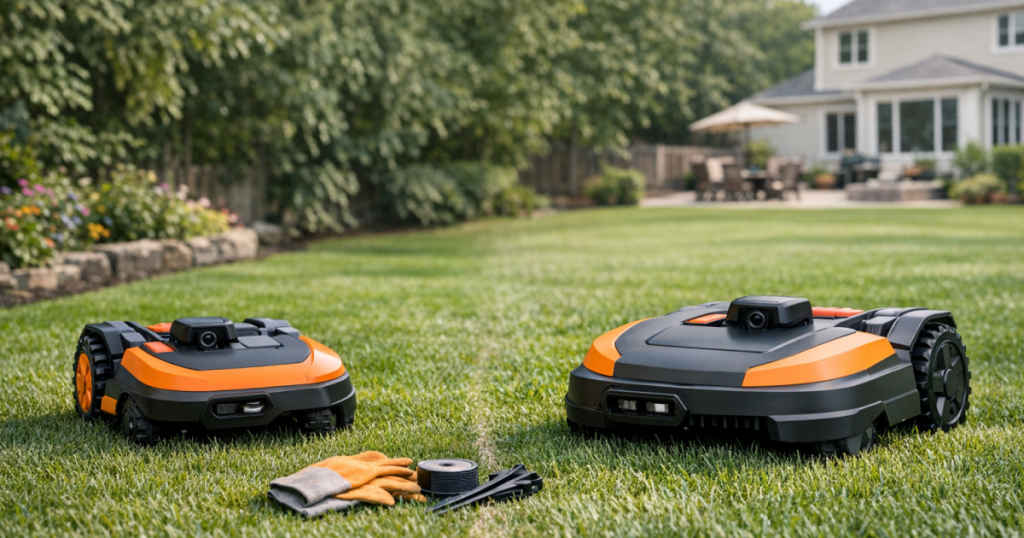
For many US suburban lawns, the smartest robot mower choice is not the biggest one on the shelf. The WR310.1 vs WR320.1 decision comes down to mowing area, budget, and whether the larger model’s added battery capacity and RadioLink connectivity line up with your actual yard. Both are Worx Landroid Vision Cloud robotic lawn mowers with the same listed navigation approach, cutting width, cutting height range, and slope rating, so this is a close family comparison rather than a matchup between two very different machines.
Quick Buying Links
Worx Landroid Vision Cloud 1⁄4 Acre (WR310.1)
Lower-cost choice for lawns up to 0.25 acre with the same listed cutting width and slope rating
Worx Landroid Vision Cloud ½ Acre (WR320.1)
Lower-cost choice for lawns up to 0.25 acre with the same listed cutting width and slope rating
The short version
The Landroid Vision Cloud 1⁄4 Acre (WR310.1) is the lower-cost option for lawns up to 0.25 acre. Worx lists it at $1,199.99, with a 20 V 4 Ah battery, 80-minute charge time, Bluetooth and Wi-Fi connectivity, and a 30.9 lb weight with battery.
The Landroid Vision Cloud ½ Acre (WR320.1) is the larger-capacity option for lawns up to 0.5 acre. Worx lists it at $1,799.99, with a 20 V 5 Ah battery, 100-minute charge time, Bluetooth, Wi-Fi, and RadioLink connectivity, and a 31.0 lb weight with battery.
- Choose WR310.1 if your lawn is within the 0.25-acre rating and keeping the purchase price lower is a priority.
- Choose WR320.1 if your lawn needs the 0.5-acre rating, or if RadioLink connectivity is part of the setup you want from this product family.
- Do not upgrade for cutting width or slope rating alone: Worx lists both models with an 8.7 in cutting width and a 30% (17°) maximum slope.
Side-by-side details from Worx’s US listings
These two mowers share the same broad identity: current Worx US Landroid Vision Cloud robotic lawn mowers available to new customers. The useful comparison starts where the official specs separate them.
- Official listed price: WR310.1 is listed at $1,199.99; WR320.1 is listed at $1,799.99.
- Recommended lawn size: WR310.1 is listed for 0.25 acre; WR320.1 is listed for 0.5 acre.
- Battery capacity: WR310.1 uses a 20 V 4 Ah battery; WR320.1 uses a 20 V 5 Ah battery.
- Charge time: WR310.1 is listed at 80 min; WR320.1 is listed at 100 min.
- Connectivity: WR310.1 lists Bluetooth and Wi-Fi; WR320.1 lists Bluetooth, Wi-Fi, and RadioLink.
- Navigation and camera: both list RTK Cloud navigation, stereo camera, and V-SLAM.
- Cutting width: both list 8.7 in.
- Cutting height range: both list 1.57 to 3.54 in.
- Maximum slope: both list 30% (17°).
- Weight with battery: WR310.1 is listed at 30.9 lbs; WR320.1 is listed at 31.0 lbs.
For a database-style look at the smaller model alongside other yard-fit factors, the WR310.1 yard-fit profile is a useful next stop once you know your mowing area.
The price difference is buying lawn capacity, not a wider cut
The official listed price gap is $600. WR310.1 is listed at $1,199.99, while WR320.1 is listed at $1,799.99. That is a meaningful jump, and the cleanest reason to spend it is the larger recommended lawn size: 0.5 acre on WR320.1 versus 0.25 acre on WR310.1.
That distinction is important because the two mowers do not separate on several specs that homeowners often notice first. Worx lists the same 8.7 in cutting width for both. It also lists the same 1.57 to 3.54 in cutting height range and the same 30% (17°) maximum slope. In plain yard terms, the ½-acre model is not presented by Worx as a wider-deck upgrade or a steeper-slope upgrade in the supplied specs.
If your maintained mowing area comfortably fits under 0.25 acre, the WR310.1 has the stronger value case on the verified numbers. If your mowing area pushes beyond that rating and fits within the 0.5-acre rating, the WR320.1 is the model aligned with that larger yard requirement. That is a refreshingly simple split in a category that can sometimes feel like it requires a surveyor, a satellite dish, and a weekend of spreadsheet therapy.
Lawn size should lead the decision
Robot mower sizing is not just about lot size. A quarter-acre residential lot does not automatically mean a quarter-acre mowing area, because the house, driveway, patio, beds, trees, and other non-grass spaces reduce the actual lawn. The same logic applies to a half-acre property. What counts here is the maintained grass area you expect the mower to cover.
WR310.1 is listed for lawns up to 0.25 acre. That makes it the more sensible match when your grass area is clearly in small-yard territory and you want the Landroid Vision Cloud feature set without paying for the 0.5-acre rating.
WR320.1 is listed for lawns up to 0.5 acre, which is double the WR310.1 rating. That is the single biggest practical difference between the two models. For a larger suburban lawn, a wider open backyard, or a front-and-back layout where the combined grass area lands closer to half an acre, WR320.1 is the one that matches Worx’s larger stated capacity.
If you are comparing the larger model against other mower sizes, the WR320.1 yard-fit profile keeps the 0.5-acre rating in context with the same kind of practical filters homeowners use when narrowing a shortlist.
Navigation, slope, and cutting specs are essentially shared
Both models list RTK Cloud navigation, a stereo camera, and V-SLAM. For shoppers, the key takeaway is that the verified navigation and camera line is the same for WR310.1 and WR320.1. The larger mower is not distinguished in the evidence by a different navigation method.
Worx also states that RTK Cloud coverage is address-dependent, so location-specific coverage belongs in your yard-address assessment rather than in the model-to-model scorecard. Since both mowers use the same listed RTK Cloud navigation, that point does not create an advantage for either model in this comparison.
The shared cutting specs tell a similar story. Both list an 8.7 in cutting width and a cutting height range from 1.57 to 3.54 in. If you were hoping the WR320.1 would buy you a wider pass across the lawn, the verified specs do not support that. The larger model’s advantage is its 0.5-acre rating, larger listed battery capacity, and added RadioLink connectivity, not a bigger cutting width.
Slope handling is also even on the supplied data. Both mowers list a 30% (17°) maximum slope. If your yard has gentle rolls, drainage swales, or a sloped side strip, the model choice should still come back to area and the other listed differences. The ½-acre version is not the confirmed slope upgrade here.
Battery, charging, connectivity, and weight
WR310.1 lists a 20 V 4 Ah battery and an 80-minute charge time. WR320.1 lists a 20 V 5 Ah battery and a 100-minute charge time. The larger model has the higher listed battery capacity, but it also has the longer listed charge time. The supplied facts do not include mowing runtime, so the fair comparison is battery capacity and charge time, not an invented estimate of how long either mower will cut between charges.
Connectivity is another genuine split. WR310.1 lists Bluetooth and Wi-Fi. WR320.1 lists Bluetooth, Wi-Fi, and RadioLink. That gives the ½-acre mower an additional listed connectivity method. For a homeowner choosing within the Landroid Vision Cloud family, that added RadioLink line is one of the concrete reasons the WR320.1 is more than just the same mower with a higher price tag.
Weight is nearly identical. WR310.1 is listed at 30.9 lbs with battery, while WR320.1 is listed at 31.0 lbs with battery. A tenth of a pound is not a meaningful ownership divider for most homeowners. If you are moving the mower for cleaning, storage, or repositioning, the official weights suggest the two are functionally in the same handling class.
Yard situations where each one makes more sense
Choose WR310.1 for a defined small lawn
The WR310.1 is the cleaner pick when your grass area fits within 0.25 acre and you do not need the 0.5-acre rating. You get the same listed RTK Cloud navigation, stereo camera, V-SLAM, 8.7 in cutting width, 1.57 to 3.54 in cutting height range, and 30% (17°) slope rating as the WR320.1, while staying at the lower official listed price.
This is the model that makes the most sense for a modest front-and-back lawn where the homeowner wants a current Landroid Vision Cloud mower but does not want to pay for unused area capacity. In a product family comparison, avoiding overbuying is a win.
Choose WR320.1 for the bigger mowing area
The WR320.1 earns its place when the 0.25-acre rating is not enough and the lawn fits within the 0.5-acre rating. Its official listed price is higher, but the rating doubles from 0.25 acre to 0.5 acre. It also brings the 20 V 5 Ah battery and adds RadioLink to the listed connectivity mix.
For a wider suburban backyard or a layout where front, side, and rear lawn areas add up quickly, the bigger rating is the central reason to move up. The upgrade is not about a wider cut or a steeper listed slope limit; it is about matching the mower to a larger grass area.
Do not let fences and gates be an afterthought
A model comparison answers only part of the ownership question. If your lawn is fenced or divided by gates, the mower still has to move through the physical layout you give it. Before you settle the mower size question, it is worth reading the site’s guide to minimum gate width for robot mowers, because passages can turn a simple yard into a more careful setup plan.
Fast answers
Is the WR320.1 better for hills?
Not on the verified slope spec. Worx lists both WR310.1 and WR320.1 with the same 30% (17°) maximum slope, so the ½-acre model should not be treated as the hill-focused upgrade in this pair.
Does the WR320.1 cut a wider strip of grass?
No. Worx lists both models with an 8.7 in cutting width. The WR320.1’s advantages are its 0.5-acre recommended lawn size, 20 V 5 Ah battery, and added RadioLink connectivity.
Which one is less expensive?
WR310.1 is less expensive on Worx’s official US listed price: $1,199.99 versus $1,799.99 for WR320.1. That lower price is its biggest advantage when the 0.25-acre rating fits your lawn.
The clean recommendation
Pick WR310.1 if your maintained lawn is within 0.25 acre and you want the lower-cost route into the Landroid Vision Cloud lineup. The shared cutting width, cutting height range, navigation line, and slope rating make it hard to justify paying more unless your yard actually needs the larger model’s capacity or connectivity difference.
Pick WR320.1 if your lawn requires the 0.5-acre rating, or if its listed RadioLink connectivity and 20 V 5 Ah battery are part of why you are stepping up. The official price is $600 higher, but the recommended lawn size doubles, which is the clearest reason this model exists beside the WR310.1.
For most homeowners comparing these two, the decision is pleasantly direct: buy the mower sized to the grass you actually maintain. WR310.1 is the sharper value for a true quarter-acre-or-smaller mowing area; WR320.1 is the better fit when the lawn area moves into half-acre territory.
Quick Buying Links
Worx Landroid Vision Cloud 1⁄4 Acre (WR310.1)
Lower-cost choice for lawns up to 0.25 acre with the same listed cutting width and slope rating
Worx Landroid Vision Cloud ½ Acre (WR320.1)
Lower-cost choice for lawns up to 0.25 acre with the same listed cutting width and slope rating