Choosing robot mower replacement blades sounds simple until you see two nearly identical packs with very different claims. One is the manufacturer’s part, the other is a cheaper aftermarket kit, and both promise a clean cut. The better choice is not always the same for every homeowner. It depends on your mower, your yard, how often you inspect the blades, and whether the screws in the kit are as trustworthy as the blades themselves.
At a glance
OEM blades are the safer default when the mower is new, still under warranty, uses model-specific screws, or works in a yard with roots, twigs, pine cones, acorns, or uneven ground. Aftermarket blades can be a reasonable upkeep purchase for experienced owners who can verify fitment, inspect screws carefully, and are willing to reject a cheap kit if the metal, coating, or screw heads look questionable.
For most homeowners, the practical answer is simple: buy OEM for your first replacement set, learn how your mower wears blades in your actual lawn, then consider aftermarket only after you know the correct blade shape, screw size, and change routine. A bargain blade is not a bargain if it loosens, cuts poorly, or turns a quick maintenance job into a tiny metal scavenger hunt in the grass.
Step 1: Check the blade system your mower actually uses
Do not shop by brand alone. Robot mowers commonly use small replaceable blades attached to a spinning cutting disc, but blade shape, hole size, screw style, and clearance can vary by model and generation. A kit marked for one product family may not be right for a different mower from the same brand.
Start with the owner’s manual, the manufacturer’s parts listing, or the exact model page. If you are comparing mower ownership costs before buying, look at the blade and parts ecosystem alongside yard size and slope capability. For example, a boundary-wire AWD mower such as the Husqvarna Automower 435X AWD is a different long-term ownership decision than a compact mower for a simple suburban lawn, and replacement parts are part of that picture.
- Match the exact mower model, not just the brand name.
- Confirm whether the kit includes screws and whether those screws are intended for your mower.
- Check whether your mower manual specifies genuine parts, a blade part number, or a replacement interval.
- Avoid blade packs that rely only on vague wording such as “universal robot mower blades.”
OEM blades: the lower-risk choice
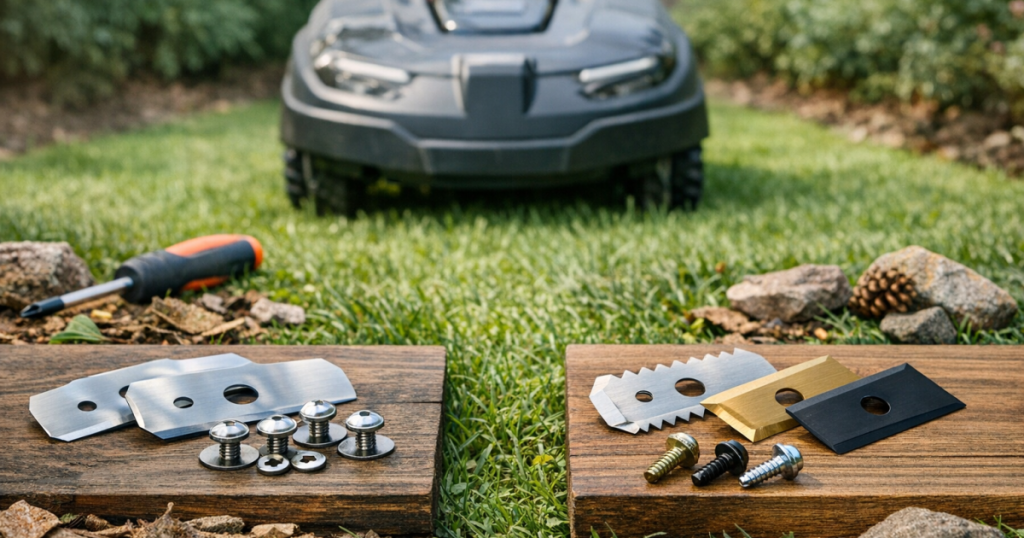
OEM means original equipment manufacturer. In plain English, the blade is made or supplied for the mower brand’s own parts program. With OEM blades, the main advantage is fit confidence. The blade, screw, and disc clearance are intended to work together on the mower the part is listed for.
That is why OEM is usually the better first purchase for a new owner. You have fewer variables to diagnose if the mower suddenly sounds different, leaves ragged grass tips, or throws an error after a blade change. Genuine parts also make more sense when a mower uses a tightly specified cutting assembly or when you are still learning the machine’s maintenance rhythm.
Recognizable OEM options include Husqvarna Automower Endurance Blades for compatible Automower models. The important part is not the name on its own; it is whether the pack is listed for your exact mower and includes the correct hardware for the blade position.
Aftermarket blades: when they make sense
Aftermarket blades are made by third-party suppliers rather than the mower manufacturer. Some owners like them because multi-packs can be convenient for frequent changes, especially on lawns where blades dull quickly from sandy soil, dry stems, fallen leaves, small twigs, or heavy spring growth.
Aftermarket can be sensible once you already know how your mower behaves with a fresh OEM set. That gives you a baseline. If a third-party blade leaves grass tips ragged sooner, corrodes quickly, sounds rough, or the screws do not seat cleanly, you can identify the change instead of blaming the mower.
For Worx owners, model names can look very similar, so slow down before buying any blade kit. A mower such as the Worx Landroid Vision Cloud WR320.1 should be matched by its exact model reference, not by a casual “fits Landroid” label. A product such as WORX WA0190 Landroid Replacement Blades is worth comparing only after you confirm compatibility for your mower version.
Step 2: Judge the screws as carefully as the blades
Blade screws are not an afterthought. They hold the cutting blade to a disc that spins thousands of times during a mowing season. A blade kit with poor screws can be worse than a dull blade because it creates fitment and retention problems.
Replace screws when the mower manual says to, when the blade kit includes model-correct replacement screws, or when the screw head, threads, or shoulder show wear. Do not keep reusing the same screw just because it still turns. A stripped head can also make the next blade change far more annoying than it needed to be.
- Use the correct driver size so you do not round the screw head.
- Replace any screw with corrosion, damaged threads, or a sloppy fit.
- Do not mix screws from different blade kits unless the manufacturer confirms they match.
- Do not force a screw that resists seating; stop and verify the part.
Step 3: Decide how often to change blades
There is no single blade-change interval that fits every US lawn. Follow your mower manual first, then adjust based on how your yard wears the blades. A small, clean lawn with soft grass may go longer between changes than a corner lot with oak leaves, cones, sandy soil, exposed roots, and weekend toys that somehow migrate into the mowing area.
A good hands-on routine is to inspect the blades every two to four weeks during active mowing season, and sooner after heavy debris, storms, or a period of fast spring growth. Keep one spare set of robot mower replacement blades on hand so you are not forced to run dull blades while waiting for parts.
Replace blades when you see torn grass tips, browning at the cut ends, visible nicks, bent corners, rust, rough mower noise, or reduced cutting consistency. Also replace the full set together. Mixing one sharp blade with two tired ones can leave the cutting disc unbalanced and the lawn unevenly trimmed.
Model-focused blade checklist
Use this as a buying checklist before clicking into any blade pack. It is deliberately conservative because blade fitment is one of those small ownership details that can cause big frustration.
- Husqvarna Automower models, including 435X AWD: Verify the genuine blade part or approved replacement listed for your exact Automower model. Replace screws according to the manual or when supplied as the correct hardware. OEM is the lowest-friction choice for owners who want minimal fitment risk.
- Worx Landroid Vision models, including WR320.1 and related Vision Cloud mowers: Match the exact WR model number before buying. Be cautious with broad Landroid compatibility claims, especially if the blade pack does not clearly identify the supported model family and screw type.
- Segway Navimow i-series mowers: Confirm the blade kit is specified for the correct Navimow model rather than assuming all Navimow blades interchange. If you are comparing a compact wire-free mower such as the Segway Navimow i215 LiDAR, include blade availability and replacement simplicity in the ownership cost.
- Large-property and AWD mowers: Expect more blade inspections if the mower covers more ground, crosses debris-prone areas, or works around slopes and tree roots. Bigger jobs do not automatically require aftermarket blades, but they do reward having spare sets ready.
Common mistakes that lead to bad blade changes
The most common mistake is treating every shiny little blade as interchangeable. Robot mower blades are small, but the tolerances around the cutting disc, screws, and mower deck still matter. If the blade is too long, too thick, poorly drilled, or paired with the wrong screw, it may not move as intended.
- Buying by photo instead of part number. Similar-looking blades can still differ in hole size, thickness, or edge design.
- Reusing tired screws indefinitely. Screws are cheap compared with the hassle of extracting a damaged one.
- Changing only one blade. Replace the full set so the disc stays balanced.
- Ignoring yard debris. Frequent dulling may be a yard cleanup issue, not a blade brand issue.
- Assuming aftermarket means poor quality or OEM means perfect value. The real test is verified fit, consistent cutting, and safe installation.
Helpful questions
Should new robot mower owners start with OEM blades?
Yes, in most cases. OEM blades give you a clean baseline for fit, cut quality, noise, and wear. Once you know how your mower performs with the manufacturer’s part, you can compare aftermarket options more fairly.
Are aftermarket blades unsafe?
Not automatically. The risk is uncertainty: wrong fitment, weak screws, inconsistent metal quality, or unclear compatibility. Choose aftermarket only when the pack clearly lists your exact mower model and the hardware looks correct.
Do dull robot mower blades damage grass?
Dull blades can tear instead of slice. That often shows up as frayed or browned grass tips and a less tidy finish. If the lawn looks ragged shortly after mowing, inspect the blades before changing schedules or blaming navigation.
Should blade screws be replaced every time?
Follow the mower manual and the blade kit instructions. As a practical rule, replace screws when the correct replacements are supplied, when the manual calls for it, or when there is any wear, corrosion, or poor seating.
The sensible buying path
For a mower you rely on several days a week, the safest ownership path is OEM first, carefully chosen aftermarket later if it genuinely saves hassle or cost without introducing fitment doubt. Keep spare blades in the garage, inspect them on a regular rhythm, and treat screws as part of the cutting system rather than packaging extras.
If you are still choosing a mower and want blade upkeep to stay simple, compare replacement parts alongside yard fit, boundary method, slopes, and obstacle load. Small accessories rarely get the headline, but they are the parts you meet again and again after purchase.