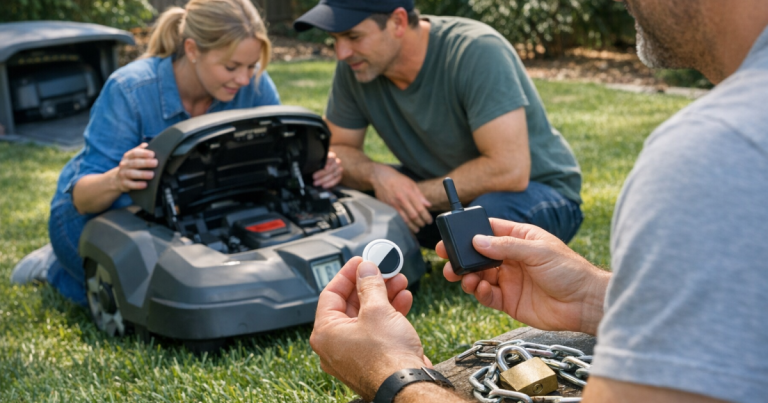
Before you order a 500-foot roll, remember this: robot mower boundary wire has to carry a clean signal around your mowing area, survive outdoor conditions, and work with the mower’s charging station and connectors. The right choice is usually not exotic. It is the correct gauge, the right conductor, and insulation that will not give up after one season in wet soil.
Powered trenching or burying boundary wire near utility lines should be handled by a qualified installer, and the work must comply with local utility-marking requirements and safety standards, including calling 811 before digging.
The short version before you order
You can often use generic boundary wire for a robot lawn mower if it matches the mower manufacturer’s required wire gauge, is rated for outdoor or direct-burial use, uses a suitable copper conductor, and can be joined securely with waterproof connectors. For many homeowner installs, 16 AWG is a common middle-ground size, 14 AWG is a sturdier choice for longer loops or tougher buried runs, and 18 AWG is usually better reserved for short, simple layouts when the mower manual allows it.
Avoid bare indoor wire, ordinary speaker wire, brittle bargain cable, and copper-clad aluminum unless the mower maker specifically allows it. OEM wire is worth paying for when you want the least compatibility guesswork, are installing a long or buried loop, need warranty clarity, or want a kit with matching stakes, couplers, and connectors.
Step 1: start with the mower manual, not the roll label
Boundary-wire systems are not all designed around the same electrical limits. The charging station sends a low-voltage signal through the perimeter loop, and the mower reads that signal to know where the working area begins and ends. Wire that is too thin, too long, corroded, badly spliced, or poorly insulated can make that signal less reliable.
Check the mower manual for three things before buying:
- The approved wire gauge or gauge range.
- The maximum loop length for that model and installation type.
- The recommended connector style for splices, repairs, and station terminals.
Do not assume a wire that works on a small rectangle will behave the same on a 1-acre layout with islands around trees, a long side yard, and a narrow pass behind the garage. Longer loops add resistance. More splices add possible failure points. This is where buying a slightly heavier, better-insulated cable stops feeling fussy and starts feeling sensible.
Step 2: choose the gauge without overthinking it
American Wire Gauge numbers run backward: lower numbers mean thicker wire. A 14 AWG cable is thicker than 16 AWG, and 16 AWG is thicker than 18 AWG. Thicker wire generally has lower resistance and better physical durability, but it can be less flexible and may not fit every connector or terminal cleanly.
- 18 AWG: Consider only for smaller, simple lawns when the mower documentation permits it. It is easier to handle, but less forgiving on long loops or rough installs.
- 16 AWG: A common choice for residential robot mower installs because it balances flexibility, cost, and signal reliability on many average yards.
- 14 AWG: A good upgrade path for larger lawns, longer cable runs, buried installations, or yards where future wire breaks would be especially annoying.
Editorially, I would rather see a homeowner buy slightly heavier outdoor-rated copper wire than save a little on a thin roll that becomes the weak link. Boundary wire is not glamorous. Neither is digging it back up.
Step 3: pick the conductor and insulation
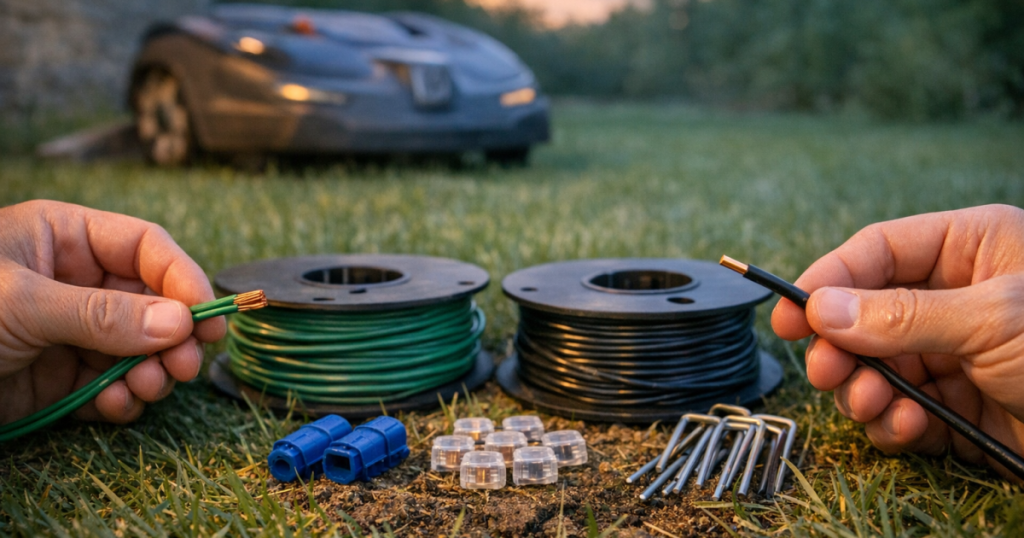
For most robot mower boundary wire buying decisions, copper is the safe default. Solid copper is simple and durable once installed. Stranded copper is more flexible and can be easier to route around curves, but the splice quality matters because each joint needs a clean, protected connection.
Be cautious with copper-clad aluminum, often shortened to CCA. It may look similar in a listing, but aluminum does not behave the same as copper for resistance, corrosion, or connector bite. Unless your mower manufacturer clearly approves it, choose copper over CCA or aluminum. The few dollars saved on questionable wire can disappear quickly if the mower starts throwing loop errors after rain.
Insulation matters as much as the metal inside. Look for outdoor-rated or direct-burial insulation if the wire will sit on the ground, be stapled under turf, or be buried shallowly along the lawn edge. UV resistance is useful for sections that may remain exposed near the charging station, garden edging, or driveway crossings.
Step 4: make the splices as compatible as the cable
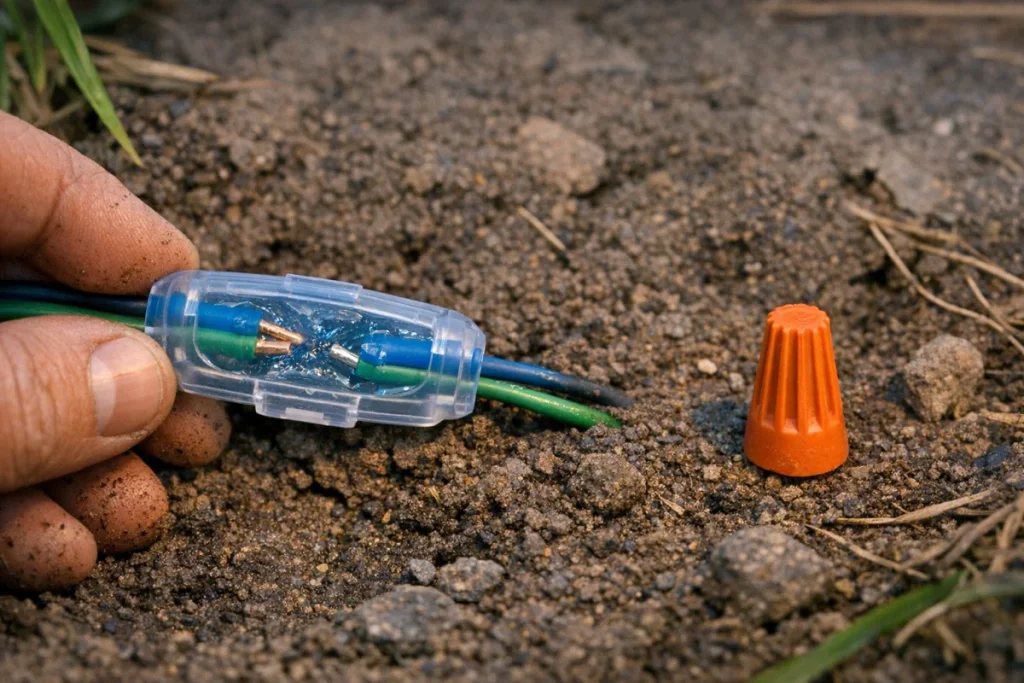
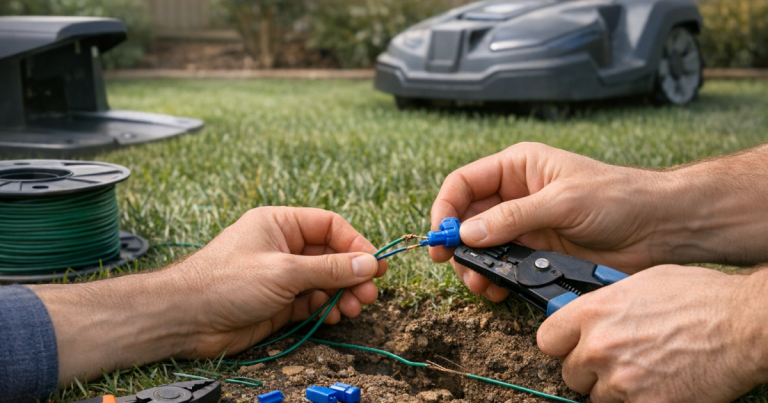
A good roll of wire can still fail if the connectors are wrong. Use waterproof, gel-filled, or manufacturer-approved couplers for underground or wet-area joins. Standard indoor wire nuts are not a good choice for buried lawn cable. Moisture creeps in, corrosion follows, and then the mower acts like the yard has developed a personality disorder.
Match connector size to the wire gauge. A connector made for a thin wire may not clamp a thicker 14 AWG cable correctly. A connector made for heavier wire may not grip a smaller cable tightly enough. If you are mixing OEM and generic wire, confirm that the splice connector is rated for both gauges.
For a traditional wired Automower setup, the Husqvarna Large Installation Kit is useful to compare because it bundles the basic parts homeowners typically need: boundary wire, stakes, couplers, and connectors. Even if you buy a different brand’s supplies, that kind of kit gives you a good checklist for what a complete installation should include.
When OEM wire is worth it
OEM wire is not magic wire. Its main advantage is reduced uncertainty. The mower brand has chosen a wire size, insulation type, and connector pairing intended for its own system. That can be worth the premium if you are installing a new mower, burying the loop, working near the maximum recommended length, or want fewer warranty arguments if troubleshooting is needed later.
Generic wire makes more sense when the manual allows the gauge, the conductor is copper, the insulation is outdoor-rated, and you are comfortable choosing compatible connectors. It is also a reasonable option for short extensions, simple perimeter changes, and repairs where you can match the existing wire closely.
Common buying mistakes
- Buying by acreage alone: A 0.5-acre property with beds, islands, and long detours can use much more wire than a plain rectangle of the same size.
- Ignoring connector fit: Thicker wire is not automatically better if it will not fit the mower’s terminals or splice connectors properly.
- Using indoor cable outdoors: Indoor wire insulation is not meant for wet soil, sun exposure, mower traffic, or freeze-thaw cycles.
- Mixing metals: Copper-to-aluminum joins can be more corrosion-prone. Keep the loop material consistent unless the connector and manufacturer guidance support the mix.
- Skipping a wire map: Take photos and note distances from fixed edges before grass grows over the line. Future you will be less grumpy.
A simple buying checklist
Before you click buy, run through this list:
- Does the gauge match the mower manual?
- Is the conductor copper rather than copper-clad aluminum?
- Is the insulation rated for outdoor or direct-burial use?
- Is the roll long enough for the perimeter, islands, guide wires, and mistakes?
- Do your couplers and station connectors accept the chosen gauge?
- Will you need extra stakes, staples, driveway sleeves, or waterproof splice connectors?
- Are you planning future layout changes, such as adding a side yard or tree island?
If your yard has two disconnected mowing areas, the wire choice is only part of the puzzle. Routing, charging access, and mower transport matter too. For that setup problem, read how to handle two separate lawns with one robot mower before you commit to a cable layout.
After installation: verify before you bury everything permanently
Lay the wire above ground or shallow-staked first if your mower brand allows that approach. Run the mower through edges, corners, gates, tree islands, and narrow passages before burying the full loop. Watch for repeated hesitation, loop errors, or places where the mower keeps leaving the intended mowing area.
If the mower repeatedly stops or traps itself in one area after the wire is installed, the problem may be a corner shape, slope, obstacle, signal issue, or local ground condition rather than the wire roll itself. The troubleshooting steps in fixing a robot mower that gets stuck in the same spot can help separate a layout issue from a parts issue.
Things owners ask before ordering
Can I use dog-fence wire?
Sometimes, but only if it matches the mower’s required gauge, conductor material, insulation rating, and connector needs. Do not buy dog-fence wire just because it is cheap or easy to find. Check the actual specifications.
Is stranded or solid wire better?
Solid copper is simple and stable once installed. Stranded copper is easier to bend and route, especially around curves. Either can work when the mower manufacturer permits it and the splices are waterproof and secure.
Should I buy extra wire?
Yes, within reason. Curves, islands, guide wires, station placement, and mistakes all use more cable than a straight perimeter measurement suggests. Extra matching wire also makes future repairs cleaner.
Does thicker wire improve mowing performance?
Thicker wire does not make the mower cut better. It can help preserve signal quality and physical durability on longer or tougher installs. The mower still needs a sensible layout, clean splices, and setup within the manufacturer’s limits.