Robot mowers are tempting targets because they are expensive, visible, and often parked outside overnight. Choosing between an AirTag vs GPS tracker is less about finding a magic anti-theft gadget and more about deciding how you want to deter a casual grab, locate a missing mower, and document what happened. A small Bluetooth tag can be cheap and easy to hide, while a true GPS tracker is usually better for live location recovery. Neither replaces the mower’s own lock, account controls, docking setup, and common-sense placement.
What to know first
The most useful robot mower security setup is layered. Use the mower’s built-in security features first, add a recovery device second, and make the charging area less attractive to walk-up theft. A tracker is helpful after the mower moves. It does not physically stop someone from lifting it.
A Bluetooth item finder such as Apple AirTag is not a GPS tracker. It estimates location through nearby compatible devices in its finding network. A GPS tracker typically uses satellite positioning and some form of cellular or network connection to report location more directly. That difference is the heart of the decision.
Before adding any accessory, check the mower manual and app settings. Many robot mowers already include some combination of PIN protection, account binding, geofence alerts, alarm sounds, app notifications, or location features. The exact mix varies by brand and model, so do not assume a mower has GPS just because it is app-connected.
Theft tools compared by deterrence and recovery value
For robot mower theft protection, built-in GPS and cellular tracker modules usually offer the strongest recovery value, while PIN locks, account binding, alarms, warning labels, and dock anchoring provide more deterrence than tracking. Bluetooth tags such as AirTag-style devices are easy to hide and inexpensive compared with dedicated tracking hardware, but they depend on nearby network devices and are less reliable for live pursuit.
- Built-in mower GPS: Strong recovery value when the mower includes it and the feature is active. Deterrence depends on whether a thief notices security messaging or hears an alarm.
- Cellular GPS tracker module: Strong recovery value because it is designed to report location away from home. It may require charging, placement planning, and possibly an ongoing service arrangement.
- Bluetooth tag: Moderate recovery value in neighborhoods where nearby phones or compatible devices can help update location. Low physical deterrence unless paired with labels or visible security cues.
- Account binding: Good deterrence against resale if the mower is locked to an owner account. Recovery value is limited unless paired with location reporting.
- PIN lock: Good deterrence against casual reuse. It does not tell you where the mower went.
- Alarm sound: Useful for a lift-and-run theft attempt near the house. Less useful if nobody is close enough to hear it.
- Warning decals: Cheap deterrence. They work best when the mower truly has tracking or account locks, not as decoration.
- Dock anchoring and placement: Good deterrence at the most predictable theft point: the charging station. It adds friction but does not recover a stolen mower by itself.
Step 1: Turn on the mower’s own security before buying add-ons
Start with the controls you already paid for. Open the mower app and check whether the mower has a PIN, alarm setting, account lock, theft alert, geofence, or location screen. If the mower was bought used, make sure the previous owner has removed it from their account and that you can fully manage it from yours.
This step sounds obvious, but it is where many security plans quietly fail. A hidden tag is useful, but a mower that still has a default PIN or a loose owner account is doing the thief a favor. If app pairing or wireless setup is already flaky, fix that before relying on notifications; our guide to robot mower Wi-Fi and Bluetooth connection problems walks through the basic checks.
Step 2: Decide whether you need live tracking or a recovery breadcrumb
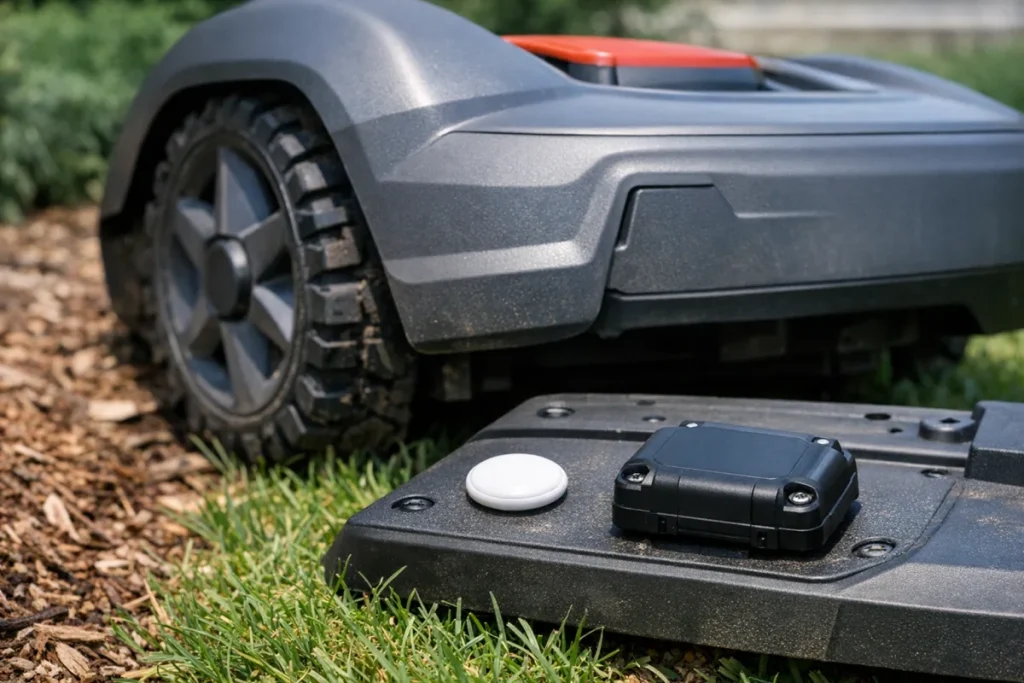
Choose a Bluetooth tag if you want a low-friction recovery aid that is small enough to hide and simple enough to forget about until something goes wrong. An AirTag-style device can make sense for suburban yards where the mower is likely to pass near phones, houses, sidewalks, or parked cars after it is taken.
Choose a GPS tracker if you want more direct location reporting after the mower leaves your property. This is the better fit for higher-value mowers, isolated properties, second homes, open front lawns, or any setup where the mower is visible from the street. A GPS tracker is also the more serious option if your mower lacks built-in location features.
The trade-off is ownership friction. GPS devices may need charging, careful mounting, signal access, and service management. Bluetooth tags are easier, but their location updates depend on other devices passing nearby. That is not a flaw; it is just how the technology works. A tag is a breadcrumb, not a dispatch center.
Step 3: Hide the tracker without hurting mower operation
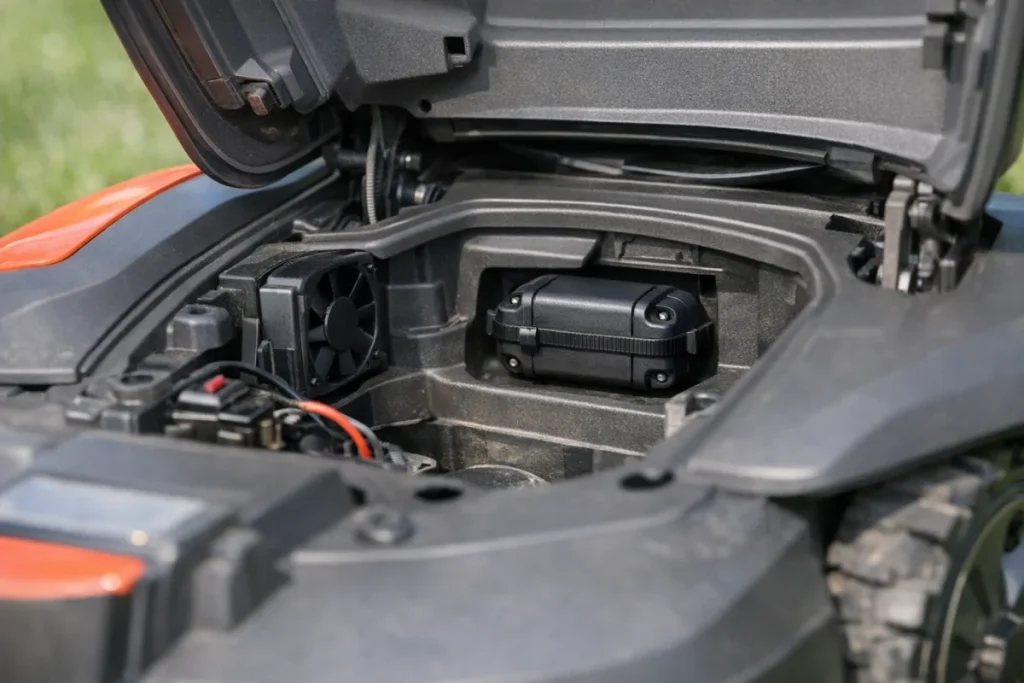
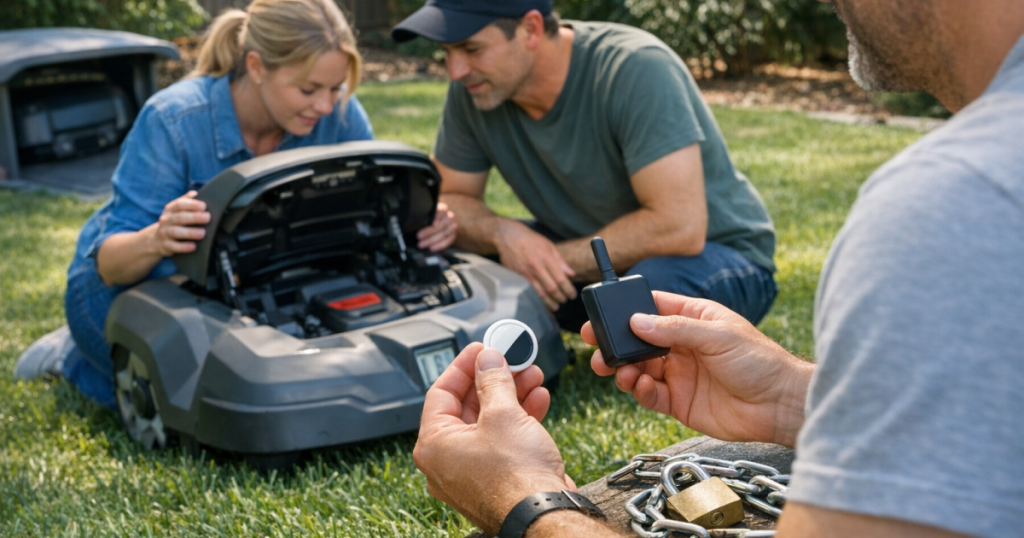
Keep the tracker away from blades, wheels, lift sensors, charging contacts, removable service panels, and any area that traps wet grass. Do not tape a device where it can drop into the cutting deck. Use a secure enclosure or mounting spot that stays clear of moving parts and routine cleaning.
A hidden location is better than a decorative one. Under a cosmetic cover, inside a non-metallic cavity, or beneath an accessory panel may be more sensible than the top shell, where the first curious hand will look. Avoid burying the tracker inside dense metal areas because that can weaken wireless performance. If the device has a speaker, remember that some item finders may make sound during setup or anti-stalking alerts, so the hiding place should not be your only security layer.
If you are comparing mower platforms before buying, look at the whole system rather than the tracker alone. A wire-free mower, an all-wheel-drive mower, and a boundary-wire mower may all need different security thinking because their docks, routes, and visible operating patterns differ. For a practical example of how platform choices affect ownership trade-offs, see this comparison of the Landroid Vision Cloud WR340 and Husqvarna Automower® 435 iQ AWD.
Step 4: Make the charging area less inviting
Most thieves do not need to understand your mowing map. They just need to see an unattended machine sitting on a dock. That makes the charging area the first place to improve.
- Place the dock where it is not the most visible object from the street.
- Use the mower’s alarm and PIN features so lifting it creates friction immediately.
- Consider anchoring the charging station according to the manufacturer’s instructions.
- Keep the mower registered to your account and record the serial number.
- Add a clear security label if the mower has tracking or account locking enabled.
- Use normal yard lighting and camera coverage where you already have it; do not build an awkward fortress around the mower.
If you move a wire-free mower’s charging station to improve security, remember that navigation gear still needs a reliable setup. RTK-based systems in particular depend on antenna placement and clear signal conditions, so review RTK antenna placement for robot mower mapping before relocating hardware purely for concealment.
Step 5: Know what to do if the mower disappears
Do not chase a live location or confront someone over a mower. Save screenshots, note the time, check your mower app, check your tag or tracker app, and report the theft to local law enforcement. If the mower platform supports account locking or theft reporting, follow the manufacturer’s process promptly.
For Bluetooth tags such as Samsung Galaxy SmartTag2 or Tile Pro, use the tag maker’s recovery workflow and keep location history notes where available. For GPS trackers, preserve the reported route and current location information. Give police the serial number, photos, and any app-based evidence rather than trying to retrieve the mower yourself.
When the AirTag vs GPS tracker choice is obvious
Pick the Bluetooth tag route when the mower is modestly priced, the yard is in a busy neighborhood, and you mainly want a hidden recovery aid with minimal upkeep. It is a sensible add-on, not a full security system.
Pick a GPS tracker or mower-specific tracking module when the mower is expensive, the lawn is open to the street, the property is rural, or recovery speed is more important than convenience. Some brands sell mower-specific tracking accessories, including Worx Find My Landroid and Vision Cloud tracker modules, but compatibility can be model-specific. Verify fit before buying rather than assuming one module works across every mower in the brand family.
If the mower already has strong built-in location tracking, spend your next effort on deterrence: PIN, account lock, dock placement, anchoring, and registration. Doubling up on trackers can be useful in a high-risk setup, but it can also create extra battery checks and app clutter. Security should make ownership calmer, not turn mowing into a part-time investigation hobby.
Key questions answered
Can an AirTag stop a robot mower from being stolen?
No. An AirTag-style device can help with recovery, but it does not lock the mower, sound a mower alarm, or physically prevent removal. Treat it as one layer alongside the mower’s own security settings.
Is a GPS tracker better than a Bluetooth tag?
For active recovery, usually yes. A GPS tracker is designed to report location more directly after the mower leaves home. A Bluetooth tag is easier to hide and maintain, but its updates depend on nearby compatible devices.
Should I put a tracker inside the mower?
Only if the location is dry, secure, away from moving parts, and does not interfere with charging, sensors, or maintenance access. If opening the mower would affect service access or weather sealing, use a less invasive mounting point.
What stands out
The best robot mower theft setup is not one gadget. It is a stack: built-in security enabled, ownership account controlled, serial number recorded, dock made less obvious, and a tracker chosen for the property risk. Bluetooth tags are the low-friction option. GPS trackers are the stronger recovery tool. For many homeowners, the smartest answer is a hidden tag plus disciplined mower settings; for open, high-value, or remote yards, a dedicated GPS solution is easier to justify.