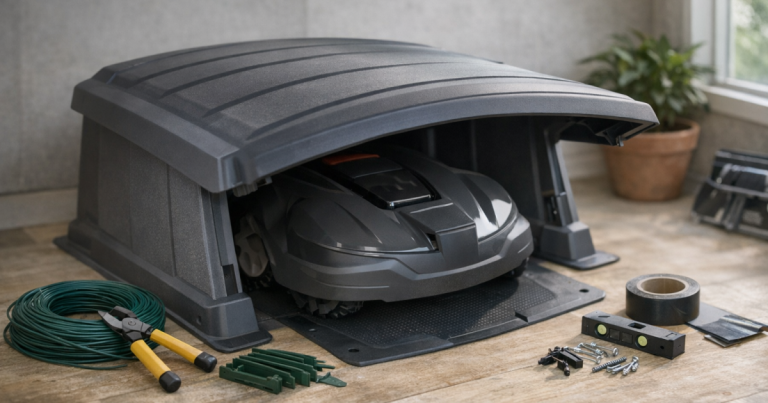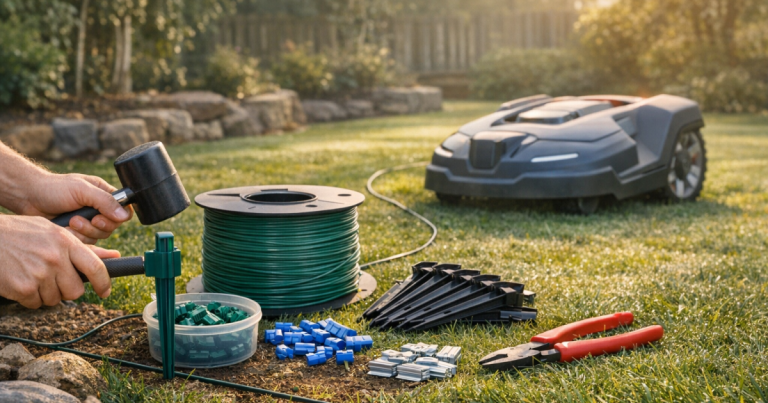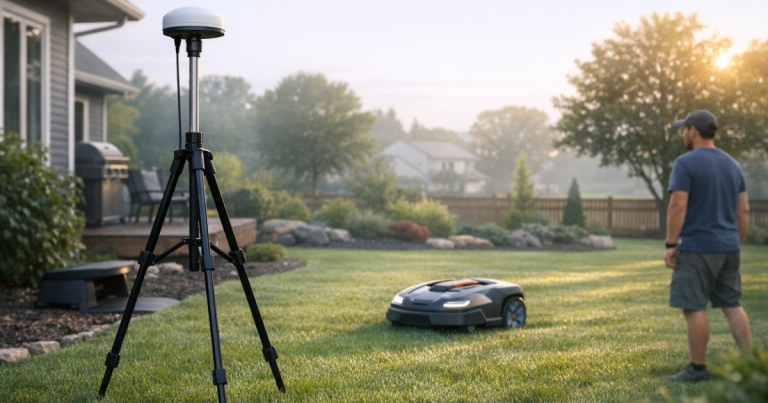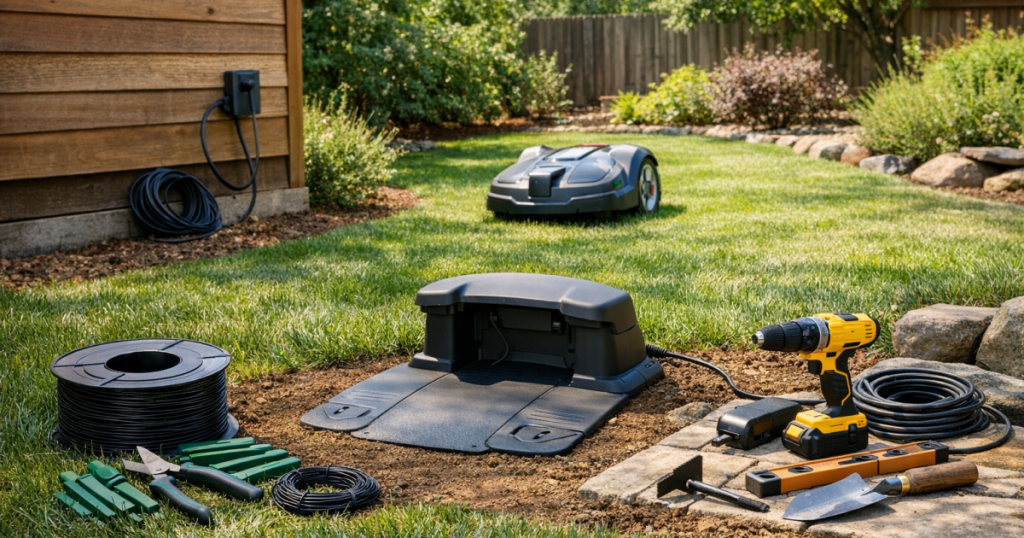
A robot mower can only be as dependable as the place it parks. A robot mower charging station needs a flat, stable, easy-to-reach location with enough open space for clean docking, a safe outdoor power source, and a route that does not force the mower into awkward turns before it has even started cutting.
Installing a new outdoor outlet, modifying exterior wiring, or routing permanent power through structures should be handled by a qualified electrician in compliance with local electrical codes and outdoor safety requirements.
The goal is simple: make docking boring. If the mower has to climb, skid, reverse around patio furniture, or hunt for signal every time it comes home, the base location is working against you.
In brief
Choose a charging station spot that gives the mower a straight, predictable approach, sits on level and well-drained ground, stays close to a proper outdoor power source, and leaves the required clearance on all sides. For boundary-wire mowers, the dock also needs clean wire routing. For wire-free mowers, it needs reliable positioning, mapping, and departure space.
- Pick firm, level ground rather than a slope, rut, mulch bed, or loose gravel.
- Leave the clearance specified in the mower manual in front of and beside the base.
- Use a properly installed outdoor-rated, GFCI-protected power source.
- Avoid sprinkler spray, low spots that puddle, and tight corners.
- Keep the mower’s first few feet of travel simple: no gate posts, edging, roots, hoses, or toys.
- For wire-free systems, avoid spots boxed in by walls, dense tree cover, metal structures, or other signal-blocking obstacles when the mower relies on satellite or RTK positioning.
Start with the mower’s path home
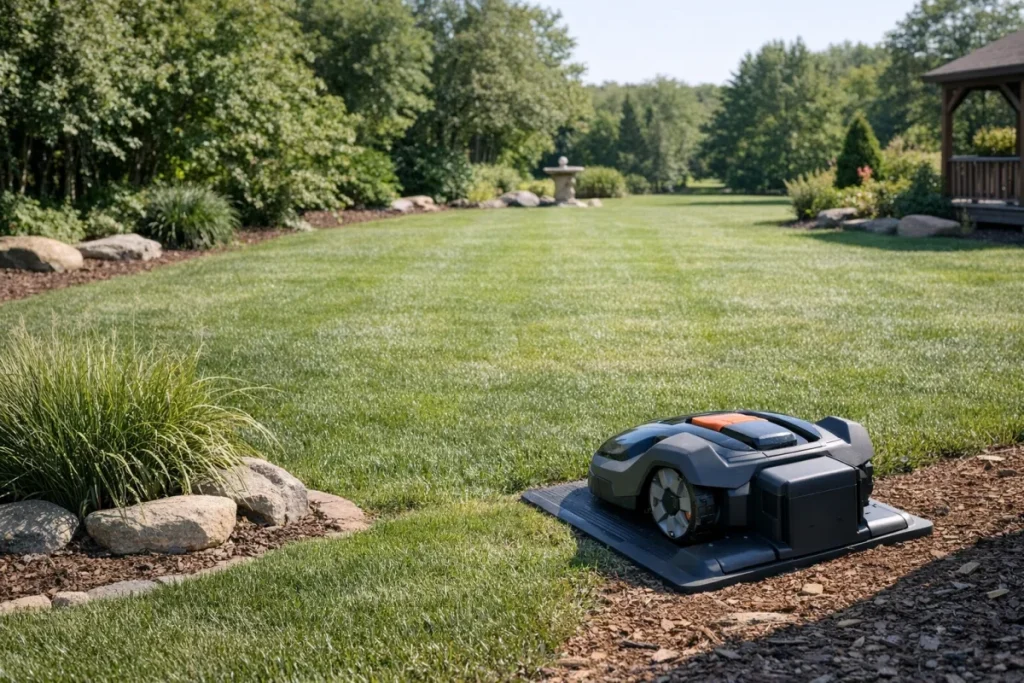
Most docking trouble is really approach trouble. The mower is trying to line itself up, find the base, and settle onto the charging contacts without being pushed sideways by a slope, bump, or awkward turn. A neat hidden corner beside the shed may look tidy to you, but to the mower it can feel like parallel parking a shopping cart.
Stand where the base would sit and look outward. The mower should be able to approach from a clear section of lawn, not from a narrow choke point between a fence and a flower bed. If the model uses a guide wire, the guide route should lead home smoothly. If it uses wire-free mapping, the mower should be able to leave the dock, orient itself, and enter the mowing area without immediately meeting a wall, step, or dense obstacle cluster.
Check the ground before you check the outlet
Power matters, but the surface matters first. The base should sit flat, with the mower level when it docks. Avoid placing it at the bottom of a dip, on a bank, or where one side of the station sits higher than the other. Even a small twist in the base can make the mower dock at an angle or miss the charging contacts.
Good surface choices include a flat section of turf, a stable paver area approved by the mower’s instructions, or a compacted, level pad that does not shift under the mower’s wheels. Loose gravel, soft mulch, exposed roots, and thin soil near a downspout are asking for slow, irritating problems later.
Place power close, but do not improvise
The charging station needs reliable outdoor power without a cable stretched across walkways, mower paths, or areas where edging tools and string trimmers will find it. Use the manufacturer’s supplied power setup as directed, and avoid treating a long extension cord as a permanent installation.
In a US yard, the cleanest setup is usually near an outdoor outlet that is properly rated and protected for exterior use. If the best lawn location is nowhere near safe power, solve the electrical side properly rather than compromising the mower’s docking path. A base in a bad location will annoy you every week; a proper outlet is usually a one-time fix.
Allow space for wires, mapping, and future access
Boundary-wire mowers need room to route boundary and guide wires without sharp, messy turns right at the base. Leave enough slack and access for adjustments, but keep wires secured according to the mower instructions so they do not lift, snag, or get cut during yard work.
Hybrid and wire-free systems shift the emphasis. With some newer models, the charging area has to support mapping accuracy as much as physical docking. The Husqvarna Automower® 420 iQ review is a useful example of why boundary approach matters: a mower that can mix virtual and physical boundary choices still benefits from a sensible, uncluttered home base.
For satellite-assisted systems, do not tuck the station under a metal awning, tight against a tall wall, or beneath dense canopy without checking the manufacturer’s positioning guidance. For camera- or LiDAR-assisted mowers, the departure lane should be visually open enough for the mower to start confidently and avoid immediate confusion.
Think about weather, shade, and yard traffic
A little shade can help reduce sun exposure on the mower and base, but do not trade shade for poor signal, poor drainage, or bad access. Under a light overhang may work for some setups; under heavy tree cover may be a problem for others. The right answer depends on the mower’s navigation method.
Keep the base away from sprinkler heads, roof runoff, and places where leaves pile up. Also think like the person who still has to live in the yard. Do not put the station where kids cut across the lawn, where dogs like to dig, or where you need to roll trash cans, bikes, or a wheelbarrow. The mower is automated; the obstacle course around it is not.
Common placement mistakes
- Choosing the most hidden spot instead of the most reliable docking path.
- Putting the base on a side slope because it looks almost level.
- Forcing the mower to turn sharply within the first few feet after leaving the station.
- Placing the base where sprinkler spray repeatedly hits the dock and contacts.
- Running power across a walkway or mowing route.
- Ignoring the manual’s clearance requirements because the mower “just about fits.”
- Installing the base before checking how gates, fences, and narrow side yards affect travel.
Two easy-to-miss mistakes show up only after the mower has lived there for a while. One is letting the grass grow tight around the station until the mower has to push through a little collar of thick turf before it can dock. The other is placing the base where normal yard items slowly migrate into the approach lane: a hose reel, patio chair, planter, dog bowl, or seasonal decoration.
Watch for “almost works” locations, too. If the mower docks cleanly when the lawn is dry but slips after rain, the spot is not as level or firm as it seemed. If it finds the station during midday but struggles near dusk, shadows, parked vehicles, or changing signal conditions may be affecting navigation. These are not random quirks; they are clues that the location is marginal.
A good rule is to leave the base area a little more boring than the rest of the yard. Avoid decorative edging, loose stones, low solar lights, and narrow planting beds right beside the dock. They may look harmless, but they reduce the mower’s margin for error when it turns, aligns, or backs out for another attempt.
Test the spot before you commit
Before staking wires permanently or finishing a base pad, run a controlled test. Let the mower leave, mow briefly, and return to charge several times from different areas of the lawn. Watch for hesitation, repeated reversing, missed docking, wheel spin, or crooked parking.
Do the same after a major seasonal restart. Grass height, wet soil, debris, and battery condition can all make the first few runs less predictable, so the checklist in How to Restart Your Robot Mower After Winter Storage is worth pairing with any dock-location check.
When the best spot is not the prettiest spot
The most reliable location may be more visible than you hoped. That is usually the better trade-off. A station that docks cleanly, stays dry, and remains easy to inspect will cause less frustration than a perfectly hidden one that traps the mower behind a shrub twice a week.
A robot mower charging station that passes the level-ground, clearance, power, drainage, and approach-path checks is usually in the right place. After that, keep the area tidy and inspect the dock contacts, wires, and surrounding grass as part of your normal ownership routine; the robot lawn mower maintenance checklist gives you a simple schedule for those follow-up tasks.
Common questions
Can the charging station go on a patio or pavers?
Sometimes, but only if the mower manual allows it and the approach from the lawn is smooth. The mower should not have to climb a lip, cross loose joints, or dock with one wheel higher than the other.
Should the dock be hidden behind the house?
Only if the mower has a clean route to and from the mowing area. A hidden dock that creates signal issues, tight turns, or poor drainage is not a good hiding place; it is a troubleshooting appointment waiting to happen.
How much clearance does a charging station need?
Use the clearance stated in the manufacturer’s manual for your model. If you are choosing between two spots, pick the one with more open space in front and to the sides, not the one that barely fits.