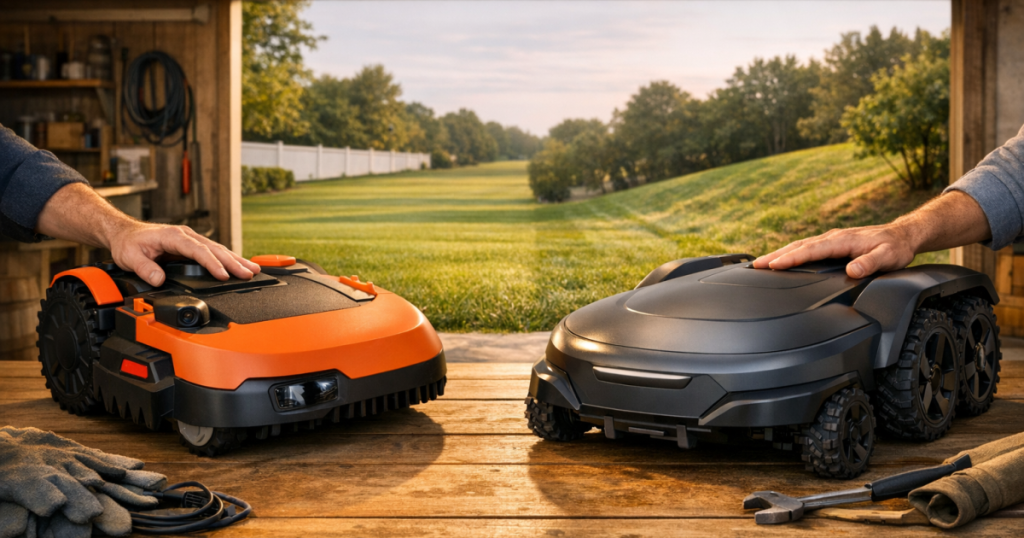
For a homeowner trying to automate a larger lawn, WR340 vs Dreame A3 AWD Pro is not just a brand choice. It is a choice between a 2-wheel-drive mower built around RTK Cloud with Vision AI/V-SLAM and an AWD mower built around onboard 3D vision without RTK or boundary wires. Both are current US-market robotic mowers, but the numbers point them at different yards.
Quick Buying Links
Worx Landroid Vision Cloud 1 Acre (WR340)
flatter 1-acre lawns where RTK Cloud navigation and stated lifetime cloud service are priorities
Dreame A3 AWD Pro Robot Lawn Mower, A3 AWD Pro 5000 - 1.20 Acre
Better for larger, steeper, uneven lawns needing AWD, wider cutting width, and no-RTK vision navigation
The cleanest split is simple: the Worx Landroid Vision Cloud 1 Acre WR340 is the narrower, 1-acre, 2-wheel-drive option; the Dreame A3 AWD Pro 5000 is the wider-cutting, AWD option rated for 1.20 acres and much steeper slopes. If your yard is mostly open and moderate, the Worx can make sense. If your lawn is uneven, sloped, or simply bigger, the Dreame has the stronger spec sheet.
Fast read: where each mower stands out
- Choose the Worx Landroid Vision Cloud 1 Acre WR340 if your main priority is a current US wire-free mower for a lawn rated up to 1 acre, and your slopes stay within its stated 30% grade limit.
- Choose the Dreame A3 AWD Pro 5000 if you want the larger stated coverage, AWD drive system, wider mowing width, and the much higher manufacturer-stated slope capability.
- The biggest navigation difference: Worx uses RTK Cloud with Vision AI and V-SLAM, while Dreame uses OmniSense 3.0 3D Vision with no RTK and no boundary wires.
- The biggest yard-fit difference: Dreame is rated for 1.20 acres and 80% slopes; Worx is rated for 1 acre and 30% slopes.
Those are manufacturer-stated figures, not a promise that every complex acre will be completed with equal ease. Trees, tight passages, fences, narrow side yards, surface changes, and station placement can still affect ownership. If you are still choosing the physical docking area, this guide to choosing the best robot mower charging station spot is worth reading before you commit to a layout.
The two mowers in plain English
Worx Landroid Vision Cloud 1 Acre WR340
The Worx Landroid Vision Cloud 1 Acre WR340 is listed by Worx as a Landroid Vision Cloud 1 Acre robotic lawn mower, item WR340. Its official US specification set gives it a recommended lawn size of 1 acre, RTK Cloud with Vision AI and V-SLAM navigation, 2-wheel drive, a 30% maximum slope rating, an 8.7-inch cutting width, and a cutting height range from 1.57 to 3.54 inches.
It also lists Bluetooth, Wi-Fi, and 4G connectivity, along with a 20 V 5 Ah Li-ion PowerShare battery. With battery installed, the listed weight is 30.9 lb. This is the more compact-cutting option of the two, and its 2-wheel-drive layout puts a clear ceiling on the kind of terrain it is officially aimed at.
Dreame A3 AWD Pro 5000 Robot Lawn Mower
The Dreame A3 AWD Pro 5000 Robot Lawn Mower is the A3 AWD Pro 5000 – 1.20 Acre variant listed on Dreame Yard Care’s US product page. Dreame states a working area capacity of 1.20 acres, OmniSense 3.0 3D Vision mapping and navigation, no RTK, and no boundary wires.
Its official specification set also lists 360° 3D LiDAR plus binocular AI vision with 300+ obstacle detection, AWD plus hub motor drive, two universal wheels and two off-road wheels, an 80% maximum slope performance rating, a 15.8-inch mowing width, and a cutting height range of about 1.2 to 3.9 inches. The A3 AWD Pro 5000 variant lists a 10 Ah battery.
Side-by-side comparison
- Product type: both are robotic lawn mowers for the US market.
- Rated or recommended coverage: Worx WR340 is recommended for 1 acre; Dreame A3 AWD Pro 5000 is rated for 1.20 acres.
- Navigation approach: Worx uses RTK Cloud with Vision AI and V-SLAM; Dreame uses OmniSense 3.0 3D Vision with no RTK and no wires.
- Drive system: Worx is 2-wheel drive; Dreame is AWD plus hub motor.
- Maximum slope: Worx is rated for 30% slopes, equal to 17°; Dreame is rated for 80% slopes, equal to 38.7°.
- Cutting width: Worx cuts 8.7 inches wide; Dreame lists a 15.8-inch mowing width.
- Cutting height: Worx adjusts from 1.57 to 3.54 inches; Dreame adjusts from about 1.2 to 3.9 inches.
- Cellular connectivity and service: Worx lists 4G and states lifetime free RTK Cloud service; Dreame lists 4G and states 3 years of complimentary 4G/link service.
Coverage: 1 acre versus 1.20 acres
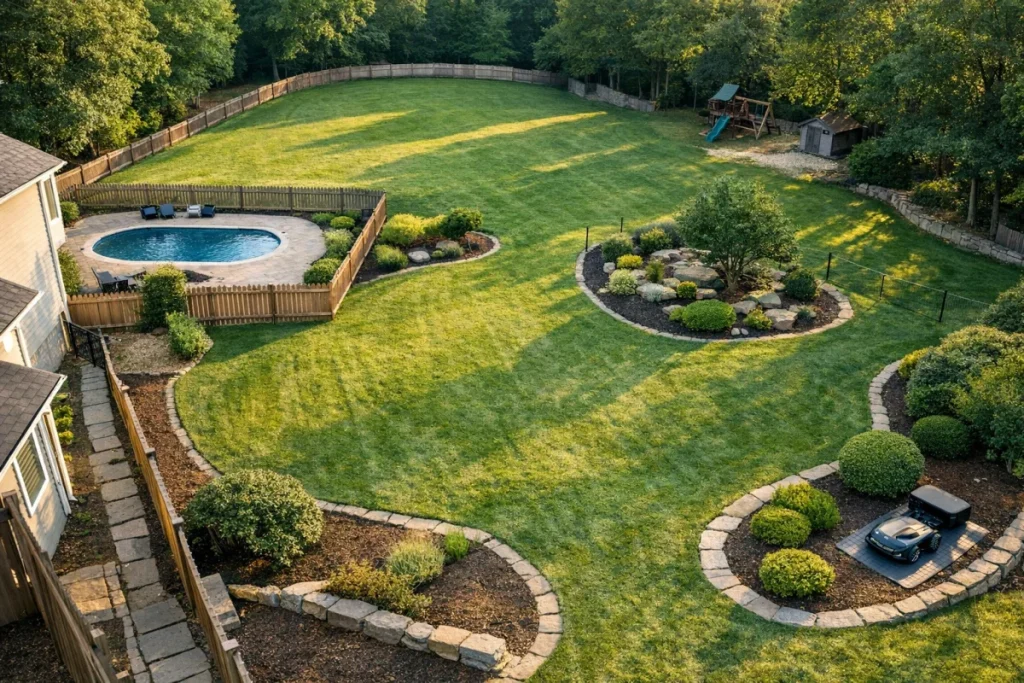
On paper, Dreame has the larger stated working area. The A3 AWD Pro 5000 is rated for 1.20 acres, while the Worx WR340 is recommended for 1 acre. That 0.20-acre difference is meaningful if your mowable grass already pushes the top end of a 1-acre class mower, or if your lawn is divided into areas that create more travel and turning.
The honest way to read coverage ratings is as a capacity guide, not a stopwatch. A neat open rectangle is much easier for a robot mower than a yard with a fenced back lawn, a narrow side passage, several islands, sloped transitions, and long travel routes back to the charger. The Dreame’s extra stated coverage gives it more headroom for large properties, but it is still a manufacturer rating, not a universal completion guarantee.
For a simple suburban acre where the grass area is genuinely around the WR340’s stated recommendation, the Worx remains in the conversation. For a property above 1 acre of mowable grass, the Dreame is the better match on verified coverage alone.
Navigation: RTK Cloud plus vision versus onboard 3D vision
This is one of the most important practical differences because setup friction is often where wire-free robot mower ownership feels either clever or irritating. The Worx WR340 uses RTK Cloud with Vision AI and V-SLAM. The Dreame A3 AWD Pro 5000 uses OmniSense 3.0 3D Vision and is stated to use no RTK and no boundary wires.
Editorially, that makes the Worx the more RTK-centered choice and the Dreame the more self-contained vision-centered choice. If you already understand RTK-based robot mower systems, Worx’s approach may feel familiar. If you specifically want to avoid RTK hardware as part of the mapping stack, Dreame’s no-RTK statement is the cleaner fit.
RTK systems can work very well, but they ask the yard to cooperate with signal reception and reference positioning. For background on why RTK placement can become a make-or-break setup detail on some lawns, read this guide to placing an RTK antenna for reliable robot mower mapping. That does not turn every RTK mower into a difficult install; it simply explains why houses, trees, and line-of-sight conditions deserve attention before you buy into an RTK-centered setup.
The Dreame’s published navigation claim is different: no RTK and no wires, with OmniSense 3.0 3D Vision. Its product page also lists 360° 3D LiDAR plus binocular AI vision with 300+ obstacle detection. Because the evidence set does not give an equivalent obstacle-detection specification for the Worx, this comparison should not turn that into a direct obstacle-avoidance win. What we can say is narrower and more useful: Dreame gives more published detail about its onboard perception hardware, while Worx’s verified navigation stack is RTK Cloud plus Vision AI/V-SLAM.
Drive and slope capability: this is the big separator
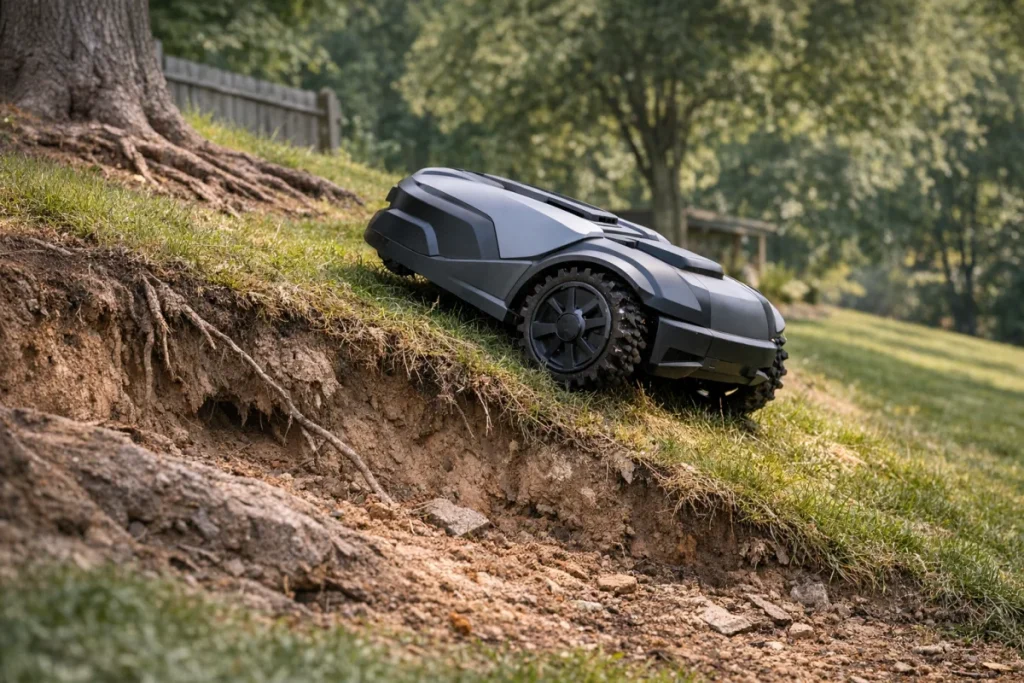
If your lawn is flat to gently rolling, drive system may not dominate the decision. If your yard has banks, uneven transitions, or steeper grade changes, it moves right to the top of the list.
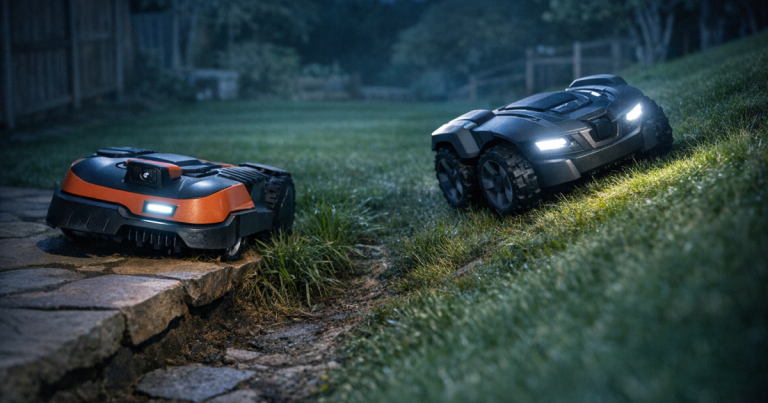
The Worx WR340 is 2-wheel drive and rated for a maximum slope of 30%, or 17°. That is a clear specification boundary. For lawns that stay within that grade, the mower fits its stated terrain envelope. For hills beyond that, the Dreame is the stronger candidate because its AWD plus hub motor drive system is paired with an 80% maximum slope performance rating, or 38.7°.
That does not mean every steep yard is effortless. Robot mowers still have to deal with traction, grass condition, approach angle, edges, and transitions. But within the supplied facts, there is no close call here: Dreame has both the more capable drive system and the much higher stated slope rating.
For a homeowner with a hilly back lawn, a sloped front bank, or uneven routes between zones, this is probably the deciding category. For a fairly level 1-acre lawn, the slope advantage may be less important than navigation preference, cutting height, or service terms.
Cutting width and height: speed potential versus grass fit
The Dreame A3 AWD Pro 5000 has a substantially wider mowing width at 15.8 inches, compared with the Worx WR340’s 8.7-inch cutting width. A wider mowing path can reduce the number of passes needed across an open lawn, though real-world schedules still depend on layout, grass growth, docking routes, and how the mower manages zones.
For large open areas, Dreame’s wider deck is a genuine spec advantage. For tighter lawns with more edges, trees, play areas, or garden features, a narrower cutting width is not automatically a flaw; it can be easier to picture in compact routes. Still, this comparison is about two mowers aimed at larger lawns, and the Dreame’s wider mowing width lines up better with that job.
Cutting height is closer. Worx lists 1.57 to 3.54 inches. Dreame lists about 1.2 to 3.9 inches. Dreame reaches lower and higher on the published range, while Worx sits within a slightly narrower band. If your lawn needs a taller regular cut, the Dreame’s upper end gives it the edge from the verified numbers. If you are comparing robot mowers for warm-season turf that benefits from higher mowing, this guide to robot mowers that cut high enough for St. Augustine grass is a useful next step.
The usual robot mower note applies: daily or frequent trimming is different from occasional heavy mowing. These machines are designed around keeping grass maintained, not rescuing an overgrown lawn after two weeks of neglect. The specs here help you choose fit; they do not replace a sensible mowing schedule.
Connectivity and service terms
The Worx WR340 lists Bluetooth, Wi-Fi, and 4G connectivity. The Dreame comparison evidence lists 4G and app-based mowing management. For cellular-linked features, the difference in stated service terms is notable: Worx states lifetime free RTK Cloud service, while Dreame states 3 years of complimentary 4G/link service.
That is not a reason to dismiss the Dreame, but it is a real ownership difference. If you value a published lifetime cloud-service statement tied to the mower’s RTK Cloud system, Worx has the clearer advantage from the supplied facts. If the bigger yard rating, AWD, wider cut, and no-RTK navigation approach are more important to your lawn, Dreame’s stated 3-year complimentary service may not outweigh those hardware-side advantages.
Current sale prices and warranty length are not used here. The supplied evidence notes inconsistent official price snippets for Worx and conflicting warranty badge text on Dreame’s product page, so those categories are intentionally left out. This comparison sticks to the specifications that are clean enough to compare.
Real-yard scenarios: which mower fits which lawn?
A mostly level 1-acre lawn
The Worx WR340 is easier to justify when the mowable area is around 1 acre, the terrain stays within its 30% slope rating, and you are comfortable with its RTK Cloud plus Vision AI/V-SLAM approach. It gives you a wire-free mower with Bluetooth, Wi-Fi, and 4G listed, plus the stated lifetime free RTK Cloud service.
A larger lawn with slopes or rougher transitions
The Dreame A3 AWD Pro 5000 is the stronger match when the lawn is closer to 1.20 acres, has steeper sections, or would benefit from AWD. Its 80% slope rating and AWD plus hub motor drive system are the clearest advantages in the whole comparison. The wider 15.8-inch mowing width also makes more sense on bigger open grass areas.
A yard where you want to avoid RTK in the navigation stack
Dreame is the cleaner fit if no RTK is a priority. Its official navigation description states OmniSense 3.0 3D Vision with no RTK and no wires. Worx is not the right pick for that specific preference because its verified navigation approach is RTK Cloud with Vision AI and V-SLAM.
A yard where published cellular service terms carry extra weight
Worx has the more reassuring statement here because the WR340 evidence includes lifetime free RTK Cloud service. Dreame states 3 years of complimentary 4G/link service. If you are comparing long-term service wording rather than terrain capability, that tilts the decision toward Worx.
Questions homeowners usually ask before choosing
Is the Dreame A3 AWD Pro 5000 automatically better because it has AWD?
No. AWD is a major advantage for slopes and uneven yards, and Dreame’s published 80% slope rating is far above the Worx WR340’s 30% rating. But if your lawn is level, around 1 acre, and you prefer the Worx navigation and service statement, AWD may not be the deciding factor.
Does the Worx WR340 need boundary wire?
The supplied comparison evidence places the WR340 in the current wire-free mower comparison and lists RTK Cloud with Vision AI and V-SLAM as its navigation system. It is not being compared here as a boundary-wire model.
Which mower has the wider cut?
The Dreame A3 AWD Pro 5000 has the wider stated mowing width at 15.8 inches. The Worx WR340 lists an 8.7-inch cutting width. On large open lawns, the Dreame’s wider width is the stronger specification.
Which one cuts higher?
Dreame lists a cutting height range up to about 3.9 inches, while Worx lists up to 3.54 inches. From the verified figures, Dreame offers the higher maximum cutting height.
Which one should you choose?
Pick the Worx Landroid Vision Cloud 1 Acre WR340 if your lawn is close to 1 acre, your slopes stay within the 30% rating, and you like the combination of RTK Cloud, Vision AI, V-SLAM, Bluetooth, Wi-Fi, 4G, and a stated lifetime free RTK Cloud service. It is the more sensible option for a moderate large lawn where the terrain does not demand AWD.
Pick the Dreame A3 AWD Pro 5000 if your yard is larger, steeper, or more uneven. Its 1.20-acre capacity, AWD plus hub motor drive, 80% slope rating, 15.8-inch mowing width, and no-RTK/no-wire navigation approach give it the stronger specification set for demanding residential lawns. It is the clear pick when terrain and cutting capacity are the main problems you are trying to solve.
The practical recommendation is straightforward: Worx is the better fit for a flatter 1-acre lawn where RTK Cloud service wording is a plus; Dreame is the better fit for larger or hillier yards where AWD, slope rating, cutting width, and onboard 3D vision carry more weight. Robot mowers are at their best when the mower matches the yard instead of asking the yard to behave like a brochure. This pair makes that trade-off unusually visible.
Quick Buying Links
Worx Landroid Vision Cloud 1 Acre (WR340)
flatter 1-acre lawns where RTK Cloud navigation and stated lifetime cloud service are priorities
Dreame A3 AWD Pro Robot Lawn Mower, A3 AWD Pro 5000 - 1.20 Acre
Better for larger, steeper, uneven lawns needing AWD, wider cutting width, and no-RTK vision navigation