Large lawns can make a robot mower feel brilliant or frustrating. The best robot lawn mowers for large yards are not simply the ones with the biggest acre rating; they are the ones whose navigation, traction, boundary method, and charging plan match your actual mowing area. If your yard has dips, roots, tree shade, side slopes, gates, or long runs around beds, the right choice starts with mapping the lawn as it really behaves.
The short version
For a large or uneven US lawn, choose a robot mower by working through four checks in order: usable mowing area, terrain, navigation method, and maintenance access. Acre coverage matters, but it is only one part of the fit. A model that looks oversized on paper can still struggle if the yard has poor signal zones, steep transitions, deep ruts, narrow passages, or areas separated by fencing.
For open acre-plus lawns, large-property wire-free models are usually the first place to look. For rougher ground, all-wheel-drive and slope-focused designs deserve priority. For tree-heavy or shaded yards, LiDAR-based or hybrid systems may be easier to live with than relying on satellite positioning alone. For complex edges, beds, and gate-to-gate mowing, setup quality often matters as much as the mower itself.
Step 1: Measure the yard the mower will actually cut
Do not shop from lot size alone. A 1.5-acre property may only have 0.7 acre of mowable grass once you subtract the house, driveway, patio, pool, woods, gardens, and hardscape. On the other hand, a one-acre corner lot with open grass on three sides can be more demanding than a bigger property with compact lawn zones.
Walk the yard and sketch the real mowing layout. Mark:
- The front, back, and side lawn areas as separate zones.
- Long narrow corridors beside the house, fence, or driveway.
- Sloped sections, rutted areas, exposed roots, drainage swales, and bumpy transitions.
- Tree canopies, tall houses, sheds, and fences that could affect satellite-based navigation.
- Places where a mower would need to cross pavement, pass through a gate, or return to a charger.
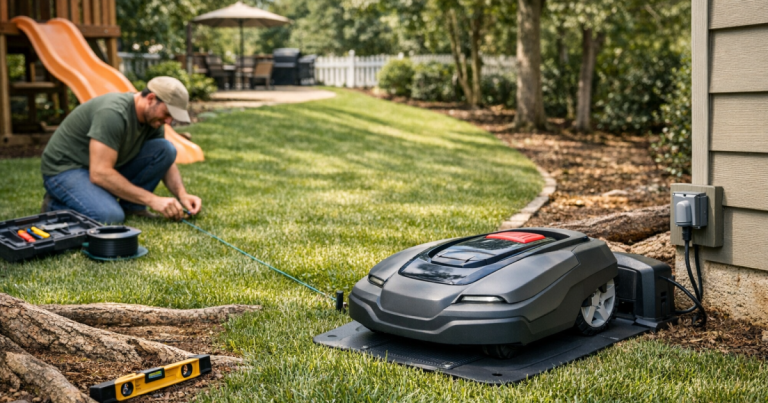
This step prevents the most common large-yard mistake: buying based on a headline acreage number without checking whether the machine can move reliably through the real layout. If you want a deeper setup walkthrough before committing, start with how to set up a robot mower in a US yard without guesswork.
Step 2: Match the navigation system to the property
Large lawns put pressure on navigation. The mower has farther to travel, more chances to lose orientation, and more edges to manage. The right system depends on what interrupts the mower’s view of the yard.
Wire-free RTK and satellite-guided mowing
Wire-free systems are appealing for large open lawns because they can avoid burying or staking long runs of boundary wire. They are often a strong fit for broad, open front lawns, large back lawns, and properties where the main challenge is area rather than clutter. The trade-off is that satellite reception can be affected by trees, buildings, slopes near structures, and awkward corners.
For open lawns with good sky visibility, a large-property wire-free mower can be the cleanest setup. For wooded lots or lawns wrapped tightly around the house, verify how the mower handles weak reception areas before assuming wire-free will be easier.
LiDAR-based and camera-assisted systems
LiDAR-based robot mowers can be attractive for shaded yards because they do not depend on satellite positioning in the same way. They may be a better match when the lawn runs under mature trees, along the side of a two-story house, or through spaces where RTK reception is inconsistent. The trade-off is that performance depends on how the mower recognizes the yard, obstacles, boundaries, and edges in your specific setting.
The ECOVACS GOAT A2000 LiDAR PRO review is useful if you are comparing wire-free mowing with LiDAR navigation and want a closer look at how that approach fits medium-to-large lawns.
Boundary-wire and hybrid installations
Boundary-wire systems are still relevant for complex or signal-challenged properties. A physical wire can provide a clear perimeter around beds, slopes, pools, drainage areas, and tricky edges. The downside is installation time, plus future repairs if the wire is cut during landscaping or seasonal yard work.
Hybrid systems can be a practical middle ground when a property has mostly open mowing areas but also a few sections that need a more controlled boundary. For large uneven lawns, flexibility can matter more than chasing the newest navigation label.
Step 3: Pick the mower type for your terrain, not just your acreage
Uneven ground changes the buying decision. A flat two-acre lawn is a different job from a one-acre yard with side slopes, washouts, roots, and damp low spots. On rougher lawns, the questions become: will the mower keep traction, will it avoid scalping, and can it recover from awkward transitions without constant rescuing?
Use these terrain checks before narrowing your list:
- Side slopes: Check the manufacturer’s maximum slope rating and look closely at whether the steepest areas are straight climbs, cross-slopes, or sudden transitions.
- Rough patches: Robot mowers are not brush cutters. Fill holes, smooth ruts, and remove exposed debris before expecting reliable automated mowing.
- Wet low spots: If a section stays soft after rain, plan drainage improvements or exclude that area from the mowing zone.
- Roots and raised edges: The mower needs enough clearance and stable contact to avoid repeated stalls or scalping.
- Long travel routes: A large yard may need thoughtful charger placement so the mower does not waste excessive time crossing nonproductive areas.
Strong large-yard mower options to compare
The right shortlist depends on your yard, but these large-lawn and uneven-lawn categories are good reference points. Treat manufacturer-stated capacity as a starting point, then check slope rating, boundary method, dealer support, app controls, replacement blades, and local setup realities before buying.
- Husqvarna Automower 440 iQ: A wire-free robot mower positioned for large properties, with Husqvarna listing it for lawns up to 2 acres. It is worth comparing if your main challenge is broad mowing area and you want a high-capacity wire-free option.
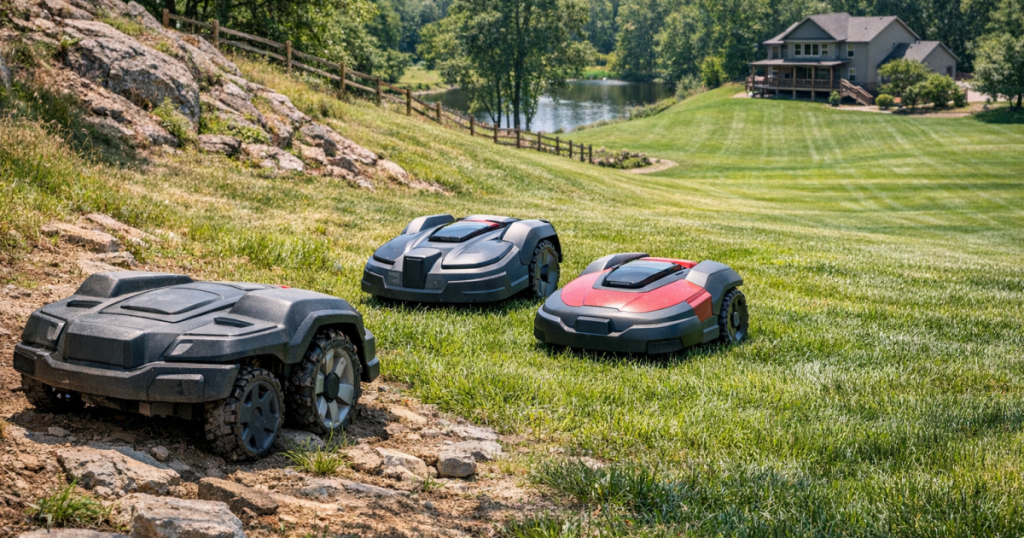
- Husqvarna Automower 435 iQ AWD: A premium all-wheel-drive wire-free model aimed at complex lawns. Put it on the list when slope handling, uneven ground, and traction are more important than choosing purely by acreage.
- Segway Navimow X450: A large-property all-wheel-drive wire-free model, with Segway positioning it for lawns up to 1.5 acres. It is a relevant comparison for homeowners who need both capacity and traction-focused design.
- Dreame A3 AWD Pro 5000: A large-property all-wheel-drive LiDAR robot mower with dual cutting discs. It belongs in the conversation for homeowners looking at LiDAR navigation and slope-oriented hardware for complicated lawns.
No mower is automatically the right answer for every large lawn. For the best robot lawn mowers for large yards, the deciding factor is whether the mower’s boundary approach, navigation style, slope capability, and maintenance needs line up with your actual property rather than an idealized flat test lawn.
Step 4: Decide whether wire-free is really easier for your yard
Wire-free mowing is exciting because it can reduce the physical installation work that large yards traditionally required. But easy setup and reliable long-term mowing are not the same thing. A wide-open lawn with clear sky exposure is very different from a shaded, fenced, multi-zone property with a detached garage and mature oaks.
Use this simple decision path:
- Mostly open lawn, few trees, clear sightlines: Start with large-property wire-free models.
- Heavy tree canopy or tight side yards: Compare LiDAR-based systems or hybrid approaches before choosing satellite-only navigation.
- Steep or rutted areas: Prioritize all-wheel-drive, slope rating, wheel design, and ground preparation.
- Multiple separated zones: Check whether the mower can handle the transfer routes, gates, and return-to-charger path you need.
- Precise exclusion zones: Look closely at how the system defines beds, play areas, pools, and no-mow sections.
The best setup often starts before the mower arrives. Mow the lawn with a conventional mower first, clear sticks and toys, fix low spots, trim overhanging branches near passages, and decide where the charger can sit with easy power access and a clean path into the main lawn.
Step 5: Plan for edges, obstacles, and the parts of the lawn a robot will not perfect
Robot mowers reduce routine mowing, but they do not erase every lawn task. Large yards still need edge planning. Expect to handle fence lines, retaining walls, tight corners, playset legs, garden borders, and mailbox areas separately unless the mower and layout are specifically well suited to those edges.
Uneven lawns also need occasional cleanup. Fallen branches, dog toys, pine cones, hoses, and sprinkler heads can all interrupt mowing. The more complex the yard, the more important it is to build a simple weekly habit: walk the lawn, clear obstacles, check blades, inspect wheels, and make sure charging contacts are clean.
For large properties, replacement blades and routine wear parts are not an afterthought. A mower covering more ground will naturally need more upkeep than one trimming a small suburban rectangle. Before buying, check how easy it is to source blades, blade screws, garage covers, boundary accessories, and charging-station parts in the US.
Common mistakes that make large-yard robot mowing frustrating
Most disappointing robot mower experiences are not caused by one bad feature. They usually come from a mismatch between the lawn and the system.
- Buying by acreage alone: Acre rating does not tell you how the mower will handle shade, slopes, passages, or obstacles.
- Ignoring the return path: The mower needs a reliable route back to the charger, not just access to the mowing area.
- Leaving rough ground untouched: Holes, ruts, exposed roots, and loose debris should be corrected before setup.
- Assuming wire-free means zero planning: Virtual boundaries still require careful mapping and real-world testing.
- Overlooking pets and kids: Pick up toys, supervise outdoor activity around the mower, and follow the manufacturer’s safety instructions.
- Expecting a manicured edge everywhere: Many yards still need occasional trimming along hard borders and tight corners.
How to narrow your shortlist in one yard walk
Take one slow walk around the property with your phone, a notepad, and a tape measure if you have one. Start at the likely charger location and move through every mowing zone as if you were the robot. Look for the places where a machine could get confused, lose traction, or run out of room.
By the end of the walk, sort your yard into one of these scenarios:
- Open and large: Prioritize high-capacity wire-free models and charger placement.
- Large and shaded: Compare LiDAR, hybrid, and boundary-based options instead of assuming satellite navigation will be seamless.
- Large and steep: Start with all-wheel-drive and slope-capable models, then confirm the mowing area capacity.
- Large and divided: Focus on multi-zone handling, gates, transfer paths, and whether the mower can realistically move between areas.
- Large but rough: Budget time for lawn prep before judging any mower’s performance.
If you are using recommendations or product links as part of your research, the site’s affiliate disclosure explains how editorial content and affiliate links are handled.
Practical takeaway
A robot mower can be a great fit for a large US yard, but the smartest purchase starts with the lawn, not the box. Measure mowable grass instead of total lot size, identify slopes and weak signal areas, decide whether wire-free, LiDAR, hybrid, or boundary-wire setup fits the property, and choose a model with enough capacity without ignoring traction and serviceability.
For uneven lawns, do not expect the mower to compensate for every ground problem. Smooth ruts, remove debris, manage wet areas, and keep blades fresh. That preparation is what turns an impressive robot mower into a reliable part of weekly lawn care.