Mowing two separate lawns with one robot mower is possible, but the setup depends on one practical question: can the mower travel between them on its own? If the answer is no, the mower may still work, but the job becomes a carry-and-schedule routine rather than true hands-off mowing.
The easiest yards have a mower-safe route between zones. The trickier ones have fences, steps, raised patios, gravel strips, narrow gates, or a street-side front lawn with no legal or safe crossing path. Those details decide whether one mower feels clever or becomes another chore.
The big picture
One robot mower can mow disconnected lawn areas if the mower supports the way you plan to use it: either it can drive through a safe passage between zones, or you can manually carry it to a secondary area and start the right mowing mode or map. If there is no physical path, the mower cannot move itself between lawns, return to charge from the distant area, or solve access problems on its own. The owner has to handle transport, scheduling, and charging.
Think of the choice in four levels:
-
Connected route: Best case. The mower can drive between areas using a gate, strip of turf, smooth hardscape, or mapped corridor.
-
Driveway or walkway crossing: Sometimes workable, but only when the route is low-risk, controlled, and supported by the mower’s setup method.
-
Carry-only zone: Possible with some mowers, but you become part of the workflow.
-
Second mower territory: Often the better answer when both lawns need frequent mowing and there is no practical connection.
Step 1: Decide whether the mower can physically reach both lawns
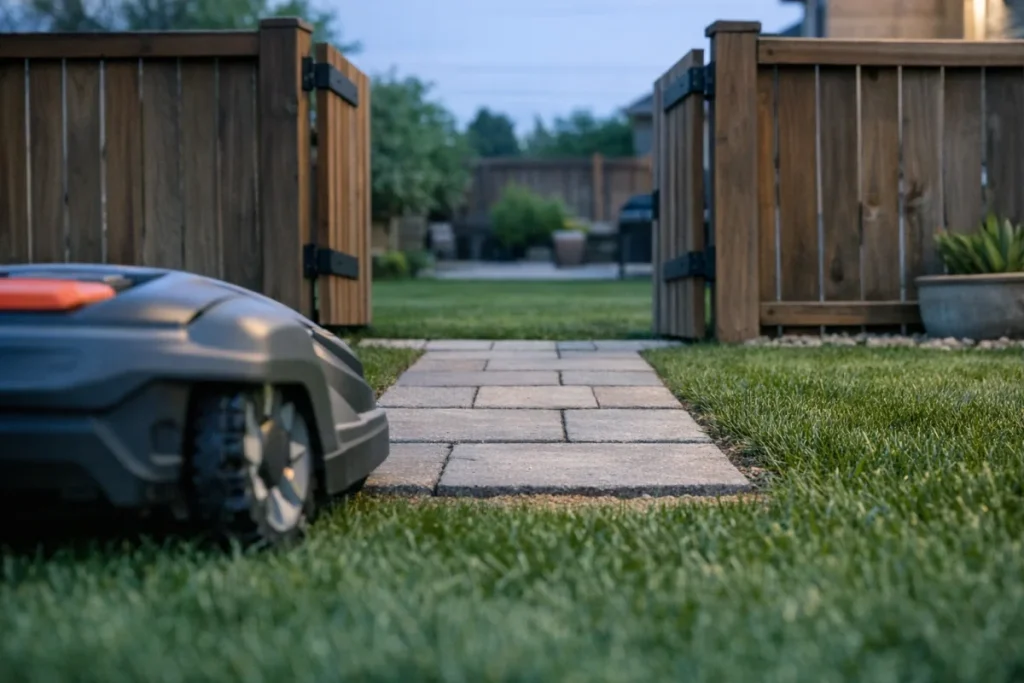
Walk the route a mower would need to take from its charging station to the other lawn. Do not think like a person walking through the yard; think like a low, slow machine that needs clearance, traction, and a predictable surface.
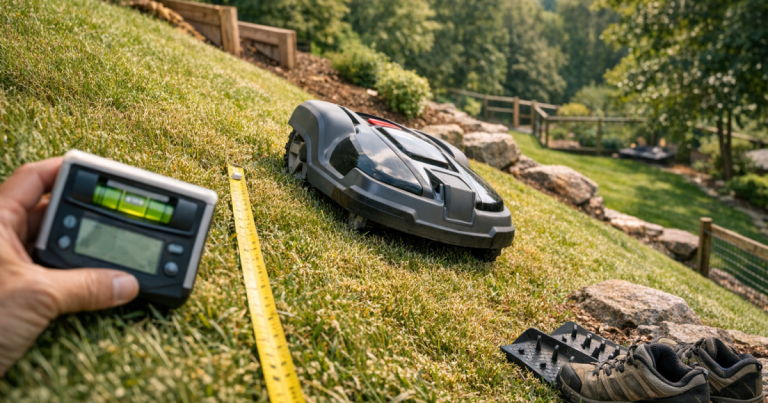
A robot mower-friendly route is usually flat or gently sloped, wide enough for the mower to navigate without scraping fences or walls, and free from steps, tall curbs, loose rock, toys, hoses, and pet bowls. A short strip of pavers may be fine for some layouts, while a stair, retaining wall, or closed gate is a hard stop.
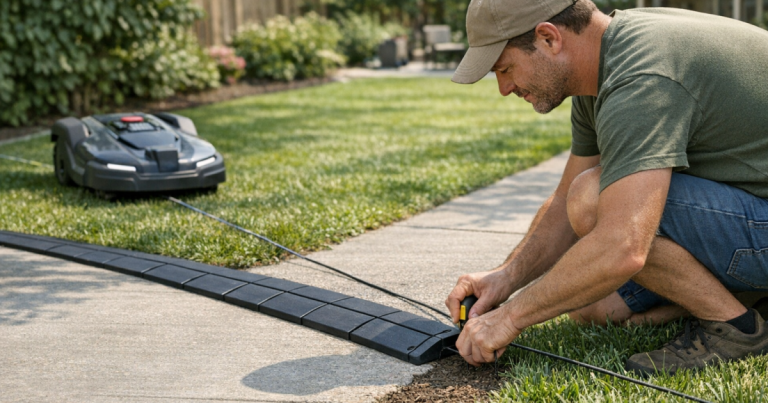
If the lawns are separated by a driveway, start by treating it as a routing problem rather than a simple shortcut. A mower should not wander into traffic, block a shared driveway, or cross where cars enter without warning. For a deeper look at this exact scenario, read how to route a robot mower between lawns across a driveway.
Step 2: Identify which kind of multi-area setup you need
Robot mowers handle multiple areas in different ways, and the names vary by brand. Before buying or remapping, look for the actual feature in the manual or app, not just a phrase on a product page.
Connected zones
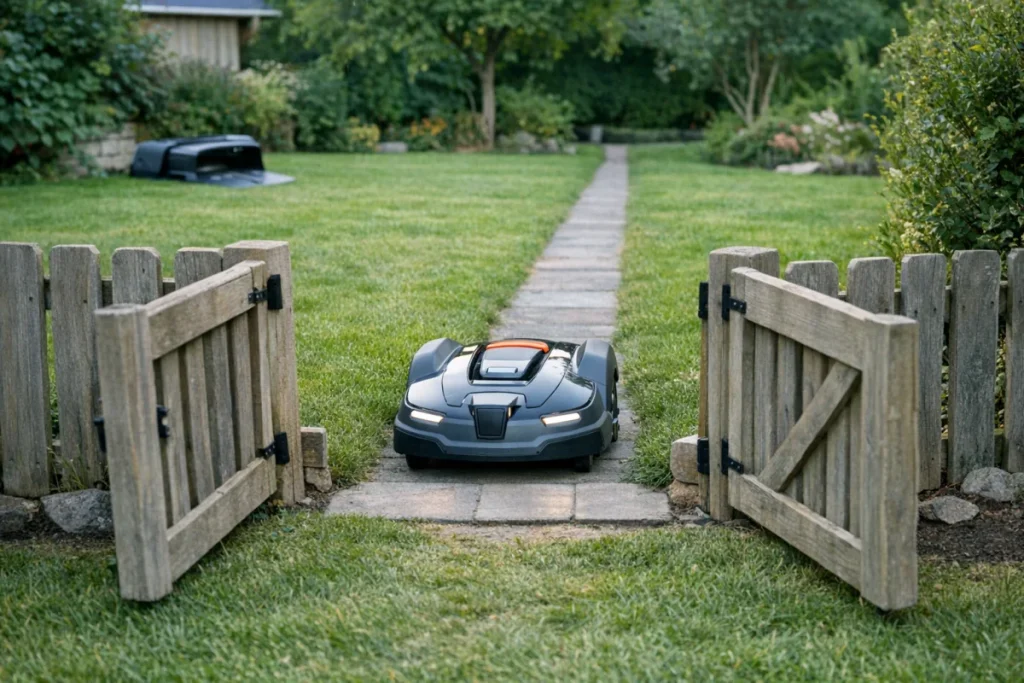
A connected zone is an area the mower can drive to and from by itself. This is the most satisfying arrangement because the mower can usually leave the charger, mow the assigned area, and return without being picked up. Wire-free models may use mapped zones, corridors, or no-mow boundaries. Boundary-wire models may use guide wires, passages, or secondary areas depending on the system.
Carry-only areas
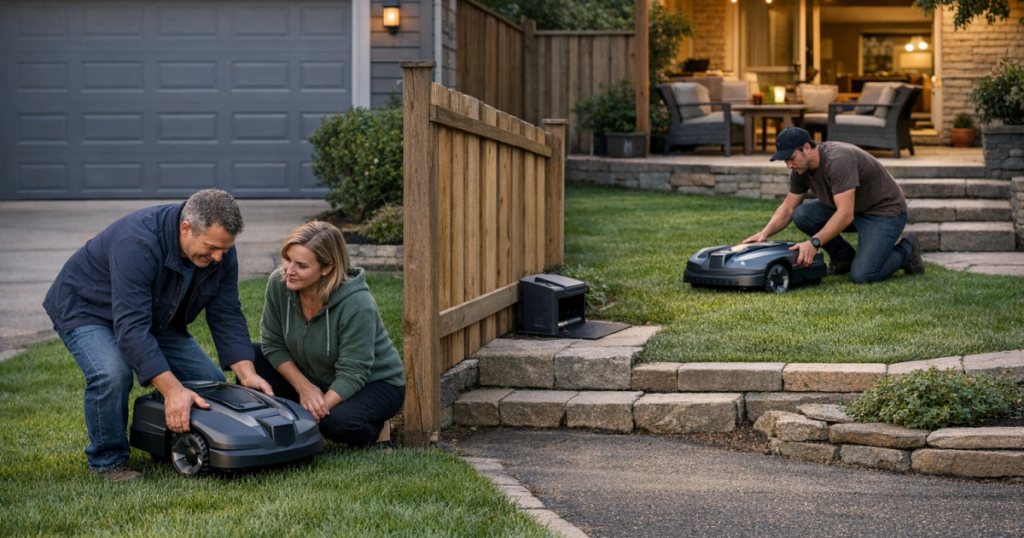
A carry-only area is a lawn the mower cannot reach on its own. You pick up the mower, place it in the second lawn, start the correct mode, and later bring it back to the charging station. This can work for a small side yard or fenced front patch, but it is less convenient than the word “robot” makes it sound.
Separate maps or saved areas
Some wire-free mowers allow more than one saved area or map, while others are more limited. Confirm whether the mower can store a map for each lawn, whether it needs the charging station in the mapped area, and whether it can mow without seeing its normal positioning reference. If setup depends on Wi-Fi or Bluetooth and the second lawn is far from the house, connection reliability can become part of the plan; these robot mower Wi-Fi and Bluetooth troubleshooting steps are useful before blaming the mower itself.
Step 3: Check charging before you commit
Charging is the detail that separates a smooth two-area setup from a fiddly one. A robot mower is designed around a home base. If it can drive to both lawns, it can usually use that base as part of its normal schedule. If you carry it to a disconnected area, it cannot automatically return to charge unless the charging station is there too.
For a carry-only zone, ask three questions:
-
Can the mower finish the smaller area before it needs to recharge?
-
Will it stop safely and wait if it runs low, or will you need to monitor it closely?
-
Are you willing to carry it back to the charger every time?
The cleanest two separate lawns setup is usually one where the larger or more visible lawn gets the charger, and the smaller, less demanding patch becomes the occasional manual area. If both lawns are large, grow quickly, or need a frequent cut schedule, one mower may spend too much time being moved around.
Step 4: Match the navigation type to the yard problem
Boundary-wire and wire-free mowers can both work across multiple areas, but the trade-offs are different.
A boundary-wire mower may be very predictable once installed, but adding a disconnected area can require extra planning. A true isolated patch may need a separate loop or a manufacturer-supported secondary-area method. That can be reliable, but it is less flexible if your layout changes.
A wire-free mower can be easier to adapt if it supports multiple maps or zones, but positioning is the key constraint. RTK-based models need a strong enough satellite and reference signal in each mowing area. Houses, dense trees, covered side yards, and narrow spaces between buildings can make mapping less dependable. If your mower uses an RTK antenna, review RTK antenna placement for reliable robot mower mapping before assuming the front yard and backyard will behave the same.
LiDAR and vision-led systems may reduce the need for an external antenna on some models, but they still have limits around surface transitions, lighting, obstacles, and how each mower defines boundaries. The point is not to chase one magic navigation label. It is to match the mower’s setup method to the exact obstacles between your lawns.
Step 5: Build a routine that is realistic to live with
If there is no driveable path, the routine matters as much as the mower. A carry-only zone works best when it is small, close to the charger, and easy to supervise casually while you are already outside.
A simple weekly routine might look like this:
-
Let the mower handle the main lawn on its normal schedule.
-
Pick one dry day for the disconnected patch.
-
Carry the mower with the blades stopped and place it on level grass.
-
Start the correct map, zone, or manual mowing mode.
-
Remove toys, branches, hoses, and pet waste before it starts.
-
Carry the mower back to the charger when finished.
That is still easier than pushing a mower for many homeowners, but it is not fully automatic. Be honest about how often you will actually move it. If the second area will be forgotten for two weeks at a time, the grass may get taller than the mower handles comfortably, and cut quality can suffer.
Common mistakes that make this harder
-
Assuming “multi-zone” means “mows anywhere.” Multi-zone support does not automatically mean the mower can travel between disconnected lawns, store separate maps, or work away from its charger.
-
Putting the charger in the wrong lawn. The station usually belongs in the area that needs the most frequent mowing and has the best access to power, signal, and open sky if required.
-
Using a rough shortcut. A narrow dirt track, loose gravel strip, or bumpy side passage can create stuck mower alerts and uneven wear.
-
Forgetting gates. A mower cannot open a gate. If you rely on a passage, it needs to be open during mowing windows and safe for pets and kids.
-
Buying too small. Two small lawns can add up. Judge the total mowable area, not just each patch individually.
When one mower is still the right call
One mower is a good fit when the total grass area is within the mower’s intended capacity, one lawn is clearly the main area, and the second area is either connected or small enough to mow manually now and then. It also helps if you enjoy a little setup tuning. Robot mowing rewards careful mapping, clean edges, and a tidy route.
One mower is less appealing when both lawns are large, the second area is behind steps or a locked gate, or the mower would need to be carried several times per week. At that point, a second smaller mower, a redesigned gate or passage, or sticking with a conventional mower for the minor patch may be the calmer choice.
Helpful questions
Can a robot mower mow a front yard and backyard with no connecting path?
Yes, but only if the mower supports a usable carry-only workflow, secondary area, or separate map for the disconnected lawn. It will not drive between the two areas, and it will not return to the charger from the isolated lawn unless there is a safe route back.
Can I just pick up the mower and move it?
Often, yes, but check the mower’s instructions first. Some models require a specific mode, map selection, restart step, or security confirmation after being lifted. Always move it with the blades stopped.
Should the charging station go in the front or backyard?
Put the charging station in the lawn that needs the most frequent automated mowing and has the most reliable access, signal, and power. For most fenced layouts, that is often the larger backyard, but the right answer depends on your yard.
Is a second mower overkill?
Not if the second lawn is large, fast-growing, or inconvenient to access. A second mower can be simpler than carrying one unit back and forth all season.
What to do next
Sketch your property as three parts: the main lawn, the second lawn, and the route between them. Mark every gate, step, curb, driveway, slope, tree canopy, and power location. If the route is mower-safe, plan a connected-zone setup. If it is not, check whether your mower supports a carry-only area and decide whether that routine will still save you time.
The right answer is not always the most automated one. A robot mower should make the lawn easier to keep neat, not turn Saturday into a shuttle service for a very determined little machine.