A gate can be the one small detail that decides whether a robot mower feels effortless or spends its life trapped in the wrong section of lawn. The minimum gate width for robot lawn mower setups is not a universal number; it depends on the mower’s body width, navigation style, the approach angle, and how much room it has to correct itself.
For most US yards, a 36-inch pedestrian gate is comfortable for many robot mower layouts. Narrower openings can work, but they need a straighter approach, careful mapping, and confirmation from the mower’s manual before you commit.
In brief
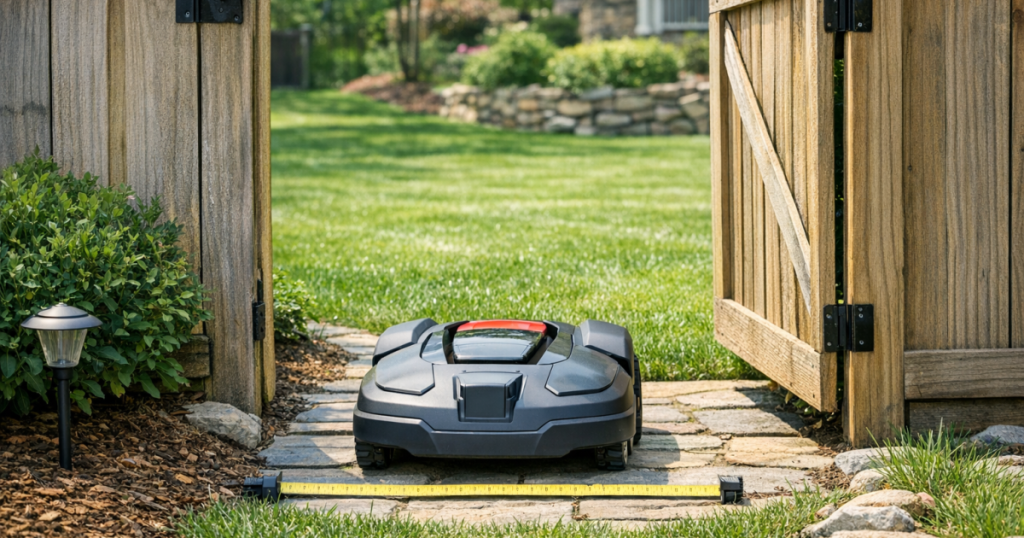
A robot mower passage should be wider than the mower’s total outside body width, not just its cutting width. As a practical planning rule, allow at least 6 to 12 inches of total side clearance for a straight opening, and more if the mower must turn immediately before or after the gate.
- Easy setup: a 36-inch gate is usually the homeowner-friendly target.
- Possible but fussier: 24 to 30 inches may work for some compact mowers if the approach is straight and the manufacturer allows it.
- Risky: openings only slightly wider than the mower body leave little room for steering correction, wheel slip, grass growth, or mapping error.
- Height: clear the tallest part of the mower, including sensors or antenna hardware, with several inches to spare.
Why one universal gate width does not exist
Robot mowers do not all drive through passages the same way. A boundary-wire mower may follow a guide path or corridor behavior. A wire-free mower may rely on satellite positioning, camera recognition, LiDAR, inertial sensing, wheel movement, or a combination of systems. Those differences affect how confidently the mower can hold a line through a confined opening.
The other issue is geometry. A mower entering a gate straight on has a much easier job than one leaving a lawn, making a sharp turn, crossing a paver strip, and then squeezing between fence posts. The mower is not simply “fitting through”; it is navigating through while correcting its path.
That is why the most useful number is not only the physical width of the gate. It is the usable corridor: the clear grass-to-grass route the mower can approach, enter, and exit without clipping posts, dropping a wheel off an edge, or losing its mapped route.
A cross-brand planning reference for gate openings
Use these as planning widths, not as a replacement for the manufacturer’s published installation requirements for a specific model. If your gate is close to the limit, check the manual before buying or cutting into a fence.
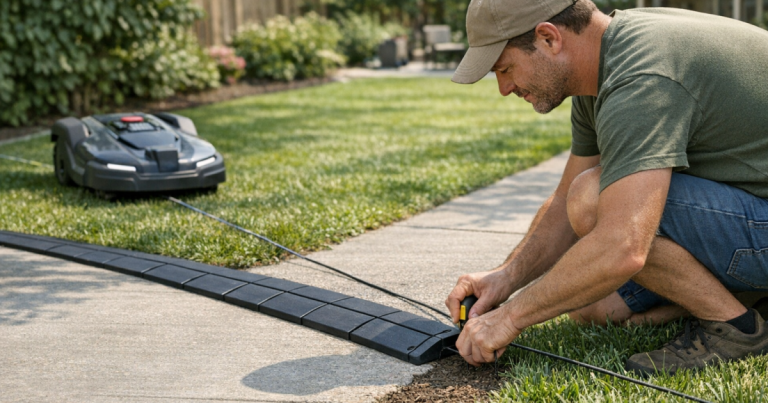
- Traditional boundary-wire robot mowers: Start with the mower’s overall body width plus 6 to 12 inches of total side clearance. A straight 30- to 36-inch opening is usually easier to plan than a slot barely wider than the mower.
- Hybrid or virtual-boundary mowers: Leave extra room for mapping tolerance and repeatable positioning. If you are comparing a flexible wired or wire-free installation, the Husqvarna Automower® 410 iQ is a useful reference point for the kind of yard-fit details to review before sizing a passage.
- Vision-based mowers: Width is only part of the job. The mower also needs a clean visual path, so avoid dark tunnels, overgrown edges, and narrow fence slots that hide the exit. A model such as the Worx Landroid Vision Cloud 1/4 Acre WR310.1 is worth comparing if your yard uses open, visible transitions instead of tight covered passages.
- LiDAR or camera-assisted wire-free mowers: Give the sensors room to see the approach and exit, not just the inside faces of the fence. For shaded or antenna-free layouts, the Segway Navimow i215 LiDAR review explains why navigation style can change the way you think about tight side yards.
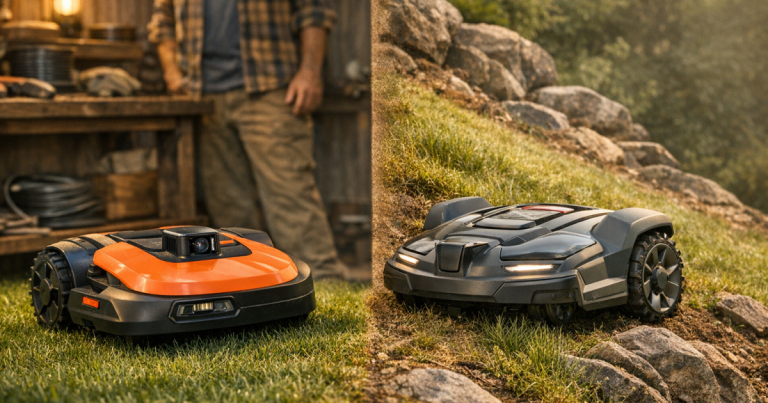
- Large-property and all-wheel-drive mowers: Do not assume a more capable mower is better in a narrow gate. Bigger wheels, wider bodies, and more aggressive terrain hardware can require more clearance, even if the mower handles slopes better.
Measure the route, not just the gate
Start with the narrowest hard point: inside face of post to inside face of post, hinge hardware included. Then measure the route at mower height, because decorative trim, latch plates, gate stops, and bowed fence boards can steal clearance where the mower actually passes.
Next, look at the ground. A robot mower can fit through a gate opening on paper and still struggle if one wheel drops into a rut, catches a metal threshold, or climbs onto a raised paver edge. The best passage is flat, firm, and boring. In robot mower terms, boring is beautiful.
If the mower needs to cross from one lawn zone to another, keep the surface consistent. Grass-to-grass is simplest. Grass to pavers can work in many layouts, but the transition should be smooth and wide enough that the mower does not scrape, bounce, or lose traction while correcting its line.
Turns before and after the gate
A narrow straightaway is far easier than a narrow opening with a turn at one end. If the mower must make a 90-degree turn immediately before the gate, plan for a larger opening or create a small landing area on both sides.
A good landing area gives the mower room to line itself up before entering and recover after exiting. For a homeowner planning a new fence opening, that often means shifting the gate a few feet away from a corner, widening a short connecting strip, or removing a tight landscape edge near the passage.
Watch out for side yards between a house and fence. They look like natural robot mower corridors, but they often combine multiple problems: narrow width, poor satellite view, mulch beds, air-conditioning pads, hose reels, downspouts, and uneven strips beside concrete. If that side yard is already awkward for a push mower, a robot mower will need an especially careful layout.
How tall does the opening need to be?
Gate height is usually less limiting than width, but it still deserves a look. The opening should clear the mower’s tallest point with several inches above it. That tallest point may be a sensor housing, control cover, stop button area, or antenna hardware, depending on the model.
Avoid sending a mower under a low bottom rail, hinged flap, or decorative arch that could rub the body. Also avoid dangling chain, loose wire mesh, or flexible edging that can brush the mower repeatedly. Even if the mower passes once, repeated contact is a poor setup.
If you are planning a dedicated mower slot instead of a human gate, make it tall enough that the mower never has to duck under pressure and wide enough that grass growth at the edges will not close the opening over time.
Common mistakes with robot mower gates
- Using cutting width as the mower width: Cutting width is the blade path, not the outside body dimension. Measure or confirm the total physical width.
- Forgetting hinges and latches: The clear opening may be several inches smaller than the advertised gate size.
- Making the passage exactly as wide as the mower: A robot mower needs steering margin, especially on wet grass or uneven ground.
- Ignoring the exit: A perfect entrance still fails if the mower exits into a wall, planter, step, root, or tight turn.
- Letting plants narrow the route: Ornamental grasses, hostas, mulch edging, and low branches can turn a workable passage into a snag point by midsummer.
- Assuming wire-free means layout-free: Wire-free mowers still need a route they can perceive, map, and repeat reliably.
Straight answers
Can a robot mower use a standard 36-inch gate?
In many residential layouts, yes. A 36-inch gate gives many robot mowers enough room to pass without making the installation overly delicate. Still, confirm the mower’s total width and the manufacturer’s passage requirements.
Can a robot mower fit through a 24-inch gate?
Sometimes, but it is not a safe assumption. A compact mower may physically fit through 24 inches, while another model may not have enough clearance or navigation margin. A straight approach, flat ground, and manual-approved passage width become much more important at this size.
Is a narrow fence slot better than leaving a gate open?
A dedicated slot can be tidy, but it should be designed for the mower rather than cut as a last-minute notch. Make it smooth, wide, tall, and easy to see through. If pets or children use the yard, also think through how that opening affects the fence’s everyday function.
Does a robot mower need a gate between front and back yards?
Only if it has to mow both areas as part of the same setup. Some homeowners treat front and back lawns as separate zones or move the mower manually. Others create a mapped passage, but the route has to be safe, repeatable, and allowed by the mower’s setup instructions.
What to remember
The most reliable robot mower gate is not the tightest opening the mower can squeeze through once. It is an opening the mower can use day after day, from different approach angles, as grass grows and yard conditions change.
If you are designing from scratch, aim for a clear 36-inch opening when possible. If you already have a narrower gate, measure the mower’s full body width, add side clearance, check the approach and exit, and confirm the model’s published passage requirements before assuming it will work.
Robot mowers are at their best when the yard gives them a clear routine. Give the gate a little breathing room, and the rest of the system has a much better chance of feeling genuinely hands-off.