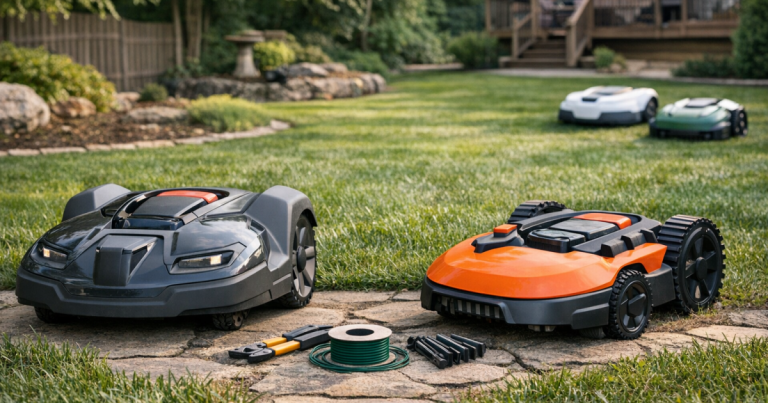
A robot mower can look perfect online and still struggle in the wrong yard. The quickest way to judge robot mower yard suitability is to measure three things before you shop: slope, obstacles, and zones. A few notes from the lawn itself will tell you whether you need a simple small-yard mower, a more capable wire-free model, or a traditional mower instead.
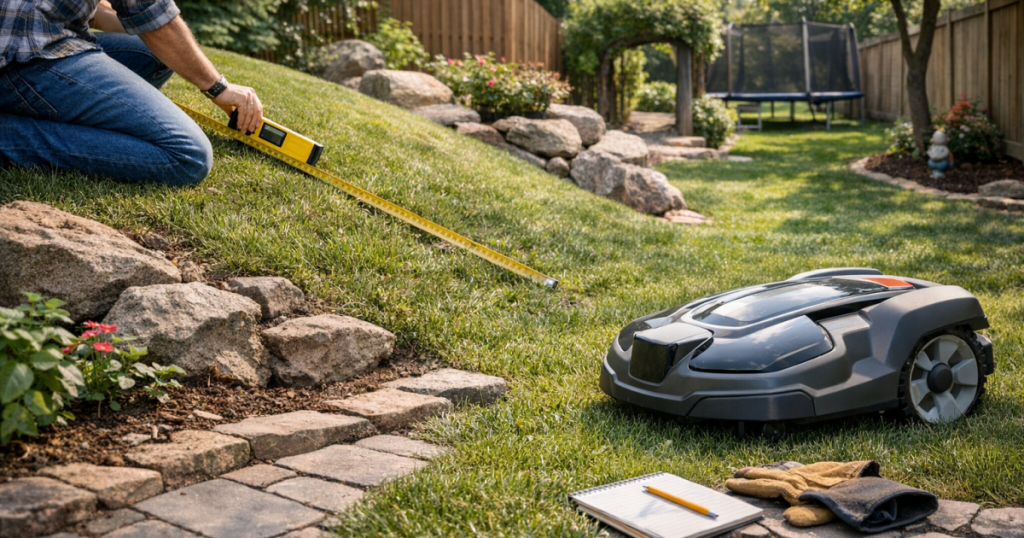
Bring a tape measure, a few lawn flags or stakes, a notepad, and either a 2-foot level with a ruler or a phone clinometer app you can double-check for accuracy. Walk the yard slowly, because the problem spots are usually not the wide open grass in the middle; they are the side strip, the gate opening, the wet dip near the fence, or the short steep pitch by the driveway.
At a glance
A yard is a better candidate for robot mowing when the mowable grass is connected, slopes stay within the mower manufacturer’s stated limits, obstacles are either fixed and easy to map or movable and easy to clear, and the mower can travel between zones without crossing unsafe surfaces. A yard becomes harder when it has steep banks, loose gravel transitions, exposed roots, narrow corridors, heavy tree cover, frequent fallen branches, or fenced sections with no practical mower path.
- Measure the steepest usable mowing areas, not just the average slope.
- List obstacles by type: fixed, movable, low, fragile, seasonal, or hazardous.
- Divide the lawn into zones based on how a mower would physically travel.
- Check narrow passages, gates, curb edges, mulch beds, and driveway crossings.
- Compare your notes with the mower’s published slope, boundary, navigation, and zone guidance before buying.
Step 1: Sketch the yard the way a mower sees it
Start with a simple overhead sketch. It does not need to be pretty. Draw the house, garage, driveway, sidewalks, patio, fences, gates, beds, trees, play areas, and every separate patch of grass. Then mark the likely charging station area, because that point affects how the mower reaches each zone.
Think in terms of movement, not curb appeal. A rectangular backyard with one open gate to the side yard is easier than a beautiful lawn broken into five disconnected islands. A front yard separated from the backyard by a driveway may be a second zone, even if the total square footage is modest.
For a deeper setup walk-through after you finish measuring, keep this robot mower setup guide handy. Your measurements will make those setup decisions much less vague.
Step 2: Measure total mowable area, not lot size
Robot mower capacity should be compared with the grass it must actually cut, not the size of your property. Break the lawn into rough rectangles, triangles, or circles and estimate each section separately. For a rectangle, multiply length by width. For a triangle, multiply base by height and divide by two. Add the sections together, then subtract large non-grass areas such as patios, pools, sheds, planting beds, and permanent play structures.
Do not aim for a perfect surveyor-grade number. Aim for a realistic mowing workload. If your backyard is 60 feet by 40 feet but a patio and garden beds take up a quarter of it, the mower is not maintaining the full rectangle. On the other hand, complicated borders, islands, and narrow strips can make a smaller lawn feel harder for a robot mower than a larger open one.
- Measure front, back, and side lawns separately.
- Note any section that can only be reached through a gate or narrow pass.
- Mark areas you do not want mowed, such as wildflower strips or drainage swales.
- Leave some capacity margin when comparing models, especially for complex yards.
Step 3: Find the steepest slope, not the nicest average
Slope ratings matter because a robot mower has to climb, turn, stop, and maintain traction while cutting. The important measurement is the steepest stretch the mower must actually mow or cross. A lawn that feels gently rolling may still have a short bank near the street that changes the buying decision.
To measure slope as a percent grade, place a 2-foot level straight uphill on the grass, lift the downhill end until the bubble is level, and measure the vertical gap from the raised end down to the ground. Then use this formula: rise divided by run, multiplied by 100. With a 24-inch level, a 6-inch rise equals a 25% grade.
- Check slopes near driveways, drainage ditches, retaining walls, and fence lines.
- Measure in several directions if the hill curves or rolls sideways.
- Mark slopes that end at a hard edge, curb, pond, street, or planting bed.
- Repeat the check when the grass is damp if the area often stays slick.
Manufacturers may publish slope limits in percent, degrees, or both. Compare the same unit, and pay attention to whether the limit applies to the general mowing area, the boundary edge, or travel routes. A mower that can handle a hill in the middle of open grass may still need more conservative setup near a drop-off or curb.
Step 4: Separate fixed obstacles from daily clutter
Obstacle handling is not just about whether a robot mower can detect something. It is about whether the yard can remain predictable enough for reliable mowing. Fixed obstacles are things like trees, mailbox posts, fire pits, raised beds, swing set legs, stepping stones, and landscape boulders. These can usually be planned around with mapping, boundary setup, or physical layout choices.
Movable obstacles are the bigger ownership habit issue. Dog toys, hoses, soccer balls, fallen branches, patio cushions, and kids’ yard games can appear after the mower has already mapped the lawn. Some mowers use cameras, LiDAR, ultrasonic sensors, bump sensors, or a combination of methods, but no robot mower should be treated as a magical clutter manager.
- Flag low objects that may sit below sensor height, such as edging stones or shallow tree roots.
- Mark fragile objects that should not be bumped, including solar lights and young plantings.
- Note seasonal debris areas under oaks, pines, fruit trees, or storm-prone branches.
- Identify places where toys, hoses, or pet waste commonly end up.
Navigation style matters here. A boundary-wire mower may be very dependable inside a defined perimeter but still needs good setup around islands and no-go areas. A wire-free mower may make mapping easier in some yards, but trees, houses, fences, and tight corners can still influence performance depending on the system. If you are curious about how one current LiDAR-based mower approaches edges and obstacle-heavy lawns, the ECOVACS GOAT A2000 LiDAR PRO review is a useful example to compare against your own yard notes.
Step 5: Define zones by access, not appearance
A mowing zone is any area the robot must treat as a separate working section because access, boundaries, or layout change. Front and back lawns are obvious zones. But a side strip behind an AC unit, a fenced dog run, a pool-side patch, or a boulevard strip between sidewalk and street may also behave like its own zone.
Walk the exact route the mower would need to take from the charging station to each area. Measure gates and tight passages at the narrowest point, not the widest. Note ground surface changes, such as grass to concrete, grass to gravel, or grass to mulch. Some yards need a mower that supports multiple zones through app mapping; others may need guide wires, physical boundary planning, or manual carrying between sections.
- Zone 1: main open lawn connected to the charging station.
- Zone 2: fenced backyard reached through a gate or side passage.
- Zone 3: front lawn separated by driveway, sidewalk, or street-facing curb.
- Zone 4: small isolated patches that may not justify robotic mowing.
This is where robot mower yard suitability becomes a practical ownership question. A mower can be technically capable on paper while still being annoying if you must open gates, move patio furniture, carry it across a driveway, or rescue it from a narrow strip every other day.
Step 6: Check edges, transitions, and problem surfaces
Edges are where many otherwise good installations get messy. Measure along fences, raised beds, retaining walls, curbs, and driveway borders. Look for places where the lawn drops suddenly, slopes toward a hard surface, or narrows into a pinch point. A clean, flat border is much easier than a wavy edge with roots, mulch spillover, and sprinkler heads.
Transitions deserve the same attention. A robot mower may need to cross a sidewalk, move over a driveway apron, or pass through a gate threshold. Measure the height difference and look for loose gravel, ruts, expansion gaps, or raised lips. If the route feels awkward when you push a regular mower through it, do not assume a robot mower will glide through without careful setup.
- Mark sprinkler heads, valve boxes, drain grates, and exposed utility covers.
- Look for soft soil where wheels could rut after rain.
- Note curb lines near streets, especially where a mower could leave the lawn area.
- Identify edging that may need trimming even after the robot handles the main grass.
Step 7: Match the yard notes to the right mower type
Your measurements should point you toward a mower category before you get distracted by premium features. A simple, mostly flat suburban yard may not need the most advanced navigation system. A larger property with trees, slopes, and several mowing areas may need stronger zone support, better hill capability, or a more careful boundary plan.
- Mostly flat, open lawn: compare basic robot mowers with enough capacity for your mowable square footage.
- Fenced backyard with a narrow side path: focus on passage handling, zone setup, and charging-station placement.
- Steep or uneven lawn: prioritize manufacturer slope ratings, traction design, and safe boundary placement.
- Many trees and structures: compare how navigation systems handle signal blockage, mapping, and obstacle zones.
- Disconnected grass sections: decide whether manual relocation is acceptable or whether the layout defeats the convenience you want.
For older-style boundary-wire systems, your sketch will help estimate where wire, connectors, and protected no-go islands may be needed. For wire-free systems, the same sketch helps you judge whether mapping, reference points, satellite reception, LiDAR visibility, or app-defined zones fit the layout. The best choice is not the most futuristic one; it is the one that matches the physical yard with the fewest daily compromises.
Common measuring mistakes that lead to bad mower matches
- Measuring the lot instead of the mowable lawn area.
- Checking only the middle of the hill and missing the steeper edge near a curb.
- Ignoring gates, side yards, and mower travel routes between zones.
- Assuming obstacle detection replaces picking up toys, hoses, and branches.
- Forgetting shaded, wet, or root-filled areas that behave differently after rain.
- Buying based on maximum capacity with no margin for complex layout or heavy growth.
- Overlooking trimming needs along fences, walls, and raised borders.
Quick answers
Can a robot mower handle a sloped yard?
Some can, but the slope must be within the manufacturer’s stated limit for that mower and the setup must account for edges, traction, and turning space. Measure the steepest mowing area and compare the same unit, such as percent grade to percent grade.
Do trees make a yard unsuitable?
Not automatically. Trees become a concern when they create exposed roots, low branches, heavy debris, tight trunks, or navigation challenges. A few cleanly spaced trees are very different from a shaded yard full of roots and fallen sticks.
What if my yard has several separate grass sections?
Separate sections can work if the mower supports the needed zone setup and can travel between areas safely. If sections are disconnected by steps, streets, steep driveways, or locked gates, expect more manual involvement.
Should I buy before measuring?
No. Measuring first helps you avoid paying for features you do not need or choosing a mower that struggles with your actual layout. Yard fit should come before brand preference.
Key takeaways
Before buying, measure mowable square footage, steepest slopes, narrow passages, obstacle patterns, and every route between zones. Then compare those notes with the mower’s published limits and setup requirements. If the lawn is mostly connected, slopes are manageable, clutter is controllable, and zones are realistic, a robot mower has a much better chance of feeling like everyday help instead of another yard chore.
Because Robot Mower Match is an affiliate-supported publisher, product mentions and links may support the site when they help readers compare options. You can read the site’s affiliate disclosure for more detail.