A hill can be the one feature that turns a promising mower match into a frustrating one. The robot mower slope rating on a spec sheet is only the starting point; the real question is whether your yard gives the mower enough grip, turning space, and safe runout if conditions get slick.
Think of this as a yard-fit check, not a pass-fail quiz. A moderate, open hill is very different from a short, sharp bank beside a driveway, fence, retaining wall, or drainage ditch.
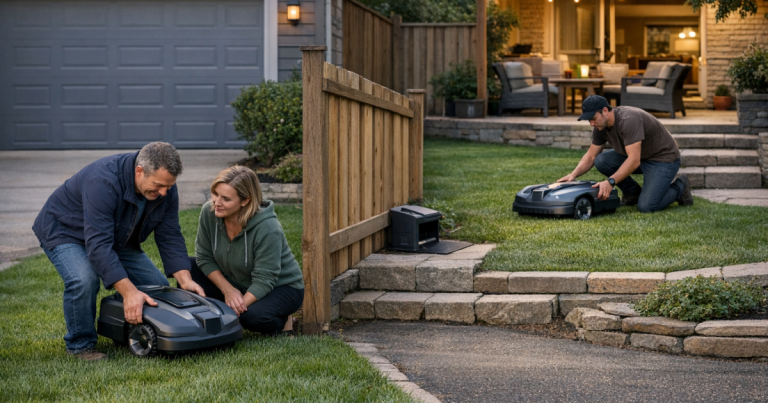
Robot mower installation on steep banks, near retaining walls, roads, ponds, or drop-offs is typically handled by a qualified installer to follow manufacturer instructions, local safety requirements, and site-specific conditions.
What to know first
A robot mower can handle a hill only when the measured grade is comfortably within the mower’s published slope rating and the surface gives it enough traction to climb, turn, and stop without sliding. For buying decisions, measure the steepest usable mowing route, convert the result to percent grade or degrees, then leave a safety margin rather than choosing a mower that barely matches your number.
That margin is important because slope ratings are not the same as a guarantee that every patch of grass on your property will mow cleanly in every condition. Damp turf, loose soil, exposed roots, thick spring growth, ruts, and side-hill turns can all make a hill feel steeper to a small robotic mower than it looks from the patio.
As a practical rule, treat any area within about 5 to 10 percentage points of a model’s maximum published grade as a closer-look zone. It may still work, but it deserves extra attention to wheel drive, boundary placement, turning area, and whether a human mower or trimmer should handle that strip instead.
Step 1: Measure the hill, not the whole lawn
Manufacturers usually describe slope as either percent grade or degrees. Percent grade is the rise divided by the horizontal run, multiplied by 100. A hill that rises 2 ft over 10 ft of horizontal distance is a 20% grade.
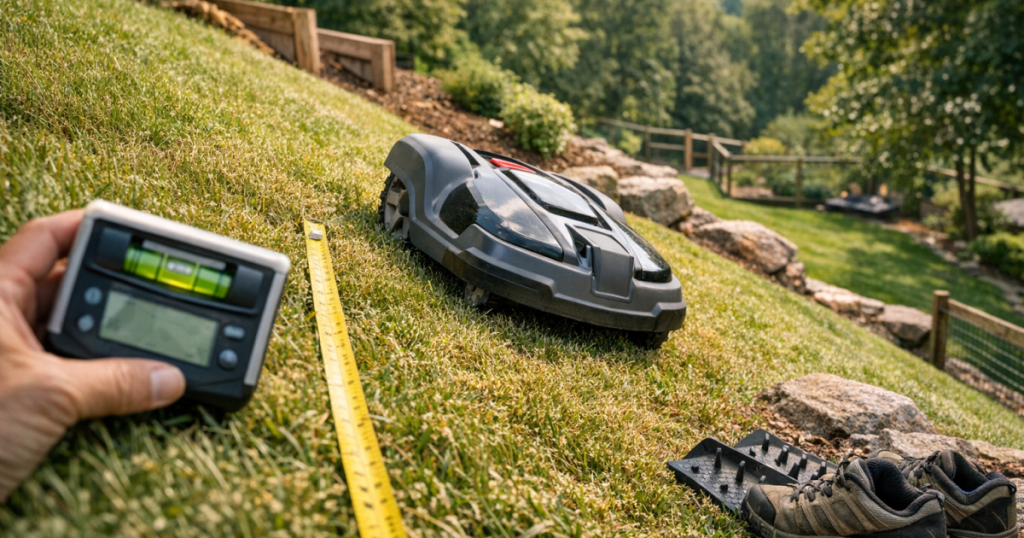
You do not need survey equipment for a useful homeowner check. You need a tape measure, a straight board or taut string, a level, and a helper if the hill is awkward.
- Pick the steepest section the robot would actually mow, not the gentlest path across the yard.
- Mark a horizontal run, such as 10 ft, straight across the slope from lower ground toward higher ground.
- Hold a level board or string from the high-side point out over the low side so it stays level.
- Measure the vertical drop from the level line down to the grass at the low end.
- Use this formula: grade percent = rise in feet ÷ run in feet × 100.
Example: if the grass drops 3 ft over a 10 ft horizontal run, the grade is 30%. If it drops 1.5 ft over 10 ft, the grade is 15%. Measure several spots if the slope rolls, pinches, or gets steeper near the bottom.
Step 2: Convert percent grade and degrees correctly
Percent grade and degrees describe the same hill in different ways, but they are not interchangeable numbers. A 45-degree slope is not a 45% grade. A 45-degree slope is a 100% grade, which is far beyond what most residential robot mower setups should be expected to manage.
Use this quick field conversion when comparing your measurements with mower specifications:
- 10% grade is about 5.7 degrees.
- 15% grade is about 8.5 degrees.
- 20% grade is about 11.3 degrees.
- 25% grade is about 14.0 degrees.
- 30% grade is about 16.7 degrees.
- 35% grade is about 19.3 degrees.
- 40% grade is about 21.8 degrees.
- 45% grade is about 24.2 degrees.
- 50% grade is about 26.6 degrees.
- 60% grade is about 31.0 degrees.
- 70% grade is about 35.0 degrees.
If your mower shortlist mixes percent and degree ratings, convert everything before comparing. This avoids one of the most common steep-yard mistakes: assuming a larger-looking number always means better hill capability.
Step 3: Check the hill shape and mowing direction
A straight uphill climb is usually the easiest version of a sloped-yard problem. The harder scenarios happen when the mower must turn on the hill, travel across the hill sideways, or recover from a wet patch near the top or bottom.
Walk the slope and look for these layout details:
- Side-hill travel: A mower crossing the slope sideways can drift downhill if traction is marginal.
- Tight turn zones: A mower that reaches the top of a bank and immediately has to turn beside a fence, bed, wall, or patio edge has less room for error.
- Bottom hazards: Roads, sidewalks, ponds, culverts, open drains, and drop-offs make a borderline slope less forgiving.
- Changing grade: A hill that starts at 15% and finishes at 35% should be judged by the steepest practical mowing section, not the average.
- Surface texture: Thick grass may help traction, while sparse turf, moss, exposed clay, loose sand, roots, and tire ruts can reduce it.
The most mower-friendly hill is broad, consistent, grassy, and free of hard boundaries at the top and bottom. The most difficult hill is short, steep, slippery, irregular, and boxed in by obstacles.
Step 4: Read the mower rating like a homeowner, not a brochure
A published robot mower slope rating tells you the maximum grade the manufacturer claims for that model under defined conditions. It does not automatically mean the mower is the right choice for every hill at that number.
When comparing models, check whether the rating refers to the main mowing area, the edge of the working area, or another installation condition. Some systems also treat boundary areas differently from open grass, so read the product documentation closely before relying on a headline number.
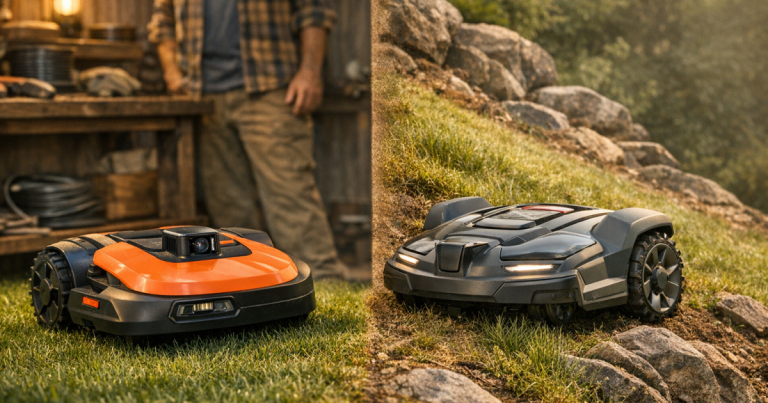
Drive type is also important. Two-wheel-drive models can be a sensible match for mild slopes and flatter suburban lawns, while all-wheel-drive models are designed for more challenging terrain. For example, the Husqvarna Automower® 435 iQ AWD is a useful model to compare when your yard has meaningful slopes, uneven ground, or complex routing, but you should still check its current published slope limits against your own measurements.
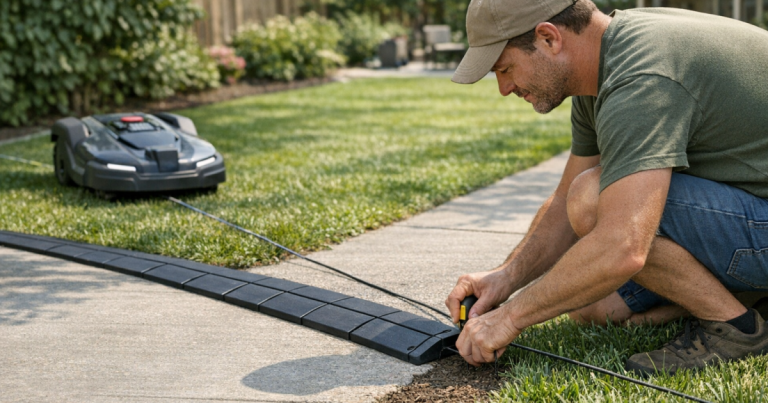
Boundary method matters too, but not in a one-size-fits-all way. A wire-free mower can simplify setup in open spaces, while a physical boundary can be useful where you want a very defined exclusion line. On sloped yards, the key is not just whether the mower is wire-free or wired; it is whether the boundary approach can be laid out so the mower has safe turning room and does not have to correct itself on the steepest part of the hill.
Step 5: Decide whether the hill is green, yellow, or red
Once you have measurements, sort the hill into one of three decision zones.
Green zone: comfortably within the rating
Your measured grade is well below the mower’s published limit, the turf is stable, and there are no serious hazards at the bottom of the slope. This is where robot mowing tends to make the most sense. You still need a good setup, but the slope is unlikely to be the main dealbreaker.
Yellow zone: close to the rating or tricky underfoot
Your hill is near the stated limit, has side-hill travel, gets slick after rain, or includes roots, bare patches, or tight turns. This is where you slow down and compare slope-capable models more carefully. A hybrid setup model such as the Husqvarna Automower® 410 iQ may be worth comparing for yards where installation flexibility is as important as the mower itself, while steeper or rougher lawns may push you toward AWD options.
Red zone: beyond the rating or unsafe if it slips
Your measured grade exceeds the mower’s rating, or the hill ends at a road, water feature, drop-off, retaining wall, or public sidewalk. In this zone, do not try to solve the problem with optimism. Exclude that section from the robotic mowing area, redesign the boundary, improve the landscape, or keep that strip as a manual-mow or trim zone.
Common mistakes that make hills harder
The slope number is only one piece of the puzzle. Many bad matches happen because the homeowner measured correctly but overlooked how the mower must behave on the hill every day.
- Measuring the average slope: Robot mowers struggle at the steepest point, not the mathematical average of the lawn.
- Ignoring wet grass: A slope that works in dry weather may become a traction problem after irrigation or rain.
- Placing turns on the steepest line: Give the mower flatter space to turn whenever the layout allows it.
- Expecting AWD to fix every yard: All-wheel drive helps with traction, but it does not remove the need for safe boundaries and sensible routing.
- Forgetting narrow passages: A hill plus a tight gate or corridor is a harder job than either feature by itself.
If your yard has a modest slope but heavy shade, trees, or awkward signal areas, navigation style also deserves attention. The Segway Navimow i215 LiDAR is one example to compare when you are weighing antenna-free navigation for a smaller yard, though slope measurements should still lead the decision.
Common questions
Is percent grade or degrees better for measuring a lawn?
Percent grade is usually easier for homeowners because it works directly from rise and run measurements in feet. Degrees are useful when a manufacturer lists slope capability that way. The important part is converting accurately before comparing models.
Can a robot mower go down a steeper hill than it can climb?
Do not plan around downhill capability alone. A mower may still need to turn, correct course, brake, or climb back up during normal operation. Judge the area by the most demanding movement the mower must make, not the easiest direction of travel.
Does all-wheel drive mean my hill is definitely fine?
No. AWD can improve traction on slopes and uneven ground, but the mower still has a published limit and still depends on turf condition, boundary layout, and obstacle placement. It is a strong clue for steep-yard suitability, not a permission slip to ignore the site.
Key takeaways
Measure the steepest section of the hill, convert the result correctly, and compare it with the mower’s published rating using a real safety margin. Then look at the shape of the hill: side-hill travel, wet grass, tight turns, and hazards near the bottom can turn an acceptable number into a poor fit.
The best robot mower choice for a hill is the one that matches the actual mowing route, not just the acreage. If your measurements land in the yellow zone, treat the hill as the deciding feature and shortlist models by slope rating, drive type, boundary approach, and room to turn before you commit.