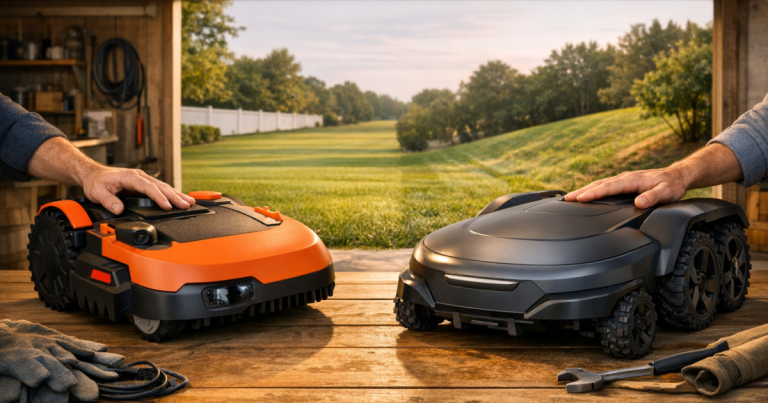
When a one-acre mower and a premium AWD mower land on the same shortlist, the decision usually comes down to terrain and setup tolerance. WR340 vs 435 iQ AWD is a comparison between a lower-priced 2-wheel-drive Worx built around RTK Cloud with Vision AI and V-SLAM, and a higher-priced Husqvarna with all-wheel drive, virtual or physical wire options, and a much steeper stated slope rating.
Quick Buying Links
Worx Landroid Vision Cloud 1 Acre (WR340)
flatter one-acre lawns where lower price and wire-free cloud-based setup matter most
Husqvarna Automower® 435 iQ AWD
Better for larger, steeper yards that can justify AWD traction and a higher official price
The short version: the Worx Landroid Vision Cloud 1 Acre WR340 makes the most sense for a flatter one-acre lawn where its coverage model fits your address. The Husqvarna Automower® 435 iQ AWD is the stronger fit for a larger, more uneven property where all-wheel drive and slope capability are worth paying for.
In brief
- Official listed price: Worx WR340 is listed at $2,299.99; Husqvarna Automower® 435 iQ AWD is listed at $4,999.99.
- Rated lawn size: Worx is listed for 1 acre; Husqvarna is listed for 1.3 acres.
- Drive system: Worx is 2-wheel drive; Husqvarna is All-Wheel Drive.
- Maximum slope rating: Worx lists 30%; Husqvarna lists 70% inside the installation.
- Cutting width: both list an 8.7 in cutting width.
- Boundary and navigation: Worx lists RTK Cloud with Vision AI and V-SLAM, with wire-free setup. Husqvarna lists virtual wire or physical wire, with Husqvarna Cloud in select locations and an EPOS reference station as the alternative where cloud coverage is unavailable.
The main split: value mower or terrain mower?
These two robotic lawn mowers overlap enough to be compared, but they are not trying to win the same backyard argument. The Worx WR340 is the more affordable route into a wire-free 1-acre setup. The Husqvarna 435 iQ AWD costs substantially more, but the official specs point to a different job: more rated area, AWD traction, and a much higher slope figure.
That makes the first decision refreshingly practical. If your lawn is mostly open, moderately sloped, and around the 1-acre mark, the Worx has the cleaner value story on the supplied facts. If your property has steep internal grades, uneven transitions, or a layout where drive traction matters more than saving money, the Husqvarna has the clearer hardware case.
There is no need to romanticize this. A robot mower that fits the wrong terrain becomes a very expensive lawn ornament with wheels. The mower that matches the yard layout is the one that will feel less fussy after the novelty wears off.
Side-by-side comparison
Price and value
The official listed price difference is the loudest number here. Worx lists the Landroid Vision Cloud 1 Acre WR340 at $2,299.99. Husqvarna lists the Automower® 435 iQ AWD at $4,999.99.
That does not automatically make the Worx the better buy, but it does set the burden of proof. For the Husqvarna to make sense, the yard needs to benefit from what the extra money buys in the verified specs: All-Wheel Drive, a 1.3-acre lawn rating, and a 70% maximum slope rating inside the installation.
For a flatter 1-acre property, the Husqvarna’s premium may be hard to justify on the facts supplied here. For a steep or more demanding lawn, the Worx’s lower price is less persuasive if its 2-wheel-drive system and 30% maximum slope rating are the limiting factors.
Lawn size rating
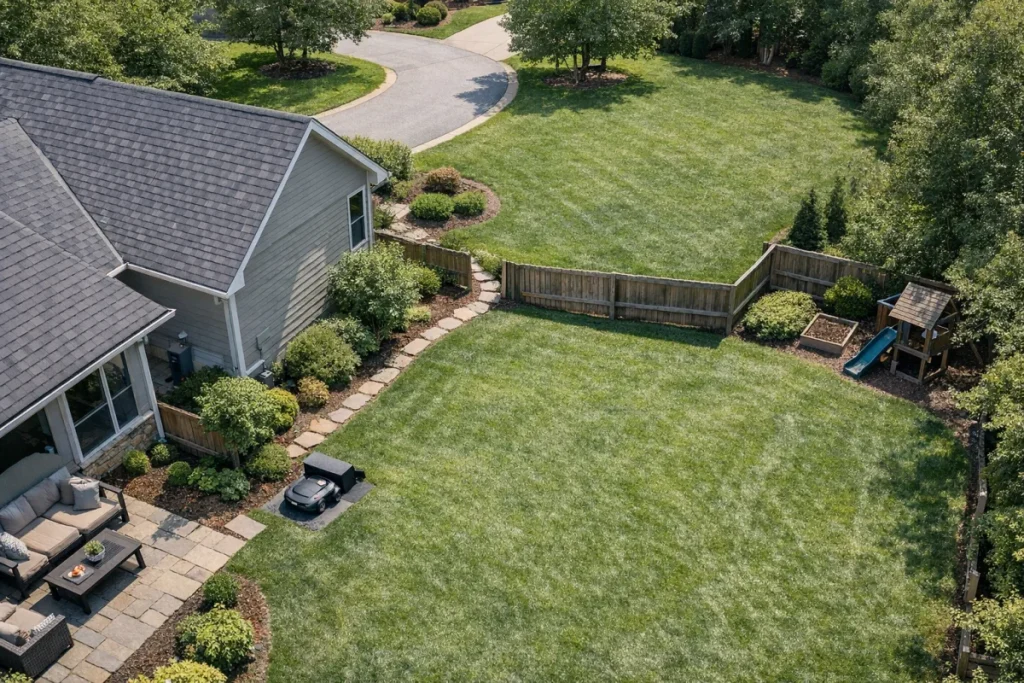
Worx lists the WR340 for a recommended lawn size of 1 acre. Husqvarna lists the 435 iQ AWD for 1.3 acres. That gives the Husqvarna a modest but meaningful capacity advantage on paper.
For a homeowner whose maintained turf is comfortably under 1 acre, the difference may not matter much. For a property that pushes past the 1-acre line, or where multiple lawn zones add up quickly, the Husqvarna’s listed 1.3-acre rating gives it more room in the comparison.
If your layout includes separate front and back lawns, side yards, or a controlled route between mowing zones, the mower’s capacity is only part of the planning. The physical route still has to work. For layout planning beyond this head-to-head, see this guide to routing a robot mower between lawns across a driveway.
Navigation and boundary approach
The Worx WR340 lists RTK Cloud with Vision AI and V-SLAM, with a wire-free setup. The official Worx page also ties RTK Cloud availability to an address coverage check. That means the WR340’s cleanest installation story is strongest where that cloud coverage is available for the property.
Husqvarna lists virtual wire and physical wire for the 435 iQ AWD. Its official information also states that Husqvarna Cloud installation is available only in select locations, with an included EPOS reference station as the alternative where cloud coverage is unavailable.
Editorially, the trade-off is simple: Worx is positioned around a no-on-site-antenna cloud-based route, while Husqvarna gives more installation paths. The Husqvarna path can be more flexible, but it is not one single setup type; virtual wire, physical wire, reference station use, and cloud availability are distinct pieces of the decision.
For homeowners comparing RTK-style installs, antenna placement can make or break mapping reliability. The planning principles in this guide to placing an RTK antenna for reliable robot mower mapping are especially relevant when a reference station is part of the setup.
Drive system and slopes
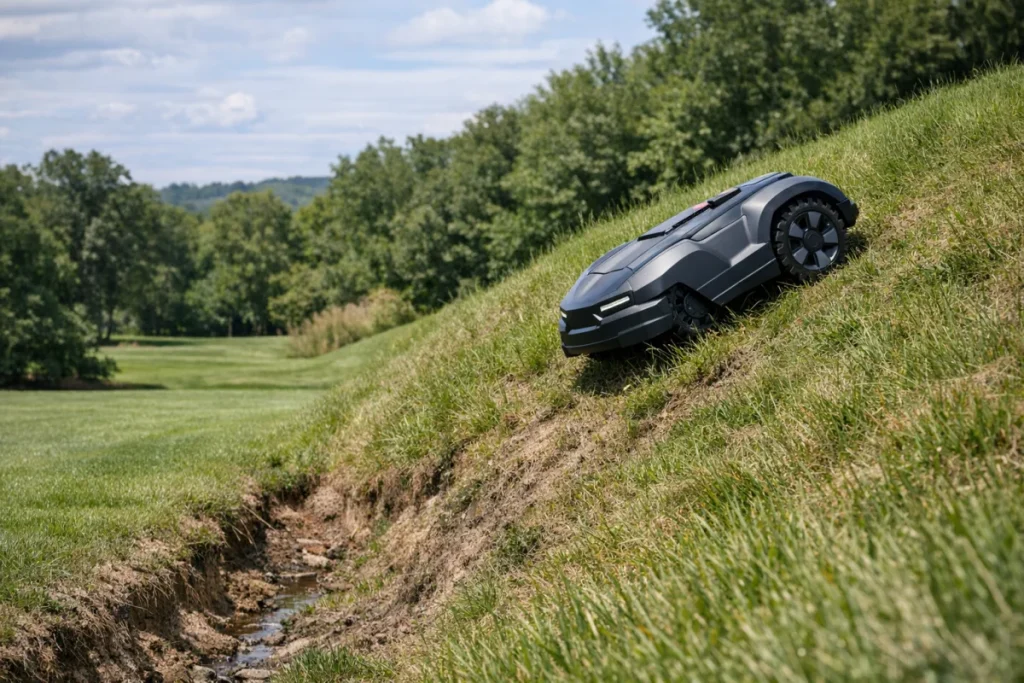
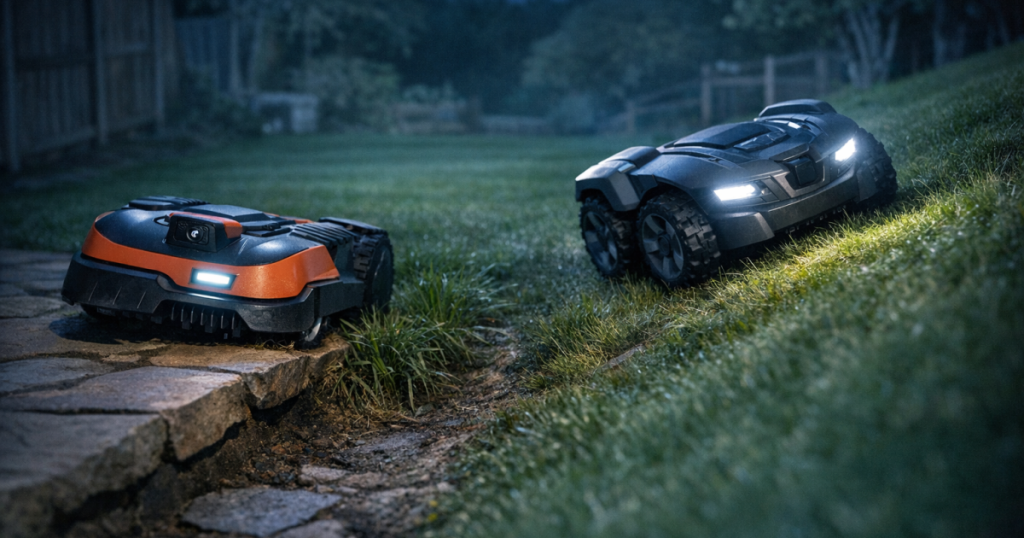
This is where the Husqvarna pulls away for difficult terrain. Worx lists the WR340 as 2-wheel drive with a 30% maximum slope rating. Husqvarna lists the 435 iQ AWD as All-Wheel Drive with a 70% maximum slope rating inside the installation.
Those two slope figures should not be blended together. Husqvarna’s cited 70% figure is specifically inside the installation, while Worx’s cited maximum is 30%. Still, for steep yards, the difference is substantial. A lawn with banks, drainage swales, or climbing routes back to the charging area is the kind of place where drive type becomes more than a spec-sheet line.
For flatter lawns, AWD may be overkill. A 2-wheel-drive mower can make more sense when the grass area is open and the main goal is reducing installation clutter and purchase cost. For steep, uneven, or traction-sensitive yards, the Husqvarna is the more convincing option based on the verified drive and slope ratings.
Cutting width and blade system
Both mowers list an 8.7 in cutting width, so neither gets a cutting-width advantage in this comparison. The blade descriptions differ slightly: Worx lists a 3-blade cutting system, while Husqvarna lists 3 pivoting razor blades.
Because the verified evidence does not provide a directly comparable cut-quality test, it would be unfair to claim that one cuts cleaner than the other. The useful takeaway is narrower: the cutting width is the same, so the bigger buying differences are drive system, slope rating, boundary method, lawn-size rating, and price.
Worx lists a cutting height range of 1.57 to 3.54 in. For Husqvarna, the captured official evidence does not list the cutting height range. That matters if you maintain warm-season grass at a taller height. For more context on turf-height fit, compare these options with our guide to robot mowers that cut high enough for St. Augustine grass.
Battery, weight, and handling
Worx lists a 20 V 5 Ah Li-ion PowerShare battery and a weight of 30.9 lb with battery. Husqvarna lists a typical mow time on one charge of 145 min and a weight of 39.9 lb.
Because the supplied evidence does not give matching battery and runtime data for both models, the fair comparison is weight. The Worx is lighter by the listed figures. That can matter when carrying the mower for storage, cleaning around the deck, or moving it during setup. The Husqvarna’s extra weight arrives alongside its AWD system and slope-focused positioning, so it is better understood as part of a more terrain-capable design rather than a simple downside.
Where the Worx WR340 makes more sense
The Worx Landroid Vision Cloud 1 Acre WR340 is the stronger fit for a homeowner who has a lawn around 1 acre, does not need AWD, and wants the lower official listed price. Its wire-free setup with RTK Cloud, Vision AI, and V-SLAM is the key attraction, especially for a yard where laying physical boundary wire would be a nuisance.
Choose the Worx side of this comparison when the verified facts line up with your yard like this:
- Your maintained lawn is within the 1-acre rating.
- Your slopes fit within the stated 30% maximum.
- You want the lower official listed price of $2,299.99.
- You prefer the WR340’s listed RTK Cloud plus Vision AI and V-SLAM setup over installing physical wire.
- You do not need an AWD mower for steep internal grades.
The limitation is not hidden in the fine print: Worx’s RTK Cloud availability depends on the address coverage check shown on its official product page. For the right address and the right terrain, though, the WR340 is the cleaner value play.
Where the Husqvarna 435 iQ AWD earns its price
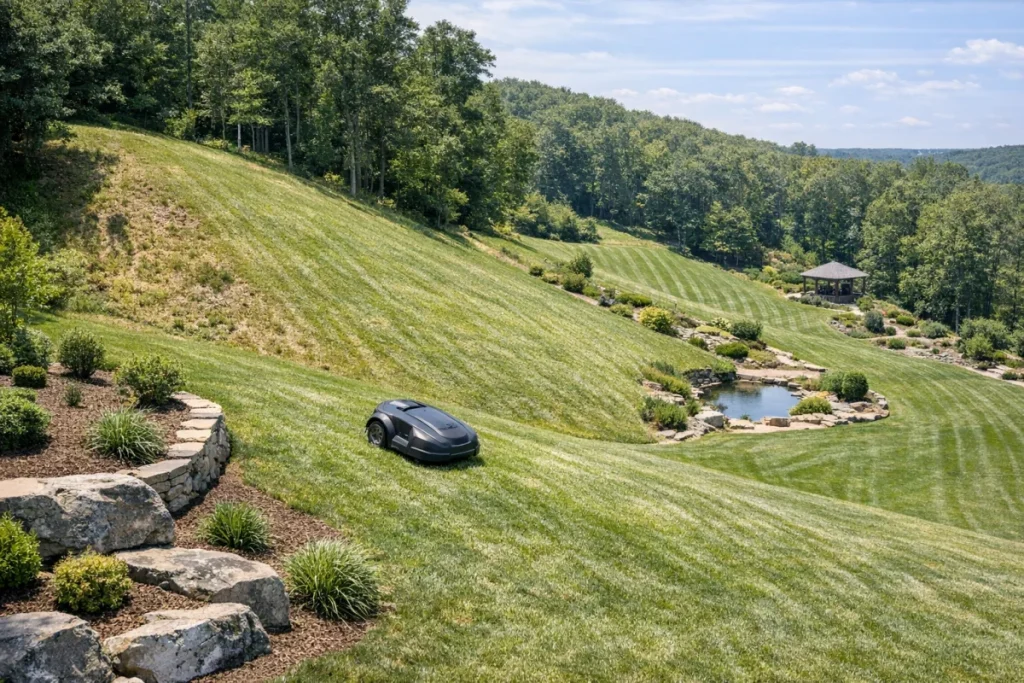
The Husqvarna Automower® 435 iQ AWD is the better match for a homeowner who is buying for slope handling and installation flexibility rather than lowest cost. It is listed for 1.3 acres, uses All-Wheel Drive, and carries a 70% maximum slope rating inside the installation.
Choose the Husqvarna side of the comparison when these verified differences matter in your yard:
- Your lawn is closer to the 1.3-acre rating than the 1-acre mark.
- Your property includes steep slopes inside the planned mowing area.
- You want All-Wheel Drive rather than 2-wheel drive.
- You value the choice of virtual wire or physical wire installation.
- You are comfortable paying the official listed price of $4,999.99 for the added terrain capability.
Husqvarna Cloud installation is available only in select locations, and the included EPOS reference station is the documented alternative where cloud coverage is unavailable. That makes the 435 iQ AWD less of a one-path product and more of a configurable install choice.
Ownership trade-offs that matter after setup
After the mower is mapped and running, the most noticeable differences are likely to be the same ones that show up in the spec comparison: how confidently the mower fits the terrain, how well the installation approach suits the property, and whether the price feels justified for the actual lawn.
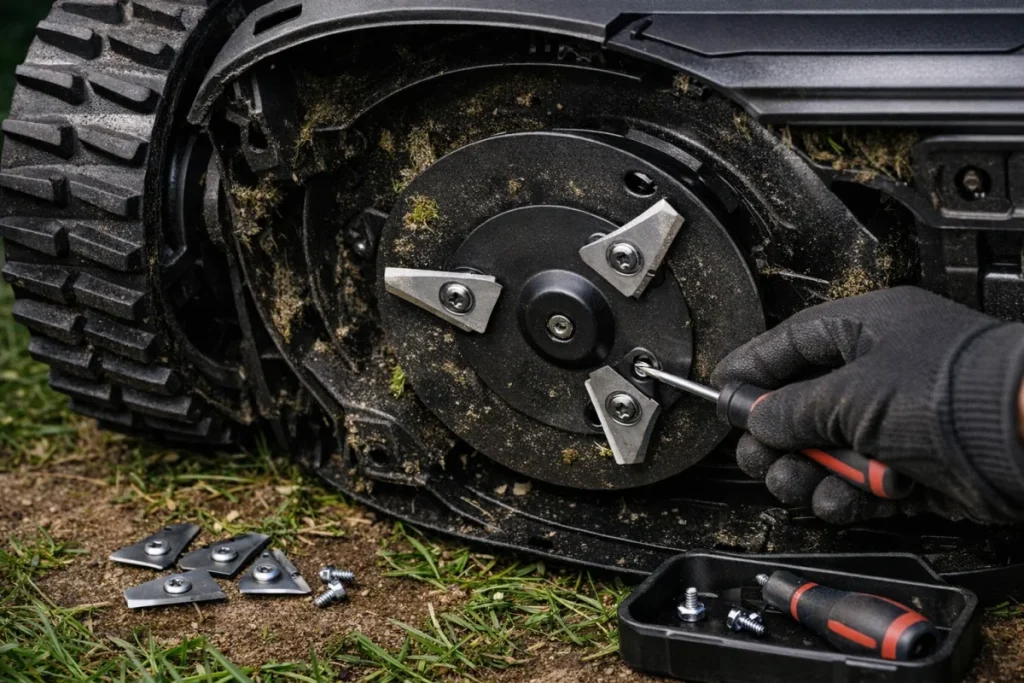
Both mowers use a 3-blade-style cutting setup in the supplied evidence, and both have an 8.7 in cutting width. Routine blade upkeep is part of robot mower ownership regardless of which side you choose. If you are budgeting for long-term maintenance, our guide on how often to change robot mower blades is a useful next step.
The biggest mistake would be buying the Husqvarna for a flat lawn simply because it has the stronger slope number, or buying the Worx for a steep property simply because it costs less. The best choice is not the spec-sheet champion. It is the mower whose strengths you will actually use.
Key questions answered
Which mower is cheaper?
The Worx Landroid Vision Cloud 1 Acre WR340 has the lower official listed price at $2,299.99. The Husqvarna Automower® 435 iQ AWD is officially listed at $4,999.99.
Which mower is better for steep slopes?
Based on the verified slope ratings, the Husqvarna Automower® 435 iQ AWD is the stronger steep-slope choice. Husqvarna lists 70% maximum slope performance inside the installation, while Worx lists 30% for the WR340.
Do both mowers use the same cutting width?
Yes. Both the Worx WR340 and Husqvarna 435 iQ AWD list an 8.7 in cutting width.
Is the Worx WR340 an AWD mower?
No. The official Worx information identifies the WR340 as 2-wheel drive. Worx has separate 4WD Vision Cloud models, but the WR340 in this comparison is not one of them.
The practical choice
Pick the Worx Landroid Vision Cloud 1 Acre WR340 if your lawn is around 1 acre, relatively manageable on slopes, and you want the lower official price with a wire-free setup built around RTK Cloud, Vision AI, and V-SLAM. It is the value-forward choice here, provided the cloud coverage model fits the property.
Pick the Husqvarna Automower® 435 iQ AWD if the lawn is larger, steeper, or more terrain-challenged. Its 1.3-acre rating, All-Wheel Drive system, virtual or physical wire options, and 70% inside-installation slope rating give it the stronger case for demanding yards.
For a straightforward lawn, save the money and lean Worx. For a property where slope and traction are the whole battle, the Husqvarna is the one with the verified hardware advantage. That is the cleanest way to read WR340 vs 435 iQ AWD without getting lost in brochure fog.
Quick Buying Links
Worx Landroid Vision Cloud 1 Acre (WR340)
flatter one-acre lawns where lower price and wire-free cloud-based setup matter most
Husqvarna Automower® 435 iQ AWD
Better for larger, steeper yards that can justify AWD traction and a higher official price