A robot mower on bumpy lawn terrain can work, but only if the uneven spots are broad and gradual rather than sharp, deep, or hard-edged. The real question is not whether the lawn is perfectly smooth; it is whether the mower can roll across the surface without dropping a wheel, scraping its underside, scalping the grass, or hitting roots with the blade disc.
Before you buy, spend 20 minutes walking the yard with a ruler, flags, and a clear idea of where the mower will travel every day. That quick inspection can save you from choosing a mower that is technically the right size but poorly matched to the ground under it.
At a glance
- A gentle rolling lawn is usually easier for a robot mower than abrupt lips, holes, exposed roots, and narrow wheel ruts.
- Treat raised roots over about 1 inch, sudden rut edges, and holes that catch your heel as repair or exclusion-zone candidates.
- Cutting height is not the same as ground clearance. A higher cut may reduce scalping, but it will not stop the chassis from high-centering on a root.
- all-wheel drive helps with traction and recovery, not with blade clearance. A mower can have great grip and still hit wood, soil, or stone.
- The best pre-buy move is to map repair spots, no-go zones, and mower corridors before comparing models.
Step 1: Walk the lawn like a mower, not like a person
People step over uneven ground without thinking. A robot mower cannot. It has a fixed wheelbase, a low cutting system, and a habit of revisiting the same awkward spots again and again. Start by walking the yard slowly in the direction the mower is likely to travel: across the front lawn, around beds, through side-yard passages, along fence lines, and back toward the charging area.
An uneven lawn becomes a robot mower problem when the ground changes faster than the mower can bridge it. That means a wheel drops into a rut, the body rides on a root, the blade disc reaches soil or wood, or a narrow path forces the machine to repeat the same bad crossing every run. Broad waves are usually manageable; sharp edges are what cause stuck mowers, scalped grass, and blade contact.
Carry a few lawn flags or landscape stakes. Mark anything that makes your foot roll, catches a shoe heel, exposes soil, or creates a hard raised edge. Do not decide yet whether the answer is repair, exclusion, or a different mower. The first pass is just a map of trouble spots.
Step 2: Check exposed roots by height and shape
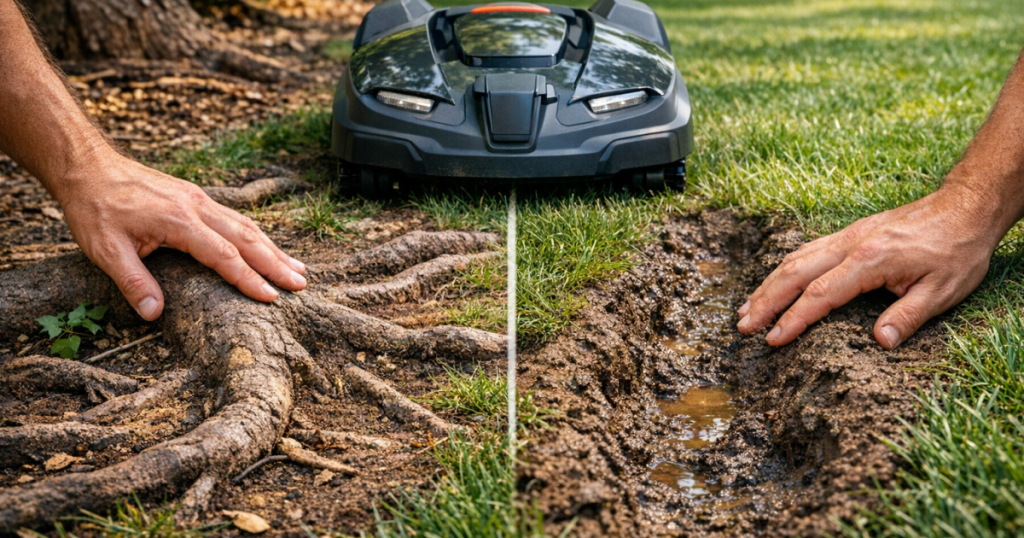
Tree roots are one of the most common reasons a mower that looks suitable on paper struggles in practice. The issue is not simply that a root is visible. Low, smooth roots that blend into the turf may be fine. Tall, abrupt, or knuckled roots are different because they can lift the mower, deflect a wheel, or put hard material near the blades.
Use this root check
- Measure the rise: Place a ruler beside the root and note how far it sits above the surrounding soil. As a practical homeowner rule, roots rising about 1 inch or more deserve closer attention.
- Look for a hard lip: A gradual root swell is less risky than a squared-off edge where soil has washed away from one side.
- Check the grass cover: Bare soil around a root usually means mower wheels will have less grip and the blades may pull in dust or grit.
- Consider the route: A root in a rarely crossed corner matters less than a root in a narrow corridor, return path, or charging-station approach.
- Protect the tree: Do not shave or cut major roots just to make a mower fit. If the root is structural, route the mower around it or turn the area into a mulch bed.
If the mower would cross the same root daily, be conservative. A single light tap is one thing; repeated blade contact with wood is hard on blades and can turn a small fit issue into recurring maintenance.
Step 3: Inspect ruts, holes, and wheel drop-offs
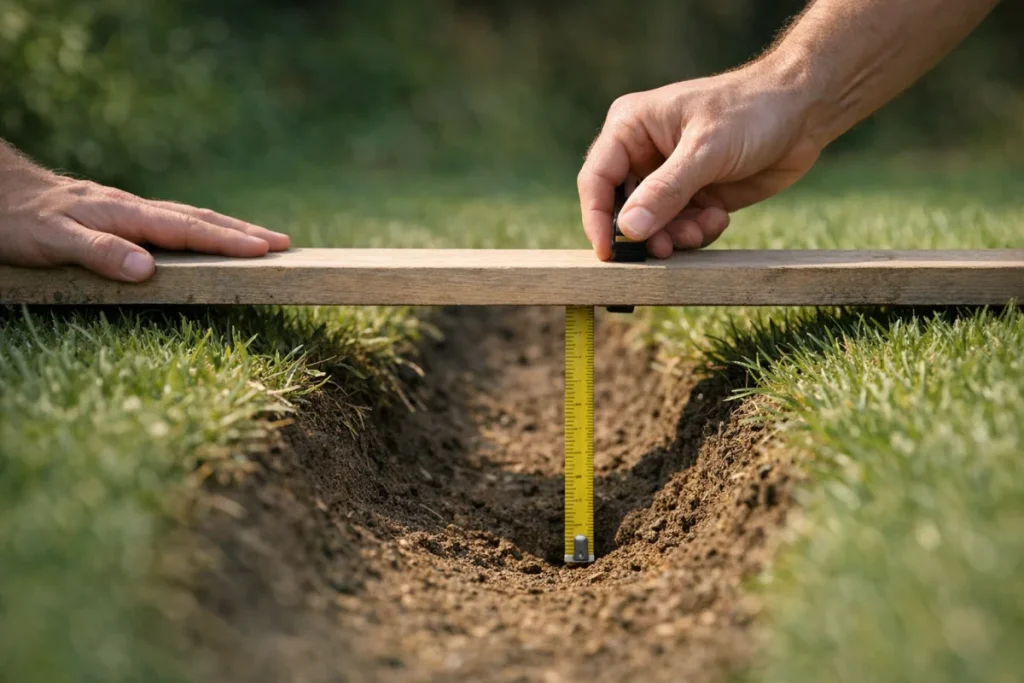
Ruts are different from roots because they pull the mower downward instead of lifting it upward. A shallow depression may only change the cut height. A deeper rut can trap a wheel, tilt the deck, or cause the mower to dig into the edge as it tries to turn out.
Use a straight board, broom handle, or level across the rut, then measure from the bottom of the depression to the underside of the board. You do not need surveyor-level precision. You are looking for abrupt changes: tire grooves near driveways, washouts below downspouts, dog paths along fences, and sunken soil where an old stump or utility trench settled.
Flag any rut that is deep enough to catch your shoe, hold standing water, or make a push mower scalp. Also mark small holes, because robot mower wheels are not looking ahead the way you are. A hole near a boundary, fence, bed edge, or slope transition is more serious than the same hole in open turf.
Step 4: Match the ground to mower clearance, cutting height, and drive type
Once the yard is marked, compare those rough spots with the mower type you are considering. Three details matter most: how low the mower sits, how high it can cut, and how much traction it has when one wheel loses grip.
Cutting height tells you the grass length the mower is designed to maintain. Ground clearance is the space under the machine as it travels over bumps. They are related in everyday results, but they are not the same measurement. A mower set higher may reduce scalping on rolling turf, but it can still drag or high-center if a root or rut edge contacts the underside.
For a robot mower on bumpy lawn areas, all-wheel drive can be useful when the problem is traction: soft patches, uneven transitions, or mild wheel slip. It is not a cure for hard obstacles. If you are comparing larger AWD machines for a rougher property, a model such as the Mammotion LUBA 3 AWD 5000H is worth looking at in the context of slope, yard size, boundary method, and ground prep. Even then, fix or exclude roots and holes that could hit the cutting area.
Step 5: Decide whether to repair, exclude, or choose a different mower
Not every rough patch means the yard is a bad candidate. The right response depends on how many problem spots you find and where they sit.
Repair the surface when the problem is soil movement
Fill holes and shallow ruts with soil in layers rather than dumping a mound on top. For low uneven areas, topdressing can help smooth the transition while keeping grass established. The goal is not a putting green; it is a surface where the mower rolls without sudden drops or blade contact.
Create no-go areas around hard obstacles
Exposed roots, rocks, drain grates, stump remnants, and bed edging may be better excluded than repaired. With boundary-wire systems, that usually means planning an island or rerouting the perimeter. If you are still choosing installation materials, the guide to robot mower boundary wire gauge and type can help you think through durability and layout before you bury or stake anything.
Choose a tougher mower only when the roughness is manageable
A more capable mower can help when the yard is uneven but basically mower-friendly: firm soil, smooth transitions, and obstacles that can be avoided. It is the wrong fix when the yard has deep holes, sharp exposed roots, broken edging, or narrow rutted channels. Buying more mower instead of repairing the surface often leads to the same stuck point with a more expensive machine.
Common mistakes that lead to stuck runs
- Judging only by acreage: A quarter-acre lawn with roots, washouts, and tight passages can be harder than a larger open lawn.
- Confusing slope with roughness: Slope ratings describe grade, not how well a mower handles holes, root lips, or sudden ground clearance changes.
- Ignoring the return path: The charging route may be crossed more often than any other part of the yard, so a rut near the dock matters.
- Testing only when dry: A rut that looks harmless in dry weather can become slick or soft after irrigation or rain.
- Letting edging create traps: Raised pavers, plastic edging, and shallow trenches near beds can stop a mower just as effectively as tree roots.
If a mower is already getting caught in one repeated area, the fix is usually a surface, boundary, or routing issue rather than random bad luck. The troubleshooting steps in how to fix a robot mower that gets stuck in the same spot are also useful before purchase because they show the patterns to look for during your yard inspection.
Straight answers
Can a robot mower drive over exposed tree roots?
Sometimes. Low, rounded roots that are mostly covered by turf may be acceptable, especially in open areas where the mower can approach from different angles. Raised, sharp, bare, or frequently crossed roots should be excluded or the surrounding soil should be improved. Do not cut important roots just to create mower clearance.
How deep can ruts be before they are a problem?
There is no universal rut depth because mower designs vary. A practical test is whether the rut catches your heel, holds water, tilts a push mower, or creates a sudden edge of about 1 inch or more. If it does, repair it before relying on a robot mower.
Will a higher cutting height stop scalping?
It can help on gentle waves and shallow depressions. It will not solve sharp drop-offs, holes, or hard roots that contact the mower body or blade area. Think of higher cutting height as fine-tuning, not a substitute for ground prep.
What to remember before you buy
A robot mower does not need a flawless lawn, but it does need predictable ground. Before choosing a model, mark exposed roots, measure rut depth, check narrow travel paths, and decide which areas will be repaired or excluded. If most issues are shallow soil problems, a weekend of filling, topdressing, and route planning may open up several mower options. If the yard has hard raised roots, deep washouts, or repeated wheel traps, fix the surface first and treat AWD or a higher-end mower as support, not a shortcut.