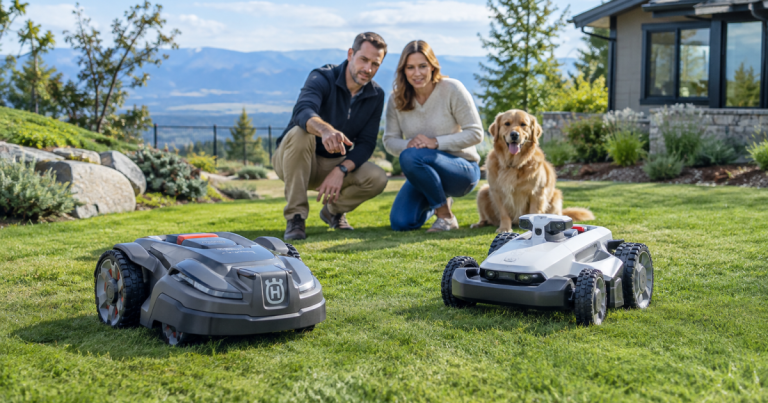
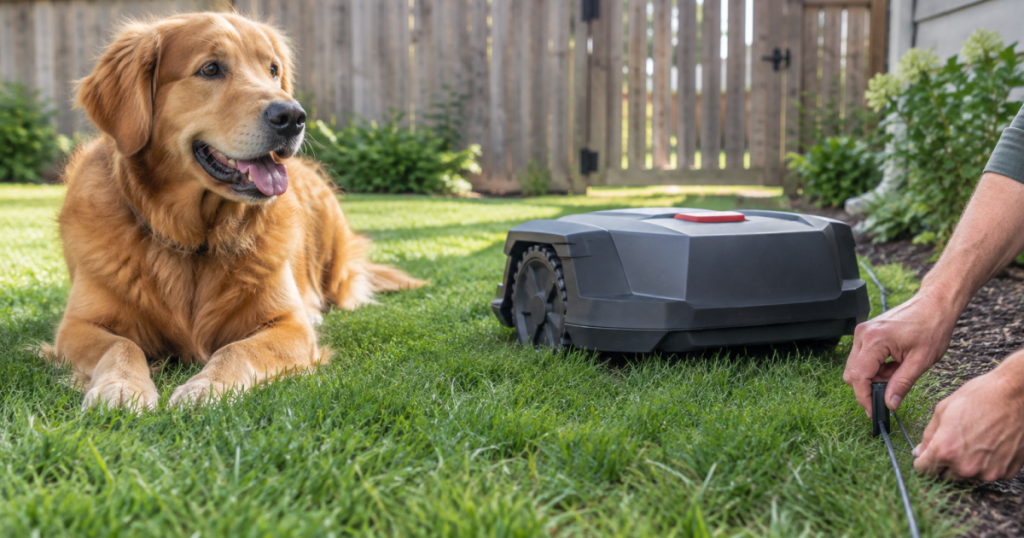
A fenced backyard with dogs can work well for a robot mower, but the fence and the pets both change the plan. The workable version of robot mowing around dogs starts with logistics: where the mower can travel, when the dogs are outside, and what needs to be picked up before each run.
Permanent fence changes, gate hardware changes, and charging-station electrical work should be handled by qualified fence or electrical professionals to meet local building codes, electrical codes, and safety requirements.
In brief
A robot mower can work in a fenced backyard with dogs if the mower has reliable access to the mowing area, the dogs are kept away during scheduled mowing, toys and waste are cleared before each run, and the charging dock is placed where the mower can return without crossing a busy pet route. The fence is not the deal-breaker by itself; the practical question is whether you can create a repeatable routine that keeps the mower, gate, dock, and dogs out of each other’s way.
- Best setup: mower operates while dogs are indoors, with the gate closed and the yard cleared.
- Most common problem: the mower cannot move between fenced zones without someone opening a gate or carrying it.
- Biggest mess risk: pet waste. A robot mower should not be treated as a cleanup tool.
- Best fence decision: use an intentional mower passage only when it does not create an escape route for the dog.
- Safer fallback: carry the mower between zones if fence changes would make the yard less secure.
Step 1: Map the fence, gates, and mowing zones before choosing a routine
Start with the fence line, not the mower. Walk the yard and divide it into zones the way the mower will experience them: the main backyard, side strips, front-lawn access, narrow dog runs, landscaped edges, and any fenced-off kennel or play area.
For each zone, ask three questions. Can the mower physically enter it? Can the dog enter it at the same time? Can the mower get back to the charging station from there without help? A “yes” to the first question is not enough. Plenty of fenced yards look simple from the patio and become awkward when a mower has to pass through a latched gate, around a grill, past a water bowl, and back to a dock before the battery runs low.
If your lawn is split by a privacy fence or several gates, decide early whether the mower will mow all zones automatically or whether you will carry it into secondary areas. Carrying is not a failure. For a small side yard, a front strip by the sidewalk, or a fenced dog run, carrying the mower may be cleaner and safer than cutting a mower door into a fence and hoping the dog never notices the new freedom hatch.
Step 2: Decide how the mower will pass through the fence
There are three realistic approaches for fenced yards. The right one depends less on the mower brand and more on your dog’s size, habits, and escape interest.
Option 1: Keep mowing inside one fenced area
This is the simplest setup. The robot mower lives, docks, and cuts inside the same fenced backyard. You do not need an automated gate, mower tunnel, or new fence opening. It is usually the easiest option if the backyard is the only area you want maintained by the mower.
The trade-off is that any lawn outside the fence needs separate mowing. For many homeowners, that is still a good bargain: the mower handles the high-traffic backyard, while a small front patch gets handled manually.
Option 2: Use a gate routine
A gate routine means someone opens the gate for the mower at the start of a session and closes it once the mower is through. This can work if you are home during mowing windows and your dog is indoors. It becomes annoying fast if the mower runs while you are busy, away from home, or trying to remember which gate position is mower-friendly and which one is dog-safe.
If you use this method, make the routine boring and repeatable. Dogs inside. Yard checked. Gate opened. Mower sent or allowed through. Gate closed. Mower finishes. Dogs go back out. The moment the gate routine depends on “just for a minute,” it is too easy to make a mistake.
Option 3: Add a mower door or passage
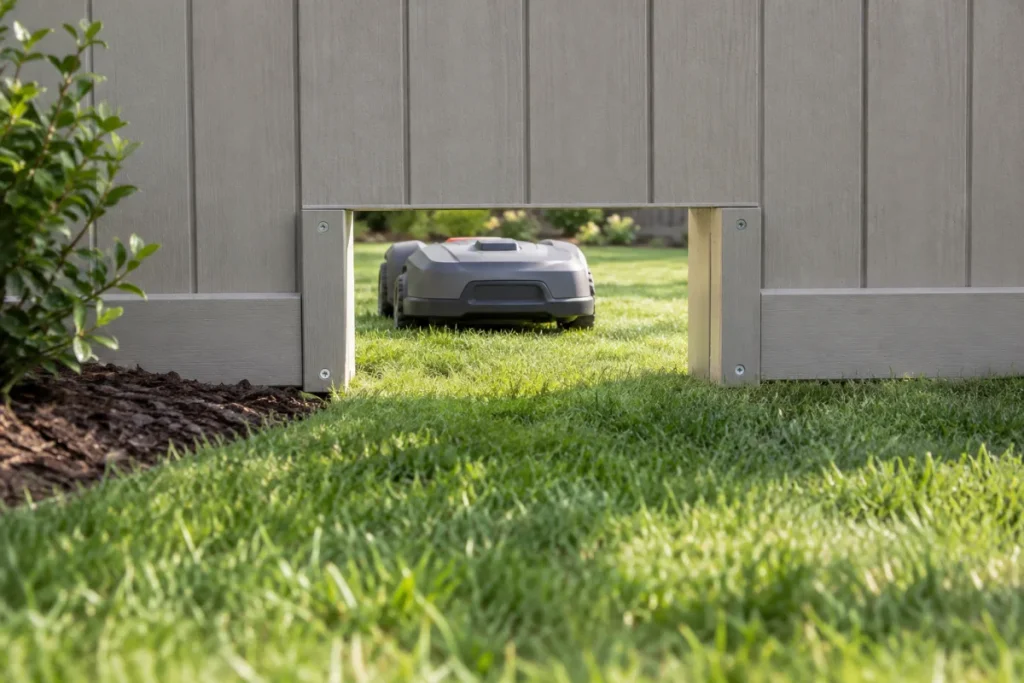
A mower door is a small passage through or under a fence that lets the mower move between lawn areas. It can be useful, but it is also the option that deserves the most skepticism in a dog yard. A passage large enough for a mower may also be interesting to a terrier, puppy, anxious dog, or determined escape artist.
If you are considering a mower door, judge it like a pet-containment decision first and a mowing convenience second. The door or passage should not weaken the fence, create sharp edges, leave a diggable gap, or allow a dog to nose it open. If the mower only needs to reach a small area once or twice a week, carrying it is often the more sensible choice.
Step 3: Set mowing times around the dogs, not the other way around
The cleanest schedule is simple: mow when the dogs are indoors. This avoids chasing, barking, pawing, toy guarding, and the occasional heroic attempt to herd the strange plastic turtle back to its dock.
Do not rely on the mower’s sensors as your whole pet plan. Robot mowers are designed with obstacle detection and safety features, but behavior varies by model and condition, and dogs are unpredictable. A sleeping senior dog, a puppy with a tennis ball, and a fast dog cutting across the lawn are three very different obstacles.
Good mowing windows are the times when the yard is naturally empty: after the morning bathroom break, during work hours if the dogs stay indoors, or in the evening before the last outside trip. Avoid scheduling the mower during fetch, feeding, sprinkler play, or the half hour when every squirrel in the neighborhood apparently files a flight plan through your fence.
Step 4: Build a pre-mow cleanup habit
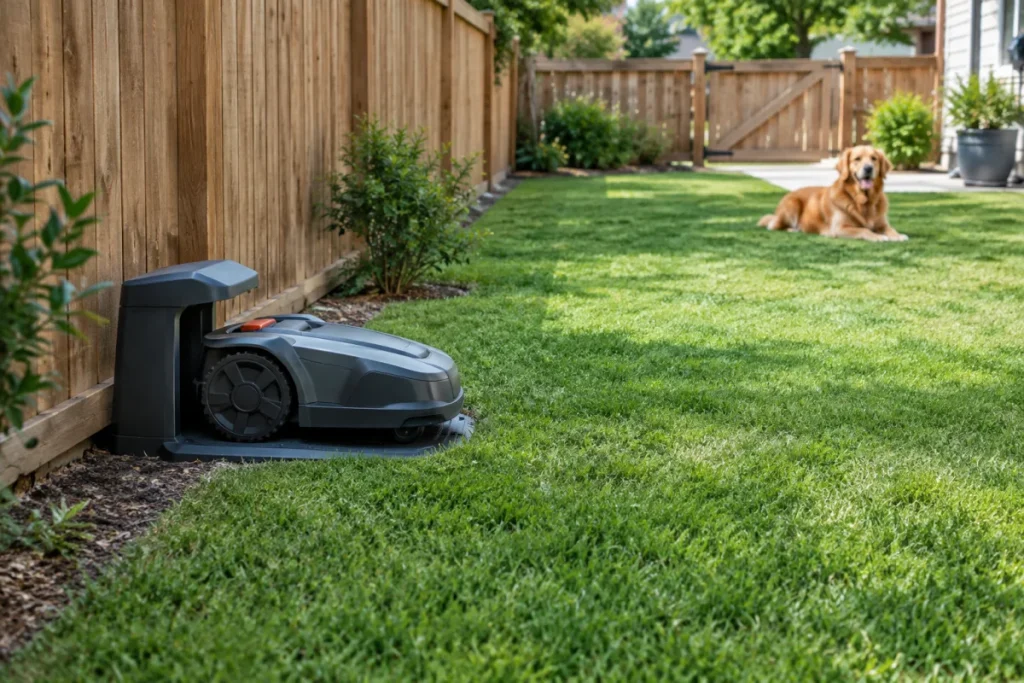
Dog yards collect mower problems faster than display lawns. Before a mowing run, clear anything the mower should not hit or drag.
- Dog toys: pick up balls, rope toys, plush toys, chew bones, and frisbees. Bright colors help humans notice them; they do not guarantee the mower will avoid them.
- Water bowls and feeding stands: keep them off the active mowing area or place them in a mapped exclusion zone.
- Pet waste: remove it before mowing. A robot mower can smear waste across wheels, blades, grass, and the underside of the deck. That turns a convenience machine into a sanitation project.
- Sticks and chews: collect branches, antlers, bully sticks, and anything hard enough to jam or damage blades.
- Temporary gear: move agility cones, kiddie pools, hoses, tie-out cables, and portable fencing.
If your mower supports mapped exclusions, use them around fixed dog features such as kennel panels, shade structures, raised beds, and permanent water stations. For a deeper setup walkthrough, see how to map no-go zones around yard obstacles before you let the mower discover every awkward object by trial and error.
Step 5: Place the charging dock where dogs will not turn it into yard furniture
Dock placement is easy to underestimate. In a fenced yard with dogs, the charging station should be boring, accessible, and out of the main dog traffic path. Avoid putting it beside a favorite digging corner, fence window, gate bottleneck, or the place where your dog launches into full-speed patrol mode.
The mower also needs a reliable route home. Follow the manufacturer’s clearance and surface requirements, and avoid squeezing the dock behind lawn furniture, raised edging, or a tight gate swing. If the mower has to approach the dock from an odd angle while a dog bed, toy pile, or water bowl keeps shifting nearby, docking errors are more likely.
If your mower struggles to return after otherwise normal mowing, work through the basics before blaming the dog. Dock alignment, signal conditions, approach path, and nearby obstacles can all interfere. This guide to how to fix a robot mower that can’t find its dock is a useful next check once the pet variables are under control.
Step 6: Be careful with power placement and extension plans
The best dock location is not always next to the nearest outlet. You may need to choose between a convenient power source and a safer, cleaner mower route. In a dog yard, also think about cord exposure, chewing risk, tripping points near gates, and whether the dock area stays reasonably dry and stable.
Do not improvise with indoor extension cords or exposed connections across the lawn. If the charging station needs power farther from the outlet, use the mower manufacturer’s approved approach and keep electrical work within local code. For more detail, read this guide on how to safely extend robot mower charging station power.
Common mistakes in fenced dog yards
- Assuming the fence solves safety: the fence contains the dog, but it can also trap the mower in the wrong zone or force a risky gate habit.
- Letting the mower run during playtime: fetch toys, fast movement, and excited dogs make mowing less predictable.
- Ignoring pet waste: no mower is a pooper-scooper. Do the cleanup first.
- Adding a mower door too quickly: a fence opening that helps the mower can also tempt the dog.
- Putting the dock at a gate pinch point: the mower needs calm entry and exit space, and so do the dogs.
- Forgetting visitors and dog sitters: anyone using the yard should know when the mower runs and which gates must stay closed.
When a fenced dog yard is a poor fit
A robot mower is less appealing if your dogs spend most of the day outside, constantly move toys around the lawn, dig along the fence, guard moving objects, or cannot be kept indoors during mowing windows. The same goes for yards where every mowing zone requires a gate to be opened several times a day.
That does not mean automation is impossible. It means the yard may need a narrower plan: mow only the main fenced lawn, schedule shorter supervised sessions, or keep a traditional mower for awkward strips. The best robot mower setup is the one you will actually maintain after the novelty wears off.
Common questions
Can a robot mower run while my dog is outside?
It is better to keep dogs indoors while the mower is running. Even calm dogs can react differently to a moving machine, and robot mower safety features should not be used as a substitute for separation and supervision.
Will dog hair, waste, or toys damage the mower?
Loose hair is usually less of a concern than toys, hard chews, sticks, and waste. The big rule is to clear the lawn first. Waste can smear across the mower and lawn, while toys and hard objects can stop the mower or damage cutting parts.
Should I cut a small opening in the fence for the mower?
Only consider a mower opening if it can be made without weakening pet containment. If the dog could squeeze through, dig under it, paw at it, or learn to use it, carrying the mower between zones is the smarter choice.
What if the dog barks at the mower?
Do not use the mower as a training test. Start with separation: dog inside, mower outside. If barking continues through windows or doors, adjust mowing times so the mower runs when the dog is settled elsewhere.
What to remember
A fenced yard with dogs needs a mowing plan, not just a mower. Keep the dog and mower on separate schedules, make gate access deliberate, remove toys and waste before each run, and put the charging dock where the mower can come and go without crossing the busiest pet traffic. If a fence modification makes you even slightly less confident about containment, skip it. A short carry across the gate is a small price to pay for a calmer yard and a dog that stays exactly where it belongs.