If you have seen 2026 FCC headlines and started searching for robot lawn mowers banned, take a breath before canceling your mowing plans. Robot mowers are not broadly illegal for homeowners to buy or use. The real issue is narrower: whether a particular wireless mower has the required authorization for sale and radio operation in the US.
Compliance note: Commercial importing, FCC equipment authorization decisions, and radio-hardware modifications should be handled by qualified compliance or legal professionals to meet applicable federal rules, safety standards, and local requirements.
At a glance
- There is no nationwide blanket ban that makes all robot lawn mowers illegal to own or operate.
- The FCC issue is mainly about radio-emitting equipment, equipment authorization, and entities on the FCC Covered List.
- Existing FCC-authorized models are different from new models that still need authorization.
- An overseas version of a mower is not automatically legal for US sale just because the brand sells a similar model here.
- Before checkout, verify the exact model number, FCC ID or regulatory labeling, seller channel, support path, and return terms.
The plain-English answer for homeowners
US homeowners can still buy and use robot lawn mowers after the 2026 FCC rule if the specific mower being sold is properly authorized for the US market and is not blocked by the FCC’s equipment authorization restrictions. The rule does not outlaw robot mowing as a category. It affects whether certain radio-connected devices can be newly authorized, imported, marketed, or sold when they involve companies or equipment covered by federal communications-security restrictions.
That distinction is easy to miss because robot mowers are no longer simple battery carts with blades. Many current models use wireless communication, GPS or GNSS positioning, RTK reference stations, Bluetooth, Wi-Fi, cellular modules, cameras, or other connected systems. Once a mower includes radio transmitters, FCC compliance becomes part of the buying picture, right alongside cutting height, slope rating, and yard size.
What the 2026 FCC concern is actually about
The FCC Covered List identifies communications equipment and services that the federal government considers to pose an unacceptable national security risk. The practical buyer question is not “was this mower made in another country?” It is “does this exact device, including its radio components and authorization holder, meet US equipment authorization requirements?”
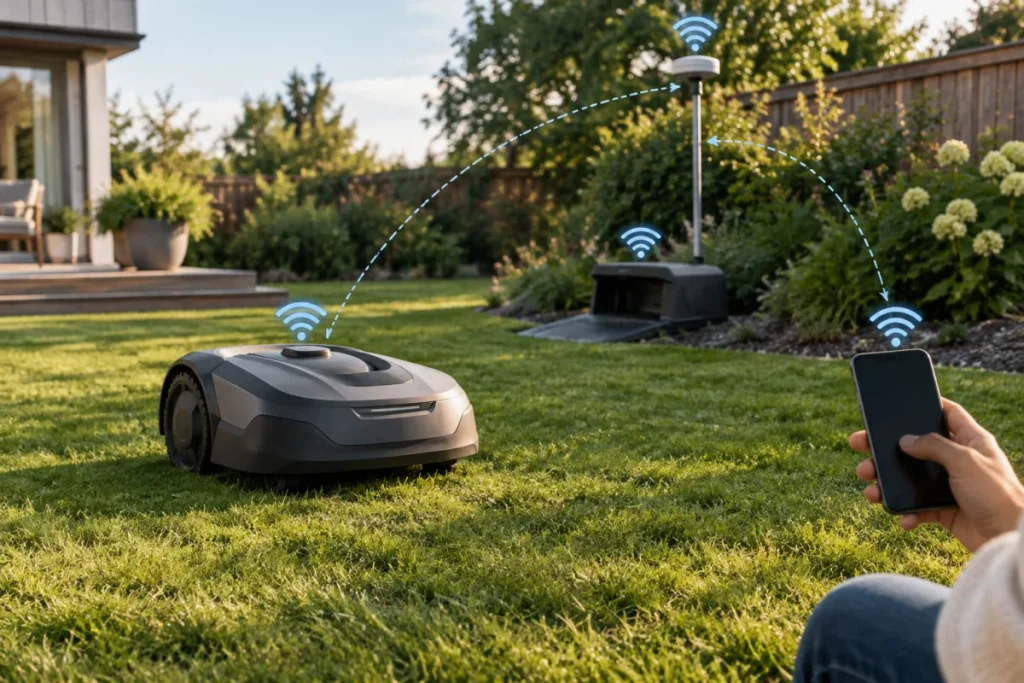
That matters because most wire-free robot mowers depend on wireless systems. A mower may communicate with an app, a charging station, an RTK base, cellular service, or positioning accessories. If the radio equipment cannot be authorized, or if an authorization is restricted because of Covered List status, that can affect whether a new product can legally enter normal US commerce.
It does not mean every foreign-made robot mower is banned. Plenty of consumer electronics are manufactured globally and still sold legally when they meet FCC rules. The important point is exact-model compliance, not broad assumptions based on brand origin or where the box was assembled.
Existing approved models versus new model authorizations
Existing approved models
If a robot mower was already properly authorized for the US market, homeowners are generally looking at a different situation than buyers considering an unreleased or newly imported mower. Existing approved equipment does not become a backyard contraband object simply because shoppers are now paying closer attention to FCC rules. You should still keep manuals, purchase records, and model information handy, especially if you ever need support, warranty service, or replacement parts.
The more practical ownership concern is continuity. Will the manufacturer continue supporting the app, firmware, replacement parts, blades, batteries, and charging accessories for the US version? Legal sale and long-term ownership convenience are related, but they are not the same thing. A mower can be authorized and still be a frustrating buy if parts or support are thin.
New models and pending launches
New robot mowers that use radio transmitters generally need valid FCC authorization before normal sale in the US. A product page, trade-show demo, preorder listing, or social-media launch post is not the same as final authorization. Retailers and manufacturers may talk about upcoming products, but buyers should treat “coming soon” language with caution until the exact US model is clearly documented.
If a mower is marketed with an RTK base station, cellular module, or other connected accessory, verify the system as a package. Sometimes the compliance-sensitive piece is not the mower shell itself but the transmitter, base station, gateway, or communications module that makes the mower work as advertised.
Conditional or limited situations
Some products may appear in early marketing before all final compliance steps are complete, and some equipment can be displayed or discussed under specific conditions. That does not mean it is ready for ordinary consumer sale. For buyers, the safe reading is simple: do not treat a preview as proof that a mower is legal to import, sell, or activate at home.
Imported inventory and gray-market mowers
The riskiest shopping path is usually the gray-market mower: a tempting listing for an overseas version, a seller with vague location details, or a model number that does not match the US documentation. The mower may look identical in photos while using different radio modules, different firmware, different labeling, or different accessories.
Before buying from a marketplace seller, look for the exact US model number and regulatory labeling. If the listing says “global version,” “import version,” or avoids showing the compliance label, slow down. A mower that cannot be legally marketed for US use may also be harder to return, repair, insure, or update. Saving a few dollars on the front end is less charming when the machine becomes a very expensive lawn ornament.
This is also where general mower specs still matter. Once you have confirmed that a model is legitimate for your market, check whether the battery, charging behavior, and mowing capacity fit your yard. The guide to robot mower battery specs worth checking before you buy is a useful next step if you are comparing two otherwise legitimate options.
What to verify before checkout
Use this checklist before buying any connected robot mower, especially a newer wire-free model or a listing from a seller you do not recognize.
- Exact model number: Match the listing, manufacturer page, manual, and box label. Similar names can hide different regional versions.
- FCC ID or regulatory label: Look for clear US compliance information for the mower and any base station, gateway, or wireless accessory.
- Seller channel: Prefer authorized retailers or clearly documented manufacturer-direct sales over anonymous import listings.
- Support for the US version: Check whether replacement blades, batteries, charging stations, boundary accessories, and service parts are available for that model.
- Software and update path: Connected mowers should have a clear official app or update channel for the US product, not a workaround meant for another region.
- Return window: If the mower cannot be activated, docked, mapped, or supported, you want a straightforward return path.
- Yard fit: Legal does not mean suitable. Confirm slope limits, boundary method, navigation style, cutting-height range, and multi-zone needs.
For installation planning, also remember that the charging station is part of the system. Outdoor power, extension practices, and station placement should be handled safely; this guide on safely extending robot mower charging station power explains the practical limits without turning your patio into a science project.
Does legal use include local rules?
Federal equipment authorization is only one layer. Homeowners should also think about ordinary property rules: HOA restrictions, local noise ordinances, shared-property boundaries, sidewalk clearance, and safe operation around pets, kids, toys, roots, and landscaping. These are usually practical use issues rather than robot-mower bans, but they can still affect whether automated mowing works smoothly in your yard.
Mapping is a good example. A mower may be legal to buy, yet still need careful no-go zones around fire pits, playsets, water features, garden beds, exposed roots, or areas where the mower could leave your property. If your yard has obstacles, the setup advice on mapping robot mower no-go zones can help you plan the boundary before the first run.
Common questions
Are robot mowers illegal to use on private property?
No, not as a category. A properly authorized robot mower can generally be used on private property when operated according to the manufacturer’s instructions and applicable local rules. The current confusion is mainly about equipment authorization and certain restricted entities, not a ban on automated mowing itself.
Can I keep using a mower I already bought?
In normal circumstances, ownership and use of an existing FCC-authorized mower are separate from whether a new, different model can receive authorization. Keep the mower’s documentation, use official updates, and avoid hardware modifications that could affect radio compliance.
Is every Chinese-made robot mower banned?
No. Country of manufacture alone is not the whole test. The relevant questions include the exact equipment, radio components, authorization holder, Covered List status, and whether the model is properly authorized for sale in the US.
Should I avoid all new wire-free robot mowers?
No. Wire-free mowers can be a good fit when the model is properly sold for the US market and your yard supports its navigation method. The sensible approach is to verify compliance first, then judge the mower on yard size, slopes, obstacles, cutting height, support, and long-term parts availability.
Why it matters
The best answer is reassuring but not careless: robot lawn mowers are still legal for many homeowners to buy and use, but 2026 makes verification more important. Do not judge by brand buzz, launch hype, or a bargain listing alone. Match the exact mower to US authorization, then match the machine to the yard you actually have.
If a seller cannot clearly show the model, compliance information, and support path, that is your cue to pause. A good robot mower should reduce weekend friction, not add a regulatory guessing game to the grass.