Robot mower slope ratings look simple on a spec sheet, but real yards rarely behave like spec sheets. The goal is simple: measure lawn slope where the mower will climb, turn, and travel sideways, not just at the easiest part of the yard. A few careful measurements can tell you whether a standard robot mower is realistic, whether you need an all-wheel-drive model, or whether part of the lawn should stay on a string trimmer or walk-behind routine.
A robot mower can handle only the slope range the manufacturer rates for that exact model, and that rating is most useful when your steepest measured area leaves a margin for wet grass, roots, bumps, thick growth, and turns. If your yard is near the mower’s stated maximum slope, treat that as a caution sign rather than a green light.
The big picture
Slope is usually shown in one of two ways: percent grade or degrees. Percent grade compares vertical rise to horizontal run. Degrees describe the angle of the hill. Robot mower brands may use either one, so you need to understand both before matching your yard to a model.
The simple formula is: percent grade equals rise divided by run, multiplied by 100. If the ground rises 2 feet over a horizontal distance of 10 feet, the grade is 20%. That is not the same as 20 degrees; 20% grade is about 11.3 degrees.
Before you focus only on slope, remember that hills are just one part of yard fit. Gates, narrow passages, trees, landscaping beds, pets, kids, and separate lawn zones matter too. If you are still checking the full property, use the yard-fit checklist alongside your slope measurements.
What you need to measure grade
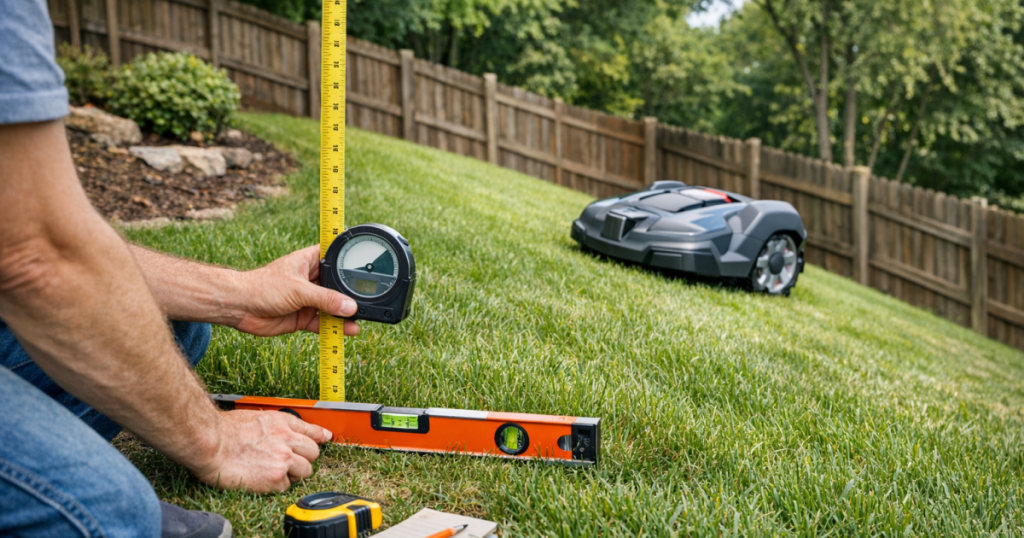
You do not need surveying equipment for a homeowner-level slope check. You need a way to measure a horizontal distance, a way to keep that line level, and a way to measure the vertical drop or rise.
- A tape measure, such as a Stanley PowerLock 25-Foot Tape Measure, for measuring run and rise.
- A straight board, string line, or long level to create a horizontal reference.
- A bubble level or line level so your reference is actually level.
- Two stakes or helpers to hold the line on longer slopes.
- A notebook or phone photo so you can record each test spot clearly.
A phone inclinometer can be useful as a quick cross-check, but it should not be your only method. Phone readings can vary depending on the case, surface contact, and whether you are measuring a small bump instead of the true grade over the mower’s travel path.
Step 1: Find the slope zones that actually matter
Do not measure only the steepest-looking point from the patio. Walk the whole mowing area and mark the places where a robot mower would have to work hardest.
- Long uphill runs from the back fence toward the house.
- Side slopes where the mower would travel across the hill rather than straight up it.
- Transitions at the bottom or top of a hill where the mower may turn.
- Sloped edges near retaining walls, ditches, driveways, sidewalks, or mulch beds.
- Rooty or bumpy areas where wheels may lose contact with the turf.
- Narrow slopes between a fence and a landscaping bed.
The harshest test is often not the tallest hill. It is the spot where a mower has to turn on a slope, correct its path, or cross wet turf at an angle.
Step 2: Use the rise-over-run method
Here is the most dependable way to measure lawn slope without special equipment. Pick one slope zone and place the uphill end of a straight board or taut string at ground level. Extend it downhill in the direction you want to measure. Use your level to make the board or string perfectly horizontal, then measure the vertical distance from the downhill end down to the grass.
That vertical distance is the rise. The horizontal length of the board or string is the run. Divide rise by run, then multiply by 100.
Example: if your level line is 10 feet long and the downhill end sits 3 feet above the grass, the slope is 30%. If the line is 8 feet long and the drop is 2 feet, the slope is 25%.
Use feet and inches consistently. If your run is 10 feet and your rise is 18 inches, convert 18 inches to 1.5 feet. The calculation is 1.5 divided by 10, multiplied by 100, which equals 15% grade.
Step 3: Convert percent grade to degrees when needed
Manufacturer specs are not always written the same way. Some list maximum slope in percent. Others use degrees. If the mower rating and your measurement use different formats, convert before you compare.
Use this homeowner-friendly conversion cheat sheet:
- 10% grade is about 5.7 degrees.
- 15% grade is about 8.5 degrees.
- 20% grade is about 11.3 degrees.
- 25% grade is about 14.0 degrees.
- 30% grade is about 16.7 degrees.
- 35% grade is about 19.3 degrees.
- 40% grade is about 21.8 degrees.
- 45% grade is about 24.2 degrees.
- 50% grade is about 26.6 degrees.
- 60% grade is about 31.0 degrees.
- 70% grade is about 35.0 degrees.
The math behind the conversion is angle in degrees equals arctangent of percent grade divided by 100. You do not need that formula every time, but it explains why percent and degrees should never be treated as interchangeable.
Step 4: Measure more than one direction
A robot mower does not always drive straight up and straight down a hill. Depending on the navigation pattern, boundary method, obstacles, and docking location, it may approach the same slope from several angles.
Take at least three readings in each questionable area:
- One reading straight up and down the hill.
- One reading across the side slope.
- One reading near the top or bottom where the mower may turn.
Side slopes deserve special attention. A mower that climbs a grade acceptably may still struggle when it travels across the same hill, because gravity pulls the machine sideways and the wheels may scrub, slip, or drift toward an edge. This is one reason the measured number alone is not the whole decision.
Step 5: Add a margin before choosing a mower
Once you know your steepest grades, compare them with the current manufacturer rating for any mower you are considering. Do not buy to the exact limit unless the rest of the area is unusually forgiving.
A sensible homeowner margin is to choose a mower rated comfortably above your steepest measured mowing zone. For example, if several readings land near 30%, a mower rated only to 30% gives you little room for wet grass, worn blades, loose soil, ruts, acorns, roots, or seasonal turf changes. Looking for extra slope capacity, a better drive system, or a revised mowing boundary is the safer fit decision.
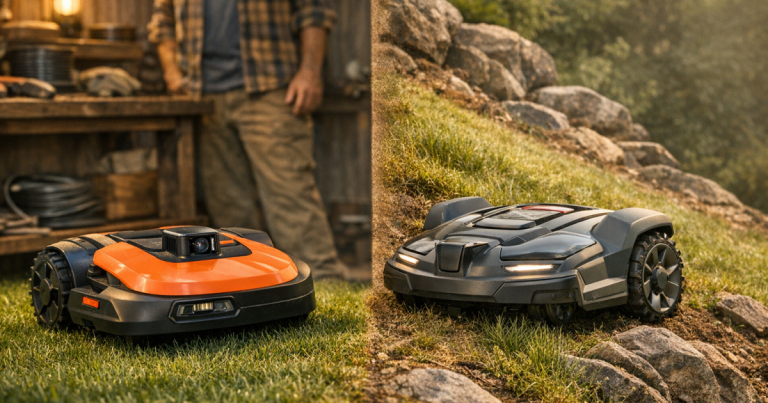
All-wheel-drive robot mowers can be helpful for complex, uneven, or steeper lawns, but AWD is not a magic override for a poor layout. The mower still needs enough traction, turning space, clean boundaries, and a route back to the charging area. If you are comparing slope ratings with yard size, navigation type, boundary method, and drive type, the Robot Lawn Mower Yard Fit Comparison is the next logical place to narrow the field.
Common measuring mistakes
Measuring the mower’s path too narrowly
A single 4-foot check can miss the real hill. Use a longer run when practical, then take additional short readings at transitions, humps, and dips. The mower experiences both the general slope and the small trouble spots.
Ignoring downhill edges
A steep slope that ends at a retaining wall, drainage ditch, pond, driveway, or street deserves extra caution. Even if the measured grade is within a model’s rating, the consequence of sliding or overshooting is higher near an exposed edge.
Assuming dry-weather performance is enough
Grass traction changes after rain, irrigation, heavy dew, or leaf drop. If your slope barely fits on a dry afternoon, it may not be a dependable robot mower area during normal weekly conditions.
Comparing percent to degrees directly
A 45% slope is not 45 degrees. A 45% grade is about 24.2 degrees. This mistake can lead homeowners to reject a workable mower or, worse, buy one that is not actually rated for the yard.
When the slope reading says “maybe”
If your measurements are close to a model’s maximum rating, do not make the decision on slope alone. Look at how the steep area connects to the rest of the yard. A steep but open back lawn may be easier than a shorter slope squeezed between a fence, steps, tree roots, and a mulch bed.
Also think about whether the steepest area truly needs robotic mowing. Some homeowners create a no-mow boundary around a ditch, terrace, or awkward bank and let the robot maintain the main lawn. That can be a better ownership experience than forcing a mower to handle every square foot.
For a deeper example of how an all-wheel-drive mower is evaluated for complicated lawns, read the Husqvarna Automower® 435 iQ AWD review. Use it as a framework for the kinds of trade-offs to consider, not as a shortcut around measuring your own yard.
Helpful questions
How steep is too steep for a robot lawn mower?
Too steep means the measured grade exceeds the manufacturer’s rating for that exact mower, or sits so close to the rating that normal yard conditions could cause slipping, poor tracking, or unreliable turns. The practical limit depends on the model, drive system, turf condition, slope direction, and whether the mower must turn on the hill.
Should I measure slope in percent or degrees?
Measure in percent grade first because the rise-over-run method is easy with household tools. Then convert to degrees only if the mower specification uses degrees. Keeping your notes in both formats makes model comparisons much easier.
Does AWD mean I can ignore slope ratings?
No. AWD can improve traction and control on uneven or steep lawns, but the mower’s published slope rating still matters. Yard layout, wet grass, obstacles, and edge conditions can all reduce the practical margin.
What to remember
Measure the steepest mowing zones, not just the most obvious hill. Use rise divided by run, convert percent to degrees when needed, and leave a margin between your yard’s worst-case grade and the mower’s stated rating. That small amount of homework can prevent the most frustrating kind of robot mower mismatch: buying a capable machine for the wrong terrain.